By many accounts, Costa Rica has been a unique Central American success story—“a beacon of Enlightenment” and “a world leader in democratic, sustainable, and inclusive economic growth,” according to the prominent economist Joseph Stiglitz.
A nation of about 5 million people roughly the size of West Virginia, Costa Rica has been punching above its weight particularly in the realm of sustainability and climate action: a pioneer in eco-tourism; successful in getting nearly all of its power from renewable sources, including an enterprising use of hydro; and a leader in fighting deforestation and conserving land with its carbon-soaking rainforests.
The Land Matters podcast welcomed two special guests recently who know a thing or two about this country: Carlos Alvarado Quesada and Claudia Dobles Camargo, the former President and First Lady of Costa Rica. They are both in the Cambridge, Massachusetts, area this year—she is a Loeb Fellow, part of a mid-career fellowship program based at Harvard’s Graduate School of Design, and he is a visiting professor of practice at the Fletcher School of Law and Diplomacy at Tufts University.
Former Costa Rican President Carlos Alvarado Quesada and former First Lady Claudia Dobles Camargo at the Lincoln Institute offices in Cambridge, Massachusetts, in April 2023. Credit: Will Jason.
Also in the studio was Enrique Silva, vice president of programs at the Lincoln Institute, who oversees the organization’s research and activities globally, and has years of experience in and familiarity with Latin America.
The conversation, recorded at the Podcast Garage in Allston after a visit by the couple to the Lincoln Institute, included reflections on leadership and climate action, and what it’s been like to take a year to decompress after an eventful time in office, from 2018 to 2022.
Costa Rica has much to show the world when it comes to the implementation of targeted sustainability practices, Quesada said. “We’re not saying people have to do exactly the same [as we did], but we can say it’s possible, and it’s been done in a model that actually creates well-being and economic growth,” he said. “Back in the day, people would say it’s impossible—‘if you’re going to create protected areas, you’re going to destroy the economy.’ It turned out to be the other way around, it actually propelled the economy.”
After seeing big successes in the countryside, the interventions have turned to urban areas. “Costa Rica has done such an amazing job in nature-based solutions, not so much on urban sustainability,” said Dobles, noting the ambitious National Decarbonization Plan she launched with Quesada, which aims to reach net-zero emissions by 2050. “In order to decarbonize, we really needed to focus also on our urban agenda.”
A big task was reinvigorating public transit, starting with a new electric train that would have spanned the city of San Jose. Quesada’s successor shelved the $1.5 billion project, demonstrating the common mismatch between long-term projects and limited time in office. A pilot project to electrify buses was implemented, however, to rave reviews. The couple says they are hopeful the train will be revived.
“I know that this is eventually going to happen. Sometimes you have political setbacks,” said Quesada. “Your administration cannot own throughout time what’s going to happen, but you can plant positive seeds.”
Costa Rica has been nothing if not creative in addressing the many dilemmas inherent in climate action. Open-ore mining is banned, for example, but entrepreneurs figured out a way to extract lithium from recycled batteries.
“That’s very linked to the discussion of the just energy transition, where the jobs are going to come from, where the exports are going to come from. While there’s a huge opportunity for many developing countries which are rich and are endowed with minerals and metals . . . we need to address those complexities,” said Quesada.
Dobles added, “When we talk about decarbonization, we cannot exclude from that conversation, the inequality conversation. This is supposed to provide our possibilities of survival as humankind, but also it’s a possibility for a new type of social and economic development and growth.”
Former First Lady Claudia Dobles Camargo makes a point as former President Carlos Alvarado Quesada looks on. The pair visited the Lincoln Institute office to discuss their climate and sustainability initiatives in April 2023 while spending a year at Harvard and Tufts universities, respectively. Credit: Anthony Flint.
Reflecting on being in the land of Harvard, MIT, and Mr. Bartley’s Burger Cottage, Dobles said she has been immersed in “the whole academic ecosystem that is happening here . . . just to be, again, in academia, sometimes just to receive information, not having the pressure of having the answers . . . . It’s been wonderful.”
“Being a head of state for four years of a country, it’s an experience that I’m currently unpacking still,” said Quesada. “I’m doing a little bit of writing on that, but you get to reflect a lot, because it’s a period of time you live very intensely. In our case, we were not only working with decarbonization, with the projects we mentioned, we [were also working] with the fiscal sustainability of the country. We had COVID. We had [the legalization of same-sex marriage].
“We tend to train ourselves for things that are outside of us, like methods, tools, knowledge,” he said. “There’s a part of it that has to do with training ourselves, our feelings, our habits, our framing, our thinking . . . to address those hard challenges.”
Carlos Alvarado Quesada served as the 48th President of the Republic of Costa Rica from 2018 to 2022, when his constitutionally limited term ended. He won the 2022 Planetary Leadership Award from the National Geographic Society for his actions to protect the ocean, and was named to the TIME100 Next list of emerging leaders from around the world. Before entering politics, he worked for Procter and Gamble, Latin America.
Claudia Dobles Camargo is an architect with extensive experience in urban mobility, affordable and social housing, community engagement, climate change, and fair transition. As First Lady, she was co-leader of the Costa Rica National Decarbonization Plan. Her architecture degree is from the University of Costa Rica, and she also studied in Japan, concentrating on a sustainable approach to architecture.
Water in the West—one of the most enduring and confounding stories of human settlement anywhere around the world.
Jim Holway, who retired as director of the Babbitt Center for Land and Water Policy this summer, has spent more than 40 years helping to solve the puzzle of ensuring sustainable water resources in this increasingly arid region. In the latest Land Matters podcast, he describes the challenges ahead, and the kind of leadership—and serious, good-faith negotiation—it will take to establish a more secure water future.
With some places having their water restricted, and big reservoirs like Lake Mead drawing down to historically low levels, it has become increasingly clear that water from the Colorado River—distributed to nine states in the US and Mexico through a series of agreements and amendments hammered out since the 1920s—is no longer enough to meet the demands of a fast-growing population.
How did the region get to this point? “I’d say it was a combination of optimism, beginning with allocating more water [than would be available], and then it was just ignoring science for political reasons,” said Holway. “If I want to get my water project approved, it’s going to be a lot easier if I can convince people there’s enough water left for their project too. Even once we should have known better, we acted like we didn’t know better.”
The water allocations now have a structural deficit, Holway said, that is clear throughout the year-to-year ups and downs of drought and sufficient snowpack. Climate change is intensifying everything.
“We designed a hydrologic system for a physical reality that is changing on us, and the change in the level of heat is driving the system. More evaporation and more demand for agriculture, more demand in urban use—that heat is actually a more significant factor than precipitation. Whereas there is a lot of uncertainty about what the future precipitation changes will be in the Southwest, it’s very clear that it’s going to be hotter.”
While politicians debate climate science, Holway says, water and land managers know they have no choice but to prepare for the uncertain future that climate change will bring: “Droughts that cause inadequate supplies for historic uses, floods that exceed the infrastructure we’ve built to handle flooding, wildfires of much greater intensity and size, urban areas that are getting increasingly hot and leading to crisis situations in the middle of the summer—this is the reality of our future, and we need to adapt to deal with it.”
Building the capacity of local communities to integrate land use planning and the management of water resources has been the calling card of the Babbitt Center under Holway’s tenure, including using scenario planning techniques to map out future supply and demand conditions. Importantly, agriculture—which uses approximately three-quarters of Colorado River water—has increasingly been at the table, Holway said.
When asked to look to the future, Holway said, “It’s important for anyone doing this kind of work to find some way to sustain themselves. I suspect the thing that makes me most optimistic is when I look at the 20- and 30-year-olds getting involved . . . it seems that they really have an understanding of the challenges they’re inheriting.”
One of those challenges is developing the capacity to work together as a civilization to address water shortages in a more serious and straightforward manner, he said.
“When societies fail, it may look like it’s because of a flood, a drought, disease, or warfare. However, societies have survived those challenges before. Why do they not survive the next one? Typically, what we find is they have lost the ability to govern themselves.
“To me, that is where my main pessimism comes from. It isn’t our water challenge. It’s, will we come together? Will we make the necessary decisions we need to govern ourselves? That is our biggest challenge, and it’s what we’re doing particularly badly at the moment.”
Water, Holway said, “perhaps will help us rediscover our ability to come together and make collaborative decisions. There are very few things that humans see as critical to their survival [more than] a good water supply. That’s pretty clear and pretty compelling. Let’s hope it’s part of our path forward.”
Jim Holway served as director of the Babbitt Center for Land and Water Policy from its founding in 2017 until late 2023. He was elected to the board of the Central Arizona Water Conservation District, directed the Western Lands and Communities program with the Sonoran Institute, and served as a professor of practice in sustainability at Arizona State University and assistant director at the Arizona Department of Water Resources. He has degrees from Cornell University and the University of North Carolina, and was inducted into the College of Fellows of the American Institute of Certified Planners.
Scranton, Pennsylvania, is facing a challenge familiar to legacy cities across the US: building its postindustrial future, now that the industries of yesteryear—in this case, coal, iron, steel, and textiles—are long gone. Essentially, Scranton must reinvent itself as a metropolis that was built, more than a century ago, for purposes that no longer exist.
Into this moment comes Paige Cognetti, a transplant from Oregon with an MBA and a stint in the Treasury department during the Obama administration, to help forge a way forward. Cognetti was serving as an advisor to the Pennsylvania auditor general and director of the Scranton school board when she won a special election for mayor in 2019, replacing a chief executive who had resigned after pleading guilty to corruption charges. She won reelection to a full term in November 2021, and is the first woman to hold the office.
Earlier in her career, the 43-year-old Cognetti worked in several political campaigns and as an investment advisor in New York City. Senior Fellow Anthony Flint caught up with the mayor on a trip to Scranton for the annual meeting of the Pennsylvania chapter of the American Planning Association.
Anthony Flint: Scranton was President Biden’s hometown, the place where urbanist Jane Jacobs grew up, and the setting for the comedy series The Office. With these interesting connections to politics and culture in mind, what’s special about the city for you? What qualities are drawing new residents and facilitating regeneration?
Paige Cognetti: It’s funny, politics brought me to Scranton. I moved to Washington, DC, in 2005, and ended up coming to Scranton for a political campaign, and then met my husband. It’s a long story until we get here in 2023, but politics did bring me to Scranton, and it can be a real anchor for what Scranton is known for.
Mayor Paige Cognetti, with the iconic Scranton Electric Building visible in the background. Courtesy photo.
More important than that is its existence as a legacy city, as an industrial city that was part of the industrial revolution in the United States, and exported things abroad, exported energy all throughout North America. That’s a huge piece of our heritage. The anthracite coal that was mined from around and underneath us really set the tone for the type of entrepreneurship that we are still known for and that we’re looking to have more of in Scranton.
The textile industry was also big here. You would have men working in coal mines and women working in textiles. There was this really perfect marriage between those two industries, and that drove the economy for a very long time. Of course, we don’t have those industries here anymore. The Scranton story now is one, I think, of resilience and creativity. Also a little bit of luck.
The different generations before us saw that if you anchor everything in an extractive industry like coal, and that goes away, then you’re left with nothing. They did a good job of diversifying the economy. We have lots of educational institutions, we have hospitals, we have healthcare, we have services. We also still have 11 percent of our jobs that are based in manufacturing. You see a lot of families that have continued through generations to own different businesses and be a part of multiple types of industries. You still have people who live in the home that their grandparents or even great-grandparents built.
It’s a special place in that way. We’ve taken a lot of the great things about our past and are applying them to the future.
AF: Thinking about this idea of repurposing a city that was built for something else: the Scranton Lace factory used to employ thousands of people on a 34-building campus, which is being redeveloped into a mixed-use residential neighborhood. Is that a replica model, in your opinion? How can adaptive reuse go beyond a boutique scale?
PC: The Lace Village is going to be an entirely new neighborhood right in the core of our city. It used to have thousands of employees and there was childcare, there was bowling, there was hair salons, there was everything. By recreating that and making a new neighborhood right there, it’s just going to be really exciting for our whole city. It’s great for all the neighborhoods around it, it’s great for the school system, it’s going to reinvigorate this industrial heart that we have there.
An industrial loom on the grounds of the former Scranton Lace Company. The complex is being redeveloped into a mixed-use residential community. Credit: Anthony Flint.
We’ve got lots of different places that I think could be like Lace Village, though not on as big of a scale. We have a cigar factory that’s just about a mile from Lace Village that’s just been redone into, I think, 150 condos. Those opened up just a few months ago. That’s a huge population boost, an energy boost for this one little segment of our neighborhood. There’s pockets of that all over the city, and that’s something that I think we can replicate.
It does take a lot of funds. We have helped shepherd state money to that project. We believe very deeply that these have to be public-private partnerships. There’s so much remediation that needs to be done. There’s so much local work that needs to be done with the streets and the curbs and the sidewalks and the lighting.
It’s important that we try to find creative ways to help fund it because we know it’s a very heavy lift to take something that used to be a factory or an industrial area and make it usable again.
AF: Because of these earlier industrial functions, Scranton has a difficult legacy of toxic pollution. How does that make redevelopment more challenging?
PC: Scranton is built on mines. Our home is actually built on top of a mine. There’s an empty lot a few parcels down from us where a house actually started to subside, and they had to take the house down. We definitely have legacy issues. We all deal with them personally. Everybody who lives in Scranton, the earth got gutted beneath us and so we deal with that all the time now.
The generations before us did a good job of cleaning those things up. We’ve come a long way, but we still have a lot of issues.
An example in our downtown is a new pocket park that finally just got sod in and the flowers are planted, the trees are planted. It used to be a dry cleaner, and just from having a dry cleaner—not even a gas plant, not even coal mining—it’s been hundreds and hundreds of thousands of dollars and many, many different iterations of how we’re going to fund this.
There’s these things that just take so much time and money. Interestingly in a place like Scranton, folks are used to [the idea that] it’s going to take a while. It’s going to take some more money.
We see a lot of issues in our stormwater. There’s a lot of things that we have to be very careful with and how we do things underground because of that legacy of mining. The riverfront that we have [along the] Lackawanna River is beautiful, but it was built up with factories. We have a long way to go to redevelop the river and celebrate it in a way that people are putting restaurants and cafes there. We don’t have those places, but the river is clean. The river is absolutely beautiful. The next piece is that land use. The next piece is that development and we’re eager to keep partnering with our developers to help realize that.
AF: You’ve had some serious flooding issues—what is needed to manage those kinds of vulnerabilities and to build resilience? How might that apply to other postindustrial cities confronting more intense climate impacts?
PC: I think every city is facing intense climate impacts. What’s interesting about a place like Scranton is, we have not taken care of the infrastructure, and so even before these last few years where the climate-related storms have started to increase, we already had a long way to go. We had a huge storm in September. We got six inches in 90 minutes, and it just blew through a few of our creeks, jumped the creeks, made new creeks through people’s yards. Even if we’d done all the projects we already have planned and teed up, I don’t even know if we’d gotten those done if that would’ve helped much given the volume of that water that came down. We’ve got millions and millions and millions of dollars of work to do.
The challenge, of course, is the funding and the fact that no matter what we do, there’s still going to be issues. The other piece is the politics of it: we don’t have a regional stormwater authority. We’re working on it, and we’ve got some of our neighboring boroughs and townships on board. The county’s not interested in doing a holistic one, but we’re looking at probably eight of our municipalities that are going to join in this authority that will work together to do stormwater mitigation. Hopefully, by pulling those resources, we’ll be able to have an authority that’s taking care of those maintenance pieces and those bigger projects and is able to raise funds on its own for those big pieces.
AF: Finally, how satisfied are you that the city has increased bike and pedestrian safety? I’ve been here and have been walking around. It’s a wonderful grid.
PC: We just came off of a walkability study, and we have a plan. We’re looking to drastically reimagine our downtown’s flow. It’s a beautiful grid, it’s gorgeous architecture, but the one-way streets and all the stoplights create hazards for bikes and pedestrians that are unnecessary. We’re looking to go to two-way streets in most of the streets, we’re looking to take down many of the stoplights and do four-way stop signs to really calm that traffic and make a safer environment. With those buildouts will be bike lanes and lots of trees and things that should make it an even more beautiful downtown to walk around.
Though Scranton’s love of one-way streets has been memorialized in the city’s street art, a recently completed connectivity study recommends converting many of them to two-way routes to reduce traffic speeds and improve pedestrian safety. Credit: City of Scranton.
We’ve got a lot of different grants teed up to be able to do this work. Our engineers are working on it now. We’re really looking forward to matching the architectural beauty of Scranton and the energy of all of our great shops and businesses, restaurants and bars with a streetscape that does them justice.
I think it will be a huge positive difference for our downtown, but like everything we do as mayors, it will take a little bit of money, a little bit of time, a little bit of conversation and a lot of enthusiasm.
Water in the West—one of the most enduring and confounding stories of human settlement anywhere around the world.
Jim Holway, who retired as director of the Babbitt Center for Land and Water Policy this summer, has spent more than 40 years helping to solve the puzzle of ensuring sustainable water resources in this increasingly arid region. In the latest Land Matters podcast, he describes the challenges ahead, and the kind of leadership—and serious, good-faith negotiation—it will take to establish a more secure water future.
With some places having their water restricted, and big reservoirs like Lake Mead drawing down to historically low levels, it has become increasingly clear that water from the Colorado River—distributed to nine states in the US and Mexico through a series of agreements and amendments hammered out since the 1920s—is no longer enough to meet the demands of a fast-growing population.
How did the region get to this point? “I’d say it was a combination of optimism, beginning with allocating more water [than would be available], and then it was just ignoring science for political reasons,” said Holway. “If I want to get my water project approved, it’s going to be a lot easier if I can convince people there’s enough water left for their project too. Even once we should have known better, we acted like we didn’t know better.”
The water allocations now have a structural deficit, Holway said, that is clear throughout the year-to-year ups and downs of drought and sufficient snowpack. Climate change is intensifying everything.
“We designed a hydrologic system for a physical reality that is changing on us, and the change in the level of heat is driving the system. More evaporation and more demand for agriculture, more demand in urban use—that heat is actually a more significant factor than precipitation. Whereas there is a lot of uncertainty about what the future precipitation changes will be in the Southwest, it’s very clear that it’s going to be hotter.”
While politicians debate climate science, Holway says, water and land managers know they have no choice but to prepare for the uncertain future that climate change will bring: “Droughts that cause inadequate supplies for historic uses, floods that exceed the infrastructure we’ve built to handle flooding, wildfires of much greater intensity and size, urban areas that are getting increasingly hot and leading to crisis situations in the middle of the summer—this is the reality of our future, and we need to adapt to deal with it.”
Building the capacity of local communities to integrate land use planning and the management of water resources has been the calling card of the Babbitt Center under Holway’s tenure, including using scenario planning techniques to map out future supply and demand conditions. Importantly, agriculture—which uses approximately three-quarters of Colorado River water—has increasingly been at the table, Holway said.
When asked to look to the future, Holway said, “It’s important for anyone doing this kind of work to find some way to sustain themselves. I suspect the thing that makes me most optimistic is when I look at the 20- and 30-year-olds getting involved . . . it seems that they really have an understanding of the challenges they’re inheriting.”
One of those challenges is developing the capacity to work together as a civilization to address water shortages in a more serious and straightforward manner, he said.
“When societies fail, it may look like it’s because of a flood, a drought, disease, or warfare. However, societies have survived those challenges before. Why do they not survive the next one? Typically, what we find is they have lost the ability to govern themselves.
“To me, that is where my main pessimism comes from. It isn’t our water challenge. It’s, will we come together? Will we make the necessary decisions we need to govern ourselves? That is our biggest challenge, and it’s what we’re doing particularly badly at the moment.”
Water, Holway said, “perhaps will help us rediscover our ability to come together and make collaborative decisions. There are very few things that humans see as critical to their survival [more than] a good water supply. That’s pretty clear and pretty compelling. Let’s hope it’s part of our path forward.”
Jim Holway served as director of the Babbitt Center for Land and Water Policy from its founding in 2017 until late 2023. He was elected to the board of the Central Arizona Water Conservation District, directed the Western Lands and Communities program with the Sonoran Institute, and served as a professor of practice in sustainability at Arizona State University and assistant director at the Arizona Department of Water Resources. He has degrees from Cornell University and the University of North Carolina, and was inducted into the College of Fellows of the American Institute of Certified Planners.
Un consenso emergente sobre cómo combatir el cambio climático es cada vez más evidente: electrificar todo, y producir dicha energía con fuentes renovables, como la energía eólica, solar e hidroeléctrica. La eliminación de los combustibles fósiles de la producción de electricidad puede realizarse sin exabruptos, ya que las instalaciones de energía limpia se han vuelto más rentables rápidamente. Las energías renovables representan el 20 por ciento de la producción de energía de los Estados Unidos y siguen creciendo de forma paulatina.
Pero existe una tarea de uso del suelo colosal y desafiante que es necesaria para concretar la transición hacia la energía limpia: no solo el emplazamiento de paneles solares y parques eólicos, sino también la construcción y mejora de líneas de transmisión, subestaciones y tuberías a lo largo de miles de hectáreas de suelo.
Investigadores de la Universidad Princeton calcularon que, si la capacidad de fabricación de las turbinas y los fotovoltaicos sigue aumentando como lo hizo hasta el momento durante los últimos años, se necesitarán hasta 640.000 kilómetros cuadrados en los Estados Unidos para aprovechar la energía eólica sola (Larson et al., 2020). Esto implica mucha infraestructura de energía renovable visible en las cumbres, en barrios suburbanos y en lo que puede considerarse patios de las viviendas de las personas.
A falta de una autoridad o un control federal, se están librando batallas de manera individual en cada estado sobre el emplazamiento de instalaciones eólicas y solares, y la oposición a modernizaciones y expansiones clave de la red que permitirán que la energía limpia se convierta en tendencia. En muchos casos, las instalaciones de energía renovable han recibido autorización para empezar a funcionar por medio del proceso de permisos, pero permanecen en el limbo porque no pueden conectarse a la anticuada red actual.
Líneas eléctricas en California. Crédito: pgiam vía E+/Getty Images.
Una combinación alocada de regulaciones de uso del suelo, incluidos los estatutos que restringen los campos de energía solar y los parques eólicos, amplificó las voces de oposición de los vecinos y grupos organizados, entre los que se encuentran algunas organizaciones medioambientales, lo que según muchos defensores climáticos es una profunda ironía de los tiempos.
Además, conflictos en torno al uso del suelo están obstaculizando otro componente crítico de la transición hacia la energía limpia: la minería de metales como el litio para hacer baterías recargables de gran capacidad, para los vehículos eléctricos y el almacenamiento de energía de las fuentes renovables cuando el sol no brilla o el viento no sopla.
Quienes apuntan a neutralizar las emisiones de carbono para mediados de siglo esperaban una ola alta de energía renovable que transformaría la forma en que todas las personas obtienen energía. Por el contrario, existen pulseadas y cuellos de botella a nivel local y estatal, ya que la ejecución de esta extraordinaria transición se empantana, literalmente, en la tierra.
“Estaría de acuerdo con que las cosas no están yendo bien ahora mismo; sin embargo, sugeriría que además tenemos muchas más oportunidades que en años previos, es decir que hay más historias de proyectos bloqueados debido a que son más las propuestas de proyectos”, dijo Banas Mills, gerenta de proyectos sénior en Graham Sustainability Institute y profesora en la Escuela de Medioambiente y Sostenibilidad de la Universidad de Michigan.
A medida que crece la frustración en lo que muchos ven como un mal pase de pelota en un momento clave en la lucha contra el cambio climático, Mills, que viene haciendo un seguimiento de las batallas sobre la energía renovable en todos los Estados Unidos y corredactó un artículo científico sobre el tema (Bessette y Mills, 2021), dice que se necesita un análisis más matizado sobre todos los lugares, ahora que las instalaciones están aumentando considerablemente. Los proyectos eólicos en lugares con más personas y mayores atractivos paisajísticos tienen más probabilidad de ser objetados; los vecinos, además, son más propensos a resistirse a los grandes paneles solares en las tierras agrícolas, que muchos defensores de la energía limpia pensaron que serían más fáciles de vender.
“Las fuentes renovables presentan una de las oportunidades económicas más grandes que las comunidades rurales hayan visto en décadas”, dijo. “Pero todas las oportunidades implican concesiones. Hay muchas comunidades que se niegan a la propuesta porque, en muchos lugares, se están dando cuenta de que las ventajas, los beneficios económicos, no superan las desventajas. Los cambios pueden requerir que se proyecten características, como el tamaño, la ubicación dentro de la comunidad y la distribución de los beneficios económicos . . . para lograr que las comunidades acepten”.
No fue siempre así. En el pasado, casi no se ejerció el poder de veto a nivel local, ya que la industrialización avanzó y la infraestructura crítica se consideró necesaria, tanto canales, vías de tren y líneas de telégrafos en el siglo IX como el sistema de avenidas conectadas en la década de 1950.
Un denominador común para la infraestructura es el uso intensivo del suelo, que se necesita para completar redes y distribuir beneficios a lo largo de grandes extensiones. Esto fue especialmente cierto en el desarrollo de la red eléctrica. Las centrales eléctricas se construían donde fuera necesario, incluso cerca de una mina de carbón o en un río. Luego, un sistema descentralizado pero altamente conectado de subestaciones, transformadores, y líneas de distribución y transmisión llevaba la energía hasta los usuarios finales, hogares y negocios. El flujo de la energía va de un punto a otro y en el momento, ya que no se almacenan grandes cantidades de electricidad; la energía se usa a medida que se produce, y vice versa.
A pesar de que la construcción, la organización y la regulación de la red comenzaron en un marco fragmentario regional, en cada estado por separado, el gobierno federal estableció un control mediante la Ley Federal de Energía de 1920, que el Congreso aprobó para coordinar el desarrollo de proyectos hidroeléctricos como la represa Hoover. Importantes agencias nuevas como Tennessee Valley Authority, creadas en 1933, ayudaron a elaborar un sentido de intención y propósito. Llevar electricidad a las áreas rurales fue parte de una movilización nacional en el desarrollo económico durante la Gran Depresión (y, además deliberadamente, una fuente de trabajo). Entre otras agencias federales, la que se conoce como la Comisión Federal Reguladora de Energía (FERC, por su sigla en inglés) tomó la iniciativa de administrar la producción de energía y la red, a pesar de que, por lo general, la supervisión de los servicios públicos y los precios que se cobran por estos en particular, sigue siendo una responsabilidad del estado.
Construcción de líneas eléctricas en Cashion, un pueblo del condado de Maricopa en Arizona, en 1934. Crédito: Biblioteca Estatal de Arizona, Archivos y Registros Públicos, División de Archivos e Historia, Phoenix, #98-3250.
En términos de los logros extraordinarios de la red eléctrica, el resultado final de la planificación y la coordinación es el paisaje familiar actual: 256.000 kilómetros de líneas de energía de alto voltaje colgadas sobre soportes de metal de hasta 60 metros de alto, despojadas de bosques y maleza a sus pies, que van y vienen por los campos, suministrando la electricidad generada por 7.300 centrales eléctricas a unos 150 millones de clientes en los Estados Unidos, según la Administración de Información Energética de los Estados Unidos. La red eléctrica de América del Norte, tres redes, técnicamente llamadas Eastern, Western y Texas Interconnect, se completa con miles de millones de líneas de electricidad de bajo voltaje y transformadores de distribución (EIA 2016).
Hasta la fecha, la mayor parte de la electricidad se produce utilizando las fuentes convencionales como el gas natural, el petróleo, el carbón y la energía nuclear. Pero, ahora, al menos un 20 por ciento de la energía del país se produce por medio de infraestructura de energía renovable (eólica, solar, hidroeléctrica, biomasa, geotérmica), y tal proporción está creciendo, a medida que las centrales eléctricas alimentadas a carbón, por ejemplo, se están eliminando de forma gradual. Durante la última década, se desmantelaron 290 centrales alimentadas a carbón en los Estados Unidos, lo que dejó un saldo de 224 en funcionamiento.
La administración de Biden prometió eliminar los combustibles fósiles como una forma de generación de energía en los Estados Unidos para el 2035, y estableció el objetivo de un 80 por ciento de electricidad libre de carbono para el 2030. La energía eólica, solar e hidroeléctrica ha sido el segmento del sector de la energía con el crecimiento más acelerado, y recibirá un impulso de US$ 370.000 millones de financiamiento en virtud de la Ley de Reducción de la Inflación (Inflation Reduction Act). Los proyectos eólicos y solares, que siguen mejorando de forma constante su tecnología y eficacia, están listos para comenzar.
Pero allí yace el desafío actual de uso del suelo, no solo en el emplazamiento de las instalaciones de energía renovables, sino también en las modernizaciones importantísimas de la red para transportar y distribuir toda esa energía limpia. En ambos frentes, el desarrollo de energía renovable se estancó en los últimos años.
La red eléctrica de EE. UU. comprende tres secciones: las interconexiones del Este, Oeste y Texas (ERCOT). Los círculos representan las 66 autoridades equilibradoras del sistema, que garantizan el equilibrio entre la oferta y la demanda. Crédito: Administración de Información Energética de EE. UU.
La oposición a los parques eólicos marinos, en particular, al proyecto Cape Wind frente al cabo Cod, fue quizás el primer y más infame ejemplo de propietarios adinerados que rechazaron la infraestructura de energía limpia porque afirmaban que les arruinaría la vista. Pero los parques eólicos en tierra, ya sea en la cima de las cumbres o sobre suelos agrícolas, han despertado una oposición feroz, incluso en áreas remotas.
En Carolina del Norte, supervisores del condado de Shasta rechazaron la propuesta por parte de Connect Wind/Fountain Wind de 48 turbinas en suelo rural después de oír preocupaciones sobre los impactos en el hábitat silvestre, las tierras indígenas e incluso la posibilidad de que las turbinas interfirieran con los intentos de apagar los incendios forestales desde el aire. Inmediatamente después de que se prohibieran por completo grandes proyectos eólicos, se aprobó un decreto. La Comisión de Energía de California está permitiendo que los desarrolladores tengan una segunda oportunidad en virtud de una disposición del Proyecto de Ley 205 (Assembly Bill 205), que puede invalidar el poder de veto para los proyectos de energía limpia.
En Iowa, un juez ordenó que los desarrolladores desmantelaran tres turbinas de 140 metros en tierras agrícolas después de que los propietarios de las tierras se quejaran del ruido que estas hacían. Los oponentes victoriosos, que argumentaron con éxito que la junta de zonificación no debería haber emitido los permisos, esperan que su batalla “empodere a otros propietarios rurales y pequeños pueblos a enfrentarse a la energía eólica”, según Des Moines Register (Eller 2018).
Otra preocupación típica es el peligro que presentan las turbinas eólicas para las aves, a pesar de que los pesticidas, las construcciones y los gatos domésticos matan en muchas oportunidades más aves que las paletas de rotación lenta, y los investigadores de energía limpia, que utilizan inteligencia artificial, han ideado formas de mantener a las aves lejos.
A las instalaciones solares no les fue mucho mejor. Si bien en los Estados Unidos hay más de 2.500 parques solares finalizados y en funcionamiento, en Indiana, Ohio, Virginia y otras partes se están bloqueando proyectos de energía solar. A menudo, los vecinos se escandalizan cuando ven lo enormes y visibles que son los paneles solares, sumado el uso intenso que hacen del suelo, que describen de un modo alarmante, por ejemplo, en una batalla sobre una propuesta del Medio Oeste, los compararon con llenar miles de canchas de fútbol con paneles de color azul intenso y brillante.
Instalación solar en el oeste de Massachusetts. Crédito: Jerry Monkman/EcoPhotography.
En un estudio que realizaron investigadores de Michigan en 2021 observaron que, a pesar de que se reconocen fácil los beneficios como el desarrollo económico, los pagos de impuestos y las compensaciones para los propietarios de tierras y las comunidades, “los proyectos se han enfrentado a una resistencia creciente . . . [debido a] la estética, el ruido y los impactos negativos para la cultura, los valores rurales y tribales, y la soberanía energética de la comunidad, junto con . . . el riesgo de la vida silvestre, las tierras agrícolas productivas, la biodiversidad y la salud de las personas” (Crawford, Bessette y Mills, 2022). Otros riesgos percibidos incluyeron la disminución de los valores de las propiedades inmuebles y las viviendas, el aumento de las tasas de electricidad, el impacto sobre el turismo y la toxicidad de los materiales utilizados en la construcción y la ejecución, según describe el estudio.
Un equipo del MIT estudió 53 proyectos de energías renovables de los Estados Unidos que se pausaron, retrasaron o cancelaron entre 2008 y 2021 en 28 estados debido a la oposición local. Los investigadores identificaron siete factores de conflicto en común: impacto medioambiental, viabilidad financiera, calidad de la participación pública, derechos tribales, preocupaciones sobre la salud y la seguridad, y preocupaciones relacionadas con los valores de las tierras y las propiedades inmuebles (Susskind et al., 2022).
“Encontramos pruebas abrumadoras que sugieren que los reguladores locales, estatales y federales deben repensar el diseño y la ejecución de los procesos de emplazamiento de la infraestructura”, concluyen los investigadores. “En los Estados Unidos, no se logrará una transición rápida y justa a una energía renovable si los gestores de políticas y los desarrolladores de energía no se anticipan y responden de forma proactiva a todo el surtido de fuentes de oposición local”.
Pulseadas de gran repercusión mediática tienen el efecto de ahuyentar a los socios preocupados por la mala publicidad. En Queensland, Australia, la compañía tecnológica Appe se retiró de un acuerdo de comprar energía de un parque eólico propuesto con 80 turbinas en una extensión de 800 hectáreas, un proyecto que el Fondo Mundial para la Naturaleza (WWF, por su sigla en inglés) había criticado por amenazar a koalas, ualabíes y azores rojos. Un vocero del WWF aplaudió la decisión y dijo que demuestra “liderazgo y compromiso con las energías renovables que son buenas para el clima y la naturaleza”.
La oposición a las líneas de transmisión que se necesitan para controlar la energía limpia nueva ha sido quizás lo más estresante de todo, y deja en un limbo a las instalaciones que ya se construyeron o autorizaron, un escenario insostenible para las empresas y los inversionistas de tecnologías verdes.
Una batalla legal de cuatro años sobre una línea de transmisión de 232 kilómetros que transportaría energía hidroeléctrica desde Quebec a Massachusetts ha sido representativa de la pelea despiadada sobre el uso del suelo. Los grupos de conservación dijeron que las tuberías amenazaban las áreas naturales en Maine, donde la mayor parte de la línea se construiría, lo que incitó a una votación en contra del proyecto a nivel nacional, a pesar de que ya se lo había autorizado. Recientemente, un juez dictaminó que la construcción podía reanudarse.
Los defensores se quejaron de que la oposición había sido financiada y motivada por un servicio público de gas natural rival para bloquear la competencia. Joseph Curtatone, presidente del Consejo de Energía Limpia del Noreste, dijo que esperaba que la decisión de la corte “ponga fin a los intentos egoístas de sabotear este proyecto financiados por empresas”. Construir el proyecto como se planificó, dijo, eliminaría más de tres millones de toneladas métricas de carbono por año y proporcionaría US$ 200 millones en modernizaciones urgentemente necesarias para la red eléctrica.
“Es un trabajo esencial en nuestro esfuerzo por electrificar todo a fin de evitar los peores efectos del cambio climático Si no se moderniza la red, no podemos distribuir electricidad para calentar las bombas y los vehículos eléctricos. Estos son los tipos de zancadas que tenemos que dar después de décadas de progreso mínimo en materia de acción climática”, dijo. “Si estamos luchando con uñas y dientes por eliminar tres millones de toneladas de CO² con energía de bajo costo, nunca vamos a alcanzar la neutralidad de carbono”.
En el libro Superpower (Superpoder), la autora Russell Gold hizo una crónica del intento, finalmente en vano, por parte del empresario de Houston Michael Skelly de obtener la aprobación de una línea de transmisión para conectar los parques eólicos en Oklahoma con la red de Tennessee, que se volvió emblemática por la oposición de la comunidad acompañada de los políticos (Gold 2020). Pero se sigue repitiendo el mismo problema. Pasaron 18 años hasta que las autoridades federales aprobaron una transmisión de 1.178 kilómetros para transportar energía limpia desde el propuesto parque eólico TransWest de 700 turbinas en unas tierras de haciendas en Wyoming hasta viviendas y negocios en California. El proyecto interestatal requirió múltiples aprobaciones en virtud de la Ley Nacional de Protección Medioambiental (National Environmental Protection Act, NEPA), con una examinación detallada de los impactos sobre la flora y la fauna, incluido el urogallo de las artemisas.
Turbinas eólicas en el estado de Washington. Crédito: Ryan J Lane vía E+/Getty Images.
Las objeciones a la infraestructura verde han evocado batallas pasadas sobre las especies en peligro, sitios sagrados y otras tierras de valor cultural. El proyecto Greenlink West, una línea de transmisión de 760 kilómetros a lo largo de Nevada, está siendo blanco de críticas porque puede afectar los fósiles de colmillos de mamut lanudo.
La ironía no pasa desapercibida para muchos de que leyes medioambientales aprobadas en la década de 1970 para combatir la contaminación desenfrenada ahora se están utilizando para luchar contra proyectos de energía renovable que frenarán el cambio climático. La litigación medioambiental está amenazando una gama amplia de iniciativas beneficiosas para el medioambiente en el país, desde la vivienda densa hasta bicisendas y tarifas por congestión.
“Soy ambientalista, lo que significa que tengo experiencia en decir no. Es lo que hacemos”, escribió Bill McKibben en su ensayo para Mother Jones titulado “Yes in Our Backyards” (Sí en nuestros patios) (McKibben 2023). Las décadas de activismo de McKibben incluyen luchas exitosas contra las tuberías de combustibles fósiles de Keystone XL. “Pero ahora estamos en un momento bisagra, en el que resolver nuestros mayores problemas, medioambientales pero también sociales, implica que debemos decir sí a algunas cosas . . . Una forma puede ser retroceder un poco y pensar en un plazo apenas más largo”.
Sin ningún sentido de un gran plan o razonamiento, y ambientalistas divididos (un bando que dice que siempre deben considerarse los impactos sobre el medioambiente, y otro que dice que no habrá ningún hábitat silvestre en funcionamiento o especies prosperando si no se detiene el cambio climático), los proyectos de energía renovable se están viendo cada vez más como lo que el profesor de Harvard Alan Altshuler llamó en inglés LULU: “usos del suelo localmente indeseados”, como cárceles o vertederos
Recientemente, surgieron diversas soluciones para superar este punto muerto, entre ellas la legislación que se introdujo este mismo año.
Se necesitan por lo menos tres pasos para implementar infraestructura de energía limpia de forma eficaz y adecuada, dice Patrick Welch, analista del grupo de estrategias climáticas del Instituto Lincoln de Políticas de Suelo: reforma de los permisos a nivel federal, cambios en la regulación local, y más planificación estratégica y creativa.
“En muchas instancias, existen problemas genuinos con relación a los emplazamientos propuestos para proyectos de energía hidroeléctrica, eólica y solar, ya sea asociados a temas de escorrentía de aguas pluviales, otros impactos sobre ecosistemas importantes o apropiaciones de tierras nuevas en suelos de comunidades indígenas”, dijo Welch. “Debemos ser más estratégicos y creativos. Cosas como la coubicación de paneles solares en espacios de estacionamiento y terrazas o derechos de paso interestatales, en lugar de despojar bosques, son soluciones buenas”.
La iniciativa Derechos Renovables del Lugar (Site Renewables Right) de The Nature Conservancy, que identifica lugares apropiados para la energía solar y eólica en el centro de los Estados Unidos al trazar un mapa de los factores, incluido el impacto medioambiental y la producción agrícola, es un buen ejemplo de cómo intentar encontrar soluciones factibles, añadió Welch. Otro es el estudio del condado de Baltimore sobre el emplazamiento de los paneles solares, que identificó alrededor de 14.000 hectáreas de lugares potenciales óptimos para la energía solar en terrazas, espacios de estacionamiento y suelo degradado (Minnemeyer y Wiggans, 2020).
Instalador de paneles solares en Lowell, Massachusetts. Crédito: Jerry Monkman/EcoPhotography.
Pero, incluso con emplazamientos más adecuados, expresó Welch, las regulaciones de permisos de uso del suelo locales pueden entorpecer el paso. “Ambos bandos han sabido por décadas que NEPA y la telaraña de permisos asociada son responsables de los retrasos innecesarios y extensos. Hoy en día, la crisis climática suma una urgencia nueva a ese debate. Las regulaciones locales también deben permitir el emplazamiento adecuado de infraestructura de energía renovable”.
A muchos, la coordinación federal, que rememora el establecimiento más intencional de infraestructura en la primera mitad del siglo XX, les pareció un primer paso obvio. Esta primavera, el senador de los Estados Unidos Sheldon Whitehouse (D-RI) y el representante de los Estados Unidos Mike Quigley (D-IL) introdujeron la Ley de Optimización de la Transmisión Interestatal de Electricidad (SITE Act), que establecería una autoridad nueva de emplazamiento federal en la Comisión Federal Reguladora de Energía (Federal Energy Regulatory Commission) para facilitar el proceso de construcción de líneas de transmisión de alto voltaje y largo alcance.
“Si no construimos más líneas de transmisión de largo alcance, gran parte de la energía limpia de bajo costo que recibimos en línea simplemente no podrá llegar a los hogares y las empresas que la necesitan”, afirmó la Casa Blanca cuando se presentó la ley. El objetivo es mejorar la confiabilidad, modernizar la infraestructura de la red decrépita del país, y reducir las emisiones, a la vez que se establece un “equilibrio responsable entre las necesidades y las preferencias locales”, dijo.
Existe acción a escala nacional y regional. Después de las críticas de que las autoridades reguladoras estatales dieron muchas vueltas en torno a la energía limpia, el gobernador de Massachusetts, Maura Healey nombró a comisionados expertos en clima para el Departamento de Servicios Públicos del estado, y estableció dos comisiones nuevas, una para revisar el emplazamiento y los permisos de la energía limpia, y otra para coordinar los desarrollos eólicos trasnacionales.
En el estado de Washington, hace poco, el gobernador Jay Inslee firmó un proyecto de ley que exige la planificación a largo plazo por parte de los servicios públicos y autoriza que los proyectos de transmisión más grandes puedan avanzar en el proceso de emplazamiento optimizado del país. Bonneville Power Administration (BPA), que gestiona la energía hidroeléctrica de 31 represas federales en el noroeste, propuso algunas mejoras al sistema, que, de concretarse, ayudarán a aumentar la capacidad de transmisión.
El mercado de electricidad se estructura de forma diferente en el noroeste del Pacífico que en California y otros estados, lo que dificulta mucho más la planificación y coordinación, dijo Emily Moore, directora del programa para el Clima y la Energía del Sightline Institute. Washington y Oregón tienen planes de acción climática asertivos para cambiar a la energía limpia, pero incluso si todos los servicios públicos concuerdan en hacer el cambio mañana, la red no podría soportar la carga, dijo, así que cientos de proyectos de energía solar y eólica están languideciendo.
“En un mundo ideal, tendríamos en claro qué cantidad de transmisión adicional se necesita . . . y dónde iría, así que podríamos empezar a construirla antes de que sea demasiado tarde”, dijo. “Pero la planificación, al menos en nuestra región, es ampliamente reactiva, no proactiva. Cambiar eso aquí demandará nuevos niveles de coordinación entre BPA, los servicios públicos individuales, los reguladores y los gestores de políticas”.
Cuando los proyectos de energía renovable o las líneas de transmisión se presentan por primera vez al público, los desarrolladores deberían practicar una mayor participación de las partes interesadas, dijo Josh Hohn, director de la empresa de diseño urbano Stantec. Hohn incita a los coordinadores de proyectos a ayudar a las personas a visualizar lo que realmente se propone “antes de dar rienda suelta a la imaginación”.
Fomentar el consenso sobre la infraestructura para la energía limpia es particularmente desafiante, en parte, porque los problemas de uso del suelo son muy locales, pero se vinculan al problema mundial del cambio climático, lo que exige conceptualizar prioridades, a veces, de formas que van en contra de la intuición. Por ejemplo, parece atroz que se eliminen árboles para hacer espacio para los paneles solares. Pero, según un ecologista de bosques, hacerlo, en realidad, reduce más las emisiones de carbono después de un período que dejar los árboles en el lugar (Canham 2021).
La tecnología también está avanzando a pasos agigantados, la dimensión de uso del suelo de la energía limpia podría volverse menos onerosa. Las excavaciones geotérmicas implican menos suelo, a pesar de su semejanza con las torres de perforación que han manchado el paisaje desde principios del siglo pasado. Las baterías están mejorando, lo que permite que la energía limpia se almacene. Y existe la noción del megaproyecto de energía solar, que consolida todos los paneles solares en uno o dos lugares apartados, como un rincón del desierto del Sahara. Si hacemos un cálculo, una sola parcela de 69.000 kilómetros, 1,2 por ciento del desierto del Sahara, cubierta con paneles solares podrían dar electricidad a todo el mundo (Moalem 2016).
En un nivel más conceptual, McKibben, que fundó la organización Third Act para reclutar a boomers ancianos preocupados por el cambio climático, pidió un cambio en la forma de pensar a la hora de analizar la infraestructura para la energía limpia. En lugar de verla como algo feo, sugiere, podríamos apreciar cómo está ayudando al planeta a dejar los combustibles fósiles y los grandes beneficios económicos que tiene a la vez. “Es otro tipo de belleza”, dijo en una entrevista, a pesar de que reconoció que las personas están acostumbradas a juzgar los paisajes por medio de indicadores más convencionales.
Aún queda por ver si tal reconceptualización puede suceder. Pero es evidente que la relación de las personas con el suelo se convirtió en un elemento clave de la transición hacia la energía limpia. Ante todo, este es un momento propicio para una política de suelo a consciencia, con el futuro del planeta que pende de un hilo, dijo Patrick Welch del Instituto Lincoln.
“Dada la escala y la urgencia necesaria para este despliegue masivo de infraestructura nueva, existe un riesgo significativo de lo que hacemos de modo que conduzca a consecuencias serias no intencionadas”, expresó Welch. “Así que debemos ser conscientes y estratégicos, pero no al punto de la inacción”.
Anthony Flint es miembro sénior del Instituto Lincoln de Políticas de Suelo, conduce el ciclo de pódcasts Land Matters y es editor colaborador de Land Lines.
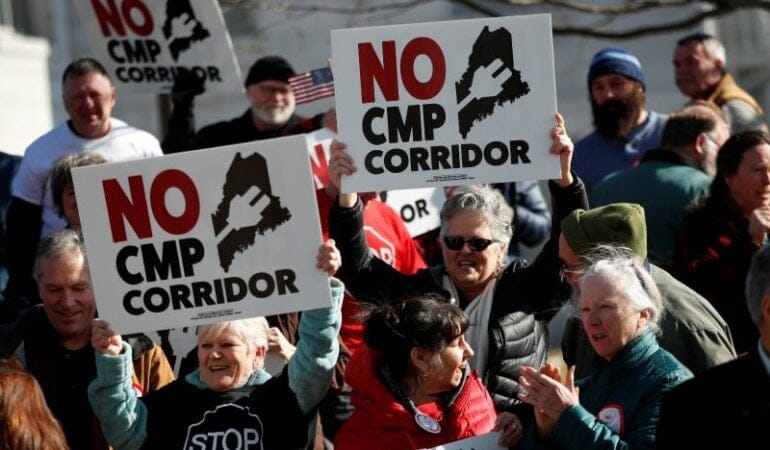
Imagen principal: Manifestantes marchan en contra de una línea de transmisión que atravesará Maine para transportar energía hidráulica desde Quebec hasta Massachusetts. Crédito: AP Photo/Robert F. Bukaty
Referencias
Bessette, Douglas L. y Sarah B. Mills. 2021. “Farmers vs. Lakers: Agriculture, Amenity, and Community in Predicting Opposition to United States Wind Energy Development”. Energy Research & Social Science. Vol. 72. Febrero. https://www.sciencedirect.com/science/article/abs/pii/S2214629620304485.
Crawford, Jessica, Douglas L. Bessette y Sarah B. Mills. 2022. “Rallying the Anti-Crowd: Organized Opposition, Democratic Deficit, and a Potential Social Gap in Large-Scale Solar Energy”. Energy Research & Social Science. Vol. 90. Agosto. https://www.sciencedirect.com/science/article/abs/pii/S2214629622001013.
EIA (US Energy Information Administration). 2016. “U.S. Electric System Is Made Up of Interconnections and Balancing Authorities”. Today in Energy. 20 de julio. https://www.eia.gov/todayinenergy/detail.php?id=27152.
Larson, Eric, Chris Greig, Jesse Jenkins, Erin Mayfield, Andrew Pascale, Chuan Zhang, Joshua Drossman, Robert Williams, Steve Pacala y Robert Socolow. 2020. “Net-Zero America: Potential Pathways, Infrastructure, and Impacts”. Interim report. Princeton, NJ: Princeton University. 15 de diciembre. https://environmenthalfcentury.princeton.edu/sites/g/files/toruqf331/fil….
Riofrancos, Thea, Alissa Kendall, Kristi K. Dayemo, Matthew Haugen, Kira McDonald, Batul Hassan y Margaret Slattery. 2023. “Achieving Zero Emissions with More Mobility and Less Mining”. University of California-Davis Climate and Community Project. https://www.climateandcommunity.org/more-mobility-less-mining.
Susskind, Lawrence, Jungwoo Chun, Alexander Gant, Chelsea Hodgkins, Jessica Cohen y Sarah Lohmar. 2022. “Sources of Opposition to Renewable Energy Projects in the United States”. Energy Policy. Vol. 165. Junio. https://www.sciencedirect.com/science/article/pii/S0301421522001471.
Research on Land Policy and Urban Development in Latin America and the Caribbean
Registration Deadline:
January 15, 2024 at 11:59 PM
The Lincoln Institute of Land Policy invites proposals for original research on land policies and urban development in Latin America and the Caribbean. Our objective is to understand how land policies are overcoming—or can overcome—systemic challenges to sustainable development in the region, including housing affordability and informality, spatial segregation, fiscal autonomy, and climate change. We need to think holistically to produce structural changes to address these challenges, so we are seeking to shed light on current policy debates across the region on key research areas of interest to the Lincoln Institute. These areas include the implementation of land-based financing instruments for infrastructure finance and fiscal stability, approaches to informal settlements’ upgrading and regularization, policies to reduce housing deficits, and enabling nature-based solutions for climate action.
Application guidelines and proposal submissions are also available in Spanish and Portuguese.
Details
Registration Deadline
January 15, 2024 at 11:59 PM
Keywords
Adaptation, Climate Mitigation, Housing, Inequality, Informal Land Markets, Infrastructure, Land Market Regulation, Land Use, Land Use Planning, Land Value, Municipal Fiscal Health, Planning, Property Taxation, Public Finance, Public Policy, Urban Development, Urban Upgrading and Regularization, Value Capture, Water


 SHARE
SHARE