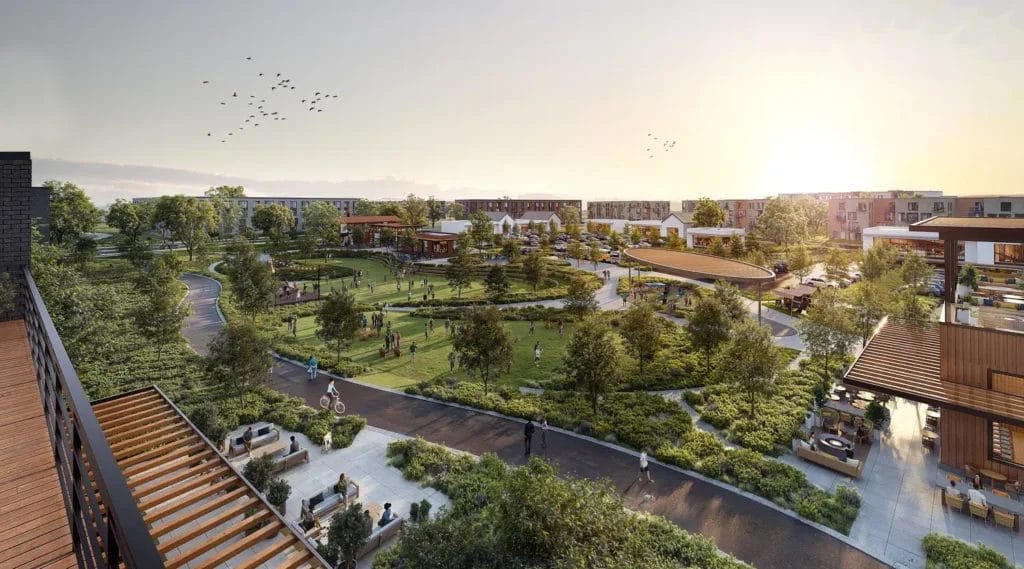
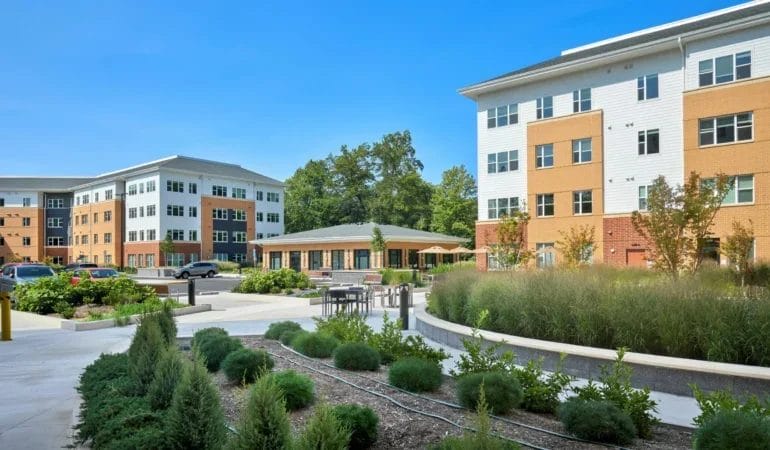
As communities across the country face the combined impacts of the housing affordability crisis, climate change, and biodiversity loss, state and local governments are exploring how to deploy underutilized land they own to meet multiple community needs. The Lincoln Institute’s Community Land for Community Benefits campaign aims to inform, complement, and increase the speed and scale of the work required to identify these lands and decide how to use them.
Conserved natural areas provide public benefits and ecosystem services
Most often, state and local officials are using community land to fill gaps in the affordable housing supply. As these efforts become more common, communities should ensure that conservation and development work together, not against one another.
Conserved lands are natural infrastructure. They’re essential to delivering clean air and water and supporting public health and recreation. They provide water filtration, flood control, groundwater recharge, climate regulation, air quality, coastal protection, habitat protection for pollinators, and other ecosystem services that are imperative to strengthening resilience in a changing climate.
As community leaders work to ensure that state and locally owned lands produce enduring benefits for residents, it will be essential to identify and delineate natural and working lands such as forests, wetlands, grasslands, and agricultural lands for conservation. Prioritizing lands that strengthen ecological connectivity will help secure ecosystem services at a large scale. Using durable mechanisms such as conservation easements will help secure long-term benefits that serve present and future generations.
Conservation and affordable housing development can find common ground
In many places and communities, tensions may arise between affordable housing development and sustainable land and resource management. But as efforts like the Conservation Lands Foundation’s Shared Ground initiative demonstrate, these enterprises do not have to clash if decisions about land use are made wisely. Affordable housing is often more compatible with land conservation than market-rate housing development is. Ensuring that affordable housing is built on already-developed, transit-accessible, underutilized parcels—rather than on converted natural or working lands—increases densification and alleviates pressure on urban, suburban, and rural natural areas and open space. And communities may be more likely to support affordable housing if it is paired with conserved open space to which they have access.
Conservation is just one of many nature-based solutions
In addition to the direct benefits of conserving community land, such as fostering healthy natural ecosystems and creating community well-being through public access to green space, the idea of using community land for nature-based solutions is gaining traction.
Nature-based solutions are actions to preserve or protect natural or modified ecosystems in ways that benefit both humans and biodiversity. In urban and suburban or rural contexts, this refers to green infrastructure deployed in and around the human-built environment, such as rain and pollinator gardens, community gardens, bioswales, green roofs, retention ponds, and tree plantings. Such interventions are frequently designed to reduce the flood impacts of runoff from impervious surfaces—such as roads, parking lots, sidewalks, and rooftops—which is particularly important during storm events. In suburban and rural environments, this list can expand to include riparian buffer zones that protect streams and rivers from agricultural runoff, and wetlands protections that ensure floodplain connectivity and help sustain water supply and regional hydrologic function. In most cases, these forms of nature-based solutions and other targeted interventions create shading and cooling effects, reducing heat-island impacts.
Communities facing extreme weather events, water stress, and other climate shocks are pursuing nature-based solutions with new urgency. These practices are being combined with concepts like climate-resilient zoning, which restricts development in high-risk flood zones or fire corridors. For example, dedicating community land to the development of “flood-able” parks and green spaces—which are intentionally engineered to receive floodwater during a storm event—builds climate resilience while strengthening the region’s biodiversity and ecosystem function. Similarly, in suburban and rural areas in arid climates, approaches such as managed-aquifer recharge—which directs floodwater to specific parcels of land to recharge the groundwater basin—are reducing water stress and increasing drought resilience.
Deploying land through a multiple-benefits frame
In short, the most innovative communities fully leverage their community land by exploring multipurpose re-use concepts and solutions to address an uncertain future. Bringing together housing, conservation, and nature-based solutions in a portfolio approach is the key to ensuring that state and locally owned lands deliver multiple, enduring benefits that enable human communities—and the natural systems on which they depend—to flourish.
Chandni Navalkha is director of conservation and stewardship and Peter Colohan is director of partnerships and program innovation at the Lincoln Institute of Land Policy.
Lead image: Urban Garden and stream at Mears Park in Lowertown St. Paul. Credit: JoeChristensen via Getty Images.
Premio Lincoln al periodismo sobre políticas urbanas, desarrollo sostenible y cambio climático 2026
El Instituto Lincoln de Políticas de Suelo convoca a periodistas de toda América Latina a participar del concurso “Premio Lincoln al periodismo sobre políticas urbanas, desarrollo sostenible y cambio climático”, cuyo objetivo es promover los trabajos periodísticos de investigación y divulgación que cubran temas relacionados con políticas de suelo y desarrollo urbano sostenible. El premio, ya en su quinto año, está dedicado a la memoria de Tim Lopes, un periodista brasileño asesinado mientras investigaba para un reportaje sobre las favelas de Rio de Janeiro.
Convocamos a periodistas de toda América Latina a participar de este concurso. Recibimos postulaciones para el premio hasta el 30 de agosto de 2026. Para ver detalles sobre la convocatoria, haga clic en el botón “Guía/Guidelines” o consulte el archivo titulado “Guía/Guidelines”.
Responding to the climate crisis will require more than solar panels, a modest carbon tax, or another flood barrier. A new book from Billy Fleming demonstrates that the climate policy, planning, and design professions have been looking in all the wrong places for models of sustainability and resilience, instead building projects that raise emissions and drive displacement. With 29 richly illustrated projects across six continents, this book shows readers a promising set of alternatives for building more just, decarbonized futures from the neighborhood to the continental scale.
Building Postcarbon Futures: Land, Justice, and Energy Transitions, published by the Lincoln Institute of Land Policy, provides a crucial counterpoint to the growing despair around climate action by presenting a series of optimistic solutions that show how various forms of collective ownership, multi-purpose infrastructure, and grassroots power are already tackling the climate crisis at great scale. It is both a celebration of action underway and a clarion call to the planners, designers, policymakers, and activists who are pushing this planet toward a future of collective flourishing.
“Building a just, postcarbon future requires a transformation of our social, political, and economic systems in ways that challenge the status quo,” said Billy Fleming, codirector of the Climate and Community Institute and assistant professor of landscape architecture at Temple University’s Tyler School of Art and Architecture. “This book explores existing works of climate justice and provides a range of tools, methods, and models of practice and policymaking to demonstrate what is possible if we act now at the scale of the crisis.”
Organized around energy, land, and urbanism, the core of the book is an atlas featuring original cartography that maps and documents examples—such as the Tu Deh-Kah Geothermal Power Plant in British Columbia and the West Arnhem Land Fire Abatement Project in Australia—of existing and effective grassroots work toward climate justice. Often, these projects are at odds with the status quo and incorporate the work of marginalized people and frontline communities.
“This is an incredible contribution, offering creative models of land stewardship and climate justice that will push design practice in radical new directions,” said Jenny Jones, principle of TERREMOTO and 2025 Smithsonian National Design Award recipient.
“This book puts the earth, the land, and the spaces we all share at the center of the climate crisis, precisely where they belong,” said Julian Brave NoiseCat, author of We Survived the Night and Academy Award–nominated director of Sugarcane.
Building Postcarbon Futures also features more than a dozen contributions from leading scholars and practitioners of planning, design, and climate policy. Their field-based research presents additional studies of the past, present, and future—including social housing experiments in Uruguay and Jakarta, land stewardship and ecosystem restoration initiatives in the Pacific Northwest and American South, and submerged histories of energy democracy and collective ownership of the power grid in the rural United States.
More information about the book can be found here.
Kristina McGeehan is the director of communications at the Lincoln Institute of Land Policy.
Lead image: A team of workers welds and installs a new solar array for a rice mill in Burkina Faso. Credit:Joerg Boethling
Lincoln Vibrant Communities Certificates Fall 2026
SHARE
The Lincoln Institute of Land Policy and Claremont Lincoln University (CLU) invite bold, forward-thinking leaders to apply for the Lincoln Vibrant Communities Certificates.
In the Fall of 2026, the Lincoln Vibrant Communities Fellows Certificate will offer a customized experience focused on data centers. While the cohort focuses on data centers, the principles and frameworks apply to all large-scale development projects—from distribution centers and advanced manufacturing to housing, logistics, and major infrastructure investments. Large-scale development does not have to be an either-or proposition. This is a unique time in history when leaders are being called on to make complex decisions that will shape the future of their communities. Join individuals from across the country in the Lincoln Vibrant Communities Fellows certificate to gain the competency and confidence to lead your community through the many facets of large-scale development.
These certificates equip participants with the leadership skills, land policy tools, and national connections needed to create measurable, lasting impact in their localities. The 24-week certificate program is designed to build capacity to address challenges in communities using the best practices, tools, and research of the Lincoln Institute of Land Policy and the academic excellence of Claremont Lincoln University. Participants will engage in an immersive in-person learning event; an online leadership curriculum; and specialized coursework covering concepts such as scenario planning, data visualization, strategic communication, conflict mediation, and policy development. This culminates in a nine-credit graduate certificate, providing a pathway for further academic and professional growth.
Individuals interested in participating in the Fall 2026 cohort can apply for the Fellows Certificate. Fellows are highly encouraged to consider participating in the Teams Certificate after completing the Fellows Certificate, but it is not a prerequisite. The next Teams Certificate will be available in 2027. These certificates, which are partially underwritten, cost $2,500 per participant.
The online application form will open on June 18, 2026. Applications are due by August 10, 2026. The program begins on September 30, 2026, in Chicago, IL. A limited number of early applicants will receive a Claremont Lincoln University sweatshirt to celebrate joining the next cohort of leaders. Please see the application guidelines for further details.
Three Michigan mayors—Sheldon Neeley of Flint, Christopher Taylor of Ann Arbor, and David LaGrand of Grand Rapids—appeared at the American Planning Association’s National Planning Conference in Detroit in April, on a panel moderated by Anthony Flint, author of Mayor’s Desk: 20 Conversations with Local Leaders Solving Global Problems.
Their conversation, which followed similar mayors’ panel sessions at APA’s national conferences in Denver and Minneapolis, highlighted the challenges municipal leaders face on issues including housing affordability, the property tax, and an evolving relationship with the federal government. These highlights from the discussion have been edited for length and clarity.
Anthony Flint: What is it like to run a city at this current time, in this political environment, and what impact has the role of the federal government had, especially as it has changed?
Mayor Sheldon Neeley: One of the things I find is that it’s the intersection of crises. It’s like any intersection, you have … to make sure you don’t run into catastrophic accidents. My engagement has been on the financial crisis, water crisis, civil unrest, and also a global pandemic. I call it prayer, planning, partnership … we looked for our partners to be able to get through that. We needed all parts of government to play a part to serve the various residents across the state of Michigan. Also, I have a great relationship with the state government as a former legislator, and also have one of the greatest state legislators in the state, [who] happens to be my wife.
Mayor Christopher Taylor: With the current climate, we have a combination of certainties and uncertainties as we grapple at the global level. We know that if we are trying to protect our community members, we need to be welcoming…. That’s going to be complicated, at best, frustrated, at worst, by the administration. We also know that some of our primary quality-of-life initiatives with respect to housing and climate action are at odds with the federal policy and with the process of the administration. We have been doing a lot of work on climate action. [The federal policies], at the very best, complicate and slow down the exciting work that we’re doing.… On housing, crucially, with all those cuts in HUD, those are going to hit our residents.
Mayor David LaGrand: The level of chaos that’s been injected at the federal level has been really problematic, because a lot of people want me to come and do something about Donald Trump. I can’t change his mind on tariffs. I can’t change his mind on a lot of things. We’re the closest people to [yell at], so we get a lot of frustration. Maybe we’re about to revert to city-state models rather than a federal one. The federal government’s been around for a couple hundred years. Cities have been around for 9,000 years. They’re very durable. They have lots of structural advantages, and there are reasons why the cities are going to be fine.
Then the question is, [do] we just forget about the federal government and the state government? The long-term question is, post–Great Society, if we made this deal … to put most of our money up to the federal level and it was going to come back in the form of grants and programming … if that bargain has been falsified, then why am I sending my federal taxes off to the federal government anymore?
If we want to do housing, we’re going to have to do it ourselves. We have to figure out what the resources are. If we want to do environmental work, we have to figure out what’s city level. We just have to be honest and break out of [the approach of saying] gee, there’s a grant somewhere we should apply for.
AF: The next question is about local action. I’m going to ask three questions, one for each of you. I’ll start with Mayor Taylor. Can you tell us about the clean energy public utility you’ve started in Ann Arbor and how that fits in with your local climate action plans?
Mayor Christopher Taylor: We have, in our liberal town, no surprise, we’ve had a climate action plan for quite some time. We were able to, through some work at the county level, find a million dollars a year starting in about 2017, which enabled us to staff up our Office of Sustainability and Innovation. In the state of Michigan, we have a franchise with a regulated provider. That franchise for electric is perpetual. That means if we wanted to run our own utility, seizing [its] assets and utilizing them, not only would we have to pay for capital, we’d also have to pay for the profit interest going forward perpetually.
We decided to start the Sustainable Energy Utility, [which] overlays the existing utility. It is an opt-in utility. It enables residents who wish to sign up to get from the city, from the public utility, 100 percent renewable, reliable, sustainable, resilient, and just-at-market, if not a little bit below, energy. We are getting this underway. We have hired some staff. We’re allocating some budget. We’re going to try to hit 100 homes this year. We’re going to try to hit 1,000 homes next year. We’re going to work … on batteries and solar panels, and we’re focusing on one of our lowest-income areas in the city. The residents are signing up for it. It’s something that gives us a lot of drive, a lot of excitement. It’s something I think that lots of jurisdictions could take a look at.
Mayor Christopher Taylor talks with a homeowner at the installation of the Ann Arbor Sustainable Energy Utility’s first solar panel and battery storage systems in May. Credit: City of Ann Arbor.
AF: Mayor Neeley, I know that the … water crisis was traumatic and this is in the rearview mirror, but we’d like an update on how the resolution is going. Importantly, this is ultimately about infrastructure and investment in the city. What can you tell other cities about your experience?
Mayor Neeley: When people find out that I’m the mayor of Flint, Michigan, they ask, how’s the water? I reply, the water’s fine. We’re doing very well. We’ve invested more than $20 million into our infrastructure repair programs [plus $100 million in federal matching funds] … to get us to this point. All of you have been watching over the last decade or so. I want to thank you for your prayers and your wishes. We’re still providing water for the poor families inside the city of Flint, while we’re trying to build … trust. It’s a confidence thing that we have to build back.
AF: I want to turn now to affordability and start with you, Mayor LaGrand. You’ve got your own special circumstances in terms of your local economy, which I’d like you to talk about, but what have you found in terms of the strategies for promoting affordable housing? I’m going to follow up with each of you about your particular strategy, and that is something we’re interested in, which is promoting the use of government-owned land for housing.
Mayor LaGrand: First of all, I’ve just got to acknowledge that I think jealousy is an under-respected emotion. I am jealous of the work that Ann Arbor is doing on the electric utility work, [which] we’re watching very carefully. It’s incredibly exciting.
One of the things that I think in the policy space is really important [is] to ground things in economics. The law of supply and demand is a law. You can try ignoring it if you want. Try ignoring gravity and see how well that works for you. Demand is going to give you price pressures. It really boils down to two things. One is the regulatory environment, and the other is how you actually make it. Again, just to geek out for you guys a little bit, one of the weird things about housing is if you look at industries in general, think about a computer, they get more and more efficient, dramatically so, right? We see that all the time. For housing, the construction industry still involves a guy or a woman coming out to a site with a hammer and knocking a bunch of pieces of wood together like it’s 1940. The housing industry hasn’t moved forward very much technologically.
Sheldon and I were deskmates in [the state legislature] in Lansing. There was a good idea of taxing vacant land that Mayor Duggan proposed for Detroit . Those of us with bad developers squatting on land—that’s a problem. I wrote a bill so that cities could have land banks and not just counties. Then when I became mayor, now we have a land bank in Grand Rapids. That’s a way for you to do public investment, and it’s exciting. That gets to your public ownership of land question.
The other thing is [ADUs, or accessory dwelling units]. Let’s say I have 50,000 garages in Grand Rapids. Those garages are all potential one-bedroom or studio apartments, but only if the regulatory environment makes that possible and makes it work. I’ve got bills in Lansing that will drop the cost of construction of an [accessory dwelling unit] about 20 grand a unit because of regulatory things in the state building code. You’ve got to get it fixed at the state level. Then at the city level, you’ve got zoning questions. Is it even allowed? Do you have prebuilt models? How easy is it to get through your zoning department? How easy is it to get financing?
If we increase supply enough, prices will moderate. We saw it happen in Minneapolis. We saw it happen in Boston last year. We see it happen in Austin. The law of supply and demand is a law.
AF: We’re going to have to move into a little bit more lightning-round mode, but I want to ask you about affordability and specifically this idea of making use of government-owned land.
Mayor Taylor: Just a couple of weeks ago [we] passed our comprehensive land use plan, which envisions substantially more housing throughout the city, much more in the downtown, substantially more on transit corridors, and more in established neighborhoods, duplexes, triplexes, ADUs, wherever we can.
There isn’t much vacant land in Ann Arbor. We do have a couple of parking lots downtown that we’re utilizing in different ways. One, we are looking to sell on the open market. We’re going to sell to the highest bidder for as much housing as we can get, [plus] a grocery store on the first floor.
Next, we have a … parking structure that has been a conversation in the city for a number of years. We are transferring the air rights to that parking structure to the next-door library. The library is going to build an awesome library on top …. They’re going to work on having affordable housing, workforce housing, artist housing. Across the street, we’ve got another surface parking lot owned by the City of Ann Arbor. We are going to break ground this season on about 300 units of new permanent housing there. We’re working on it.
AF: Mayor Neeley, have you seen efforts to redevelop underutilized land in the city of Flint?
Mayor Sheldon Neeley: The good news is that if Grand Rapids and Ann Arbor don’t have a home for you … we have land, and we have industrial space, and also residential space. What we’re doing, we’re taking a lot of structures down, and we’re redeveloping that land. It’s affordable. The Real Estate Association says the land value has increased over the last decade by about 332 percent, but it’s still very affordable. Flint, right now, for the first time in 20 years, is actually growing in population, so people are realizing that it’s a good investment to come back there and even start your business.
Flint Mayor Sheldon Neeley watches the clean-up of an illegal dumping site in 2022 after speaking about a grant-funded partnership between the city and the county land bank to stabilize neighborhoods and fight blight. Credit: City of Flint.
AF: All around the country, there’s this new property tax revolt just at the time when local governments are counting on that revenue. Just interested in your reflections on that revolt, and then also where you stand on the land value tax.
Mayor David LaGrand: If you want to geek out, the land value tax is called Georgian economics. It’s a great idea. It’s good for everybody incrementally, so I’d like it in general.
Property tax in Michigan is badly broken, but let me tell you middle-class people: It’s broken in your favor. That’s really the conversation we have to have when we [discuss] property tax. It’s money for the local government. It’s revenue. It’s not an inalienable way to tax if you want to do the stuff [that] government does. The question [is] who pays the most.
Mayor Taylor: With respect to property tax, we’ve identified some of the challenges. If you stay in your home, your property taxes tick up with inflation. If you move, they leap up to the assessed value. That is great if you’re in your home. It’s hard if you’re a senior and want to downsize. The way our property tax system operates keeps people in their homes longer when they want to stay there.
Second, and this is a little bit of a particularity with respect to Ann Arbor, University of Michigan, a fairly important economic engine in the city, doesn’t pay any taxes. We do have an opportunity to have a city income tax. The way that it’s structured in Michigan, however, in the city of Ann Arbor, would mean that the imposition of an income tax would, on the one hand, be capped at 1 percent for residents, 10 percent for nonresidents, and crucially, would involve an approximately 13 percent property tax cut for people in the city of Ann Arbor.
Mayor Neeley: How many of you guys are thoroughly confused by this whole tax question right now? Let me help you simplify it. Taxation is a necessary thing in order to provide services for residents inside any particular community. Let me give you an example from the city of Flint. We have more than 290 churches, about 23 vacant school buildings [that have] been vacant for more than a decade. We have two major hospitals. We have three university campuses. All our nonprofit entities are not paying property taxes. We talk about a PILOT payment [payments in lieu of taxes]. We need to make sure everybody is able to get their share [of public services when] just one-third of the communities are paying for all the services that they need.
We use a combination of different revenue streams to be able to have a support base. I do operational audits to see how we can provide more services for less without cutting or raising the price. These are dialogues and conversations that we need to have.
We can get industry back in and using land space for redevelopment, housing, or other businesses. If we have hospitals, we need to be able to have a PILOT payment because if they need help with the fire department, police department, those are tax dollars of the residents that are providing that level of service. All these things have to come together .… We need to take a really good look … around the table and be able to have these really engaged conversations. Truth has never been afraid of an audience, and so we need to be able to speak the truth, whether you’re Republican, Democrat, white, Black, rich, or poor. We need to have that.
Lead image: Grand Rapids Mayor David LaGrand speaks during a session at the American Planning Association’s National Planning Conference in Detroit in April. Seated next to him (partially obscured) is Ann Arbor Mayor Christopher Taylor, with Flint Mayor Sheldon Neeley and Anthony Flint of the Lincoln Institute of Land Policy completing the panel. Credit: American Planning Association.
Mindy O’Neall, 44, was elected the 53rd mayor of Fairbanks, Alaska, in 2025, flipping the seat from Republican to Democrat for the first time in a decade and becoming the fourth female municipal chief executive in the city’s history.
The Iowa native drove a stick-shift pickup truck to Alaska to look for adventure 23 years ago—landing first in Anchorage, where she worked as an aide in the state legislature, and then in Fairbanks, home to roughly 30,000 people including the Fort Wainwright military base. She worked at the Fairbanks Economic Development Corporation and the Interior Gas Utility, served as a labor business representative, and founded Blue Canoe Media, a boutique communications and consulting firm.
At the University of Alaska Fairbanks, O’Neall earned a master’s in communication, researching governance and climate impacts in rural Alaska. Prior to her election as mayor, she served on the Fairbanks North Star Borough Assembly and was executive director of the Cold Climate Housing Research Center, and also serves on boards of the Alaska State Homebuilders Association and Alaska Municipal League. She campaigned on the issues of downtown revitalization, affordable housing, and public safety. She lives in downtown Fairbanks with her dog, Tito, who she pointed out is the true official dog of Alaska, the mutt.
Anthony Flint: For the uninitiated, what kind of place is Fairbanks? And why did you want to be mayor?
Mindy O’Neall: I would say we’re the land of extremes. We are extremely cold in the winter. Some people may be surprised to learn that we can get up to 90 to 100 degrees in the summer. We have exotic animals, grizzly bears and polar bears, and we have extreme industry, like mining and gas and oil development. At the heart of it is the people … who have grit and determination and oftentimes this mindset of abundance … [and a] mindset of scarcity as well. We’re at the end of the line. We have three to four days of food security at any given time.
Fairbanks Mayor Mindy O’Neall. Courtesy photo.
I’ve been in Alaska for over 23 years. I’m originally from Iowa, and I came up here just like a lot of other folks, looking for adventure. If you’ve ever been to the Midwest, they say, why would you ever want to leave the heartland? And I said, don’t worry, I’ll be back in a year. I just want to go check it out. And, after a year, it was painfully obvious that there was so much more to discover to Alaska that I just had to stay.
One of the things that’s interesting about Alaska is we have seven boroughs, that are kind of like counties in the lower 48. And then we have cities within those boroughs, and so Fairbanks has a borough that has a governing body, which is the assembly, and a mayor, and then within the borough, there are two cities…. We always like to joke that for a place that’s so against government and overregulation, we have a lot of government.
I started my public service during COVID…. We had a mayor that was on paper doing a fine job. But he was very discriminatory to the Alaska Native population here, and after some comments and blow-ups on social media … I just believe that public service is a privilege, and somebody who is in office has to have the respect of every population that is within their community … [a] key piece of public service is showing your community respect, even if you don’t understand them, even if you don’t agree with them. I think that we have lost that on a lot of levels of government these days.
I do think that one of the benefits of being in this position is being a female. This is the first time Fairbanks has had a female mayor in about two decades, and I’m the fourth one since 1903 … a young female in my 40s, leading this community and being a role model for girls in our community to see that there’s somebody like them … in an environment that is sometimes very hostile and sometimes very male-driven.
AF: Everybody’s wrestling with affordability these days, and one big part of that is housing. What are the policies that can help, in your region, whether homebuying or renting?
MO: We suffer from a housing stock that’s from the ’70s. Alaska really got its last big boom during the oil pipeline of the ’70s, and what happened was there was such an explosion of [people] coming up to the state that they built things the way that they knew how to build things, which was without a lot of insulation, built out of whatever that they had. So we suffer from very inefficient housing.
[We need to focus on] building generational wealth outside of homeownership. Building homes and housing has been the game or the business of large, wealthy developers. And in our community, we just can’t really afford that. We don’t have enough folks for a large developer to make money here.… How can we lower the amount of investment [that is necessary for housing]?
AF: The Lincoln Institute has been helping municipalities identify government-owned land that can be used for affordable housing. Do you see opportunities in that approach?
MO: Absolutely, I do. A few facts for you here. Sixty percent of our land in Alaska is federal, and 25 percent is owned by the state of Alaska. 10 percent is owned by Native corporations, and one percent is private. So we have a lot of government land that’s available. Now, about 80 million of those acres are managed for conservation. But that’s still quite a bit of land left for us to use.
We have a parking structure that has been mothballed for probably five years. The university that used it ended up not needing it, and so they literally welded the doors shut, and this building has been sitting there, kind of deteriorating ever since. There was some funding that became available … for land acquisition. We’ve put out an RFP for a developer to then build two or three stories on top of that parking garage, therefore activating the space, using the garage for parking, covered parking, which is very important in Fairbanks, but also getting units into the downtown core. So, that’s one example, and there’s a few others that we have, but I’m really eager to see how that plays out.
AF: What are the unique challenges of living with climate change in Alaska, and what, at the state and local level, can be done about it?
The Lost Horse Creek fire outside of Fairbanks in 2023. Credit: Togie Whiel/AKIMT.
MO: They often call the Arctic the canary in the coal mine, because we start to see the issues of climate change far beyond and far before the lower 48 or other parts of the world. Something’s been happening in our environment for quite some time. We have more wind in Fairbanks, which means that we have more risk for summer fires. In the winter, we’ve had more snow than usual, and it’s also been colder than usual, which means that our ground will not thaw quickly—meaning that when the temperature gets hot in the air, it’s all going to melt into water, but there’s going to be nowhere for it to go because the ground hasn’t thawed yet. And so now we miss out on that water, and we get lots of floods. And then we don’t have moisture in the ground, and so it’s more susceptible to wildfires in the summer.
I don’t think there’s really much we can do about this now. It’s happening. We’re in a cycle of climatic disruption. But we can plan for it. We can plan for extreme events—what we’re going to do when the power goes out and it’s negative 30 degrees.
The other thing is, with planning comes money, and Alaska is a place where we do not collect sales taxes on a statewide basis. Some municipalities do, we do not, as the municipality of Fairbanks. And income taxes. So we pay property taxes, and that’s all we pay. As we address these more and more dramatic events, it’s costing us more and more to repair the roads, costing more and more to protect the utilities that are above and below ground. We’re seeing less and less investment from the federal government for events like that. So as Alaskans, it’s time for us to really think hard about how we want to protect … our assets that we have. And what level of commitment comes from our own pocketbooks.
AF: Leading into that, how have you navigated being a mayor at a time when the federal government is reducing funding, and withdrawing from being a partner on so many issues?
MO: We continue to ask our public employees to do more with less. At the same time, the public expects services to be modern. So, that means we have to invest in technology.
It’s a tough spot. I have all of these ideas and plans for being mayor, and then you come into the office.… The way we want to provide services and make things more efficient … with less and less funding, from the state and from the federal government, we’re going to have to look at ways that we contribute to ourselves. And that comes back to the values that we hold as a community.
It’s tough. It’s definitely something I’m working on—how we do more with less, how we explain the value of good governance, [and] putting our own skin in the game.
Poco después de comenzar su mandato en 2022, el alcalde de Atlanta, Andre Dickens, hizo el tipo de promesa que los votantes no suelen olvidar: se comprometió a abrir paso a 20.000 nuevas viviendas dentro de los límites de la ciudad para 2030, en el contexto de un rápido aumento de los alquileres y los precios de las viviendas.
Con la presión encima, una de las primeras medidas que tomó Dickens fue formar un grupo de trabajo en materia de vivienda para investigar parcelas y propiedades pertenecientes la ciudad. El alcalde lo consideró la ruta más rápida para poner manos a la obra, con el beneficio adicional de que sería más barato construir en estas parcelas, ya que el suelo, que casi siempre es el elemento más caro del proceso de construcción, ya estaba incluido.
El equipo del alcalde también estableció un centro de ayuda para la vivienda, simplificó los permisos, puso a disposición de los emprendedores inmobiliarios diferentes tipos de financiamiento y creó un programa de prevención de desalojos para ayudar a detener la ola de falta de hogares. Sin embargo, los más de 50 sitios y 217 hectáreas que se identificaron, que van desde escuelas cerradas hasta tierras y propiedades de MARTA, el sistema de transporte público de la ciudad, permitieron que la ciudad aprovechara la ventaja especial que proporciona la propiedad pública. “Los esfuerzos de desarrollo de capacidades están dando sus frutos en la forma de un vehículo sofisticado y colaborativo para desarrollar viviendas para familias de ingresos mixtos, ancladas en la comunidad, en suelo de propiedad pública”, comentó Dickens.
La estrategia de Atlanta es parte de un movimiento nacional para hacer un mejor uso del suelo propiedad del gobierno. Y la cantidad de suelo que se incluye (terrenos infrautilizados, como baldíos, lotes de estacionamiento abandonadas o edificios fuera de servicio, propiedad de entidades que van desde distritos escolares hasta autoridades de vivienda) no es insignificante. Según el Centro de Soluciones Geoespaciales (CGS, por su sigla en inglés), en todo el país, sería factible construir en más de 93.077 hectáreas de suelo de propiedad municipal con acceso al transporte público. Eso es más que la superficie total de la ciudad de Nueva York.
De 276.000 acres, o 111.693 hectáreas, de suelo edificable, el 86 % es suelo local, 12 % es del estado y 2 % es federal.
El análisis de tierras locales, estatales y federales del CGS encontró un total de 111.694 hectáreas de suelo de propiedad gubernamental donde podría construirse en áreas urbanas con acceso al transporte público e infraestructura existente. Este suelo podría albergar casi 7 millones de viviendas nuevas a una densidad modesta, según el CGS, que forma parte del Instituto Lincoln de Políticas de Suelo. Un destacado comentarista de asuntos urbanos calificó el potencial de estas tierras como una solución “escondida a plena vista”.
Para alentar a las comunidades de los EUA a identificar suelo de propiedad pública que podría utilizarse para mejoras de vivienda o medioambiente, el Instituto Lincoln lanzó una iniciativa llamada Community Land for Community Benefits (“Suelo de la comunidad para beneficio de la comunidad”). “Las tierras públicas desempeñan un rol clave a la hora de abordar la capacidad de pago de la vivienda, pero los gobiernos locales necesitan apoyo para permitir la transformación”, indicó George W. McCarthy, presidente y director ejecutivo del Instituto Lincoln. “La campaña Community Land ayudará a los responsables de formular políticas y a sus socios a identificar y aprovechar el suelo de propiedad pública”.
Se calcula que se deben construir entre seis y ocho millones de viviendas nuevas para superar las restricciones en la oferta que contribuyen al aumento de los costos habitacionales, según análisis de fuentes como Freddie Mac, Zillow, Goldman Sachs y McKinsey. La ventaja de desarrollar o redesarrollar suelo de propiedad pública es que el gobierno puede dictar los términos de uso y garantizar que cualquier vivienda que se construya sea permanentemente asequible. Alquilar el suelo o entregarlo a un desarrollador sin fines de lucro también puede tener el efecto de mantener bajos los costos generales. “La capacidad de pago del suelo es el mayor obstáculo para la vivienda asequible”, explica McCarthy. “Si un emprendedor inmobiliario tiene que comprar tierras a precio de mercado, eso elimina, de forma casi automática, la posibilidad de construir viviendas asequibles. El costo del suelo será demasiado alto para que esto funcione”.
A medida que los gobiernos hacen un inventario de los terrenos de propiedad pública, surge una serie de otras opciones para la construcción de nuevas viviendas, en suelo con distintos regímenes de tenencia y propiedad: terrenos comerciales con mal rendimiento, como un centro comercial en quiebra; estacionamientos privados infrautilizados; terrenos que son propiedad de empresas ferroviarias de carga o de pasajeros; corrales de ganado; y terrenos que son propiedad de comunidades tribales o instituciones religiosas, que, por diversas razones, buscan vender sus activos inmobiliarios en la actualidad. (Obtenga más información sobre el movimiento para construir viviendas en tierras de propiedad religiosa).
A menudo, las instituciones cívicas como universidades, hospitales y fundaciones comunitarias también son propietarias de grandes extensiones de tierra y, además, tienen una misión orientada a la comunidad. Un esfuerzo coordinado para mapear estas hectáreas, a través de jurisdicciones e instituciones cívicas concurrentes, puede orientar las iniciativas destinadas a abordar la asequibilidad de la vivienda y la resiliencia ante el cambio climático, mientras revela oportunidades potenciales para obtener parcelas más grandes y contiguas a partir de parcelas fragmentadas.
A continuación, se incluye un desglose de la tierra de propiedad gubernamental con acceso a transporte público por categoría (federal, estatal y local), que comienza con suelo bajo el control de los municipios, que es, con amplia diferencia, el segmento más grande de la propiedad pública.
LOCAL: más de 95.000 hectáreas
Las ciudades tienen más de 237.000 acres, o 95.000 hectáreas, de suelo edificable.
Varias ciudades, grandes y pequeñas, se unen a Atlanta para valuar sus activos inmobiliarios, determinar cómo podrían usarse y avanzar con los proyectos. En el sector de Morgan Park, en Chicago, 11 baldíos de propiedad de la ciudad se están reurbanizando para viviendas, como parte de la Iniciativa de viviendas intermedias faltantes de la ciudad. Una base de datos de baldíos de propiedad de la ciudad revela que hay 7.000 más.
De manera similar, en Detroit, donde la alcaldesa Mary Sheffield firmó una orden ejecutiva para destinar todos los ingresos por la venta de propiedades comerciales de la ciudad al fondo fiduciario de desarrollo y preservación de viviendas asequibles, se está examinando el estado de 100.000 parcelas vacías, la mayoría de las cuales son propiedad de la ciudad, según la organización sin fines de lucro Detroit Future City. El suelo vacante es candidato, como mínimo, para mejoras naturales como jardines comunitarios, si no se usa para vivienda, comentan desde la organización.
Sin embargo, los terrenos baldíos representan los espacios más inmediatos en el ejercicio de identificar suelo municipal adecuado. Emma Mulvaney-Stanak, la alcaldesa de Burlington, Vermont, lanzó un plan para usar parques, estacionamientos y otras parcelas públicas mal aprovechadas para la construcción de viviendas. Entre los sitios del proyecto, se incluye una zona comercial de tres cuadras deteriorada en el centro de la ciudad, con un auditorio en desuso; y un extenso estacionamiento de propiedad de la ciudad, adyacente a una incubadora de empresas emergentes de tecnología que ahora ocupa una fábrica que solía usarse para fabricar hornos y otros equipos de cocina.
Cuando el suelo se percibe como un activo de la comunidad, pueden surgir tensiones y conflictos, incluso si la propiedad está olvidada hace mucho tiempo o las condiciones se han deteriorado. Como las tierras de propiedad pública pueden ser un imán para conflictos de intereses, en especial si involucran cualquier tipo de espacio recreativo o abierto, la ciudad adaptó el proceso de adquisición, comentó Charles Dillard, director de Planificación de Burlington. “Queremos darle la vuelta al proceso de solicitud de propuestas”, agregó, para obtener primero la opinión de la comunidad e identificar un esquema de desarrollo y diseño que se ajuste a ello.
Al combinar una parcela de propiedad de la ciudad con dos de propiedad privada en el South End de Burlington, Vermont, líderes locales crearon un área que será transformada en un barrio de uso mixto. Créditos: Burlington Community and Economic Development Office.
“No suele haber consenso sobre qué se debe construir, si es que se debe construir algo”, indicó Dillard, y señaló que, en general, los conflictos surgen en torno a “cuestiones de capacidad de pago y beneficio público: qué se está construyendo y para quién… Entonces, en última instancia, se trata de democratizar el desarrollo y reafirmar la función del sector público como líder en la creación de la perspectiva de la vivienda y la ciudad en evolución”.
En Atlanta, los funcionarios de la ciudad construyen una narrativa que resalta el contexto más amplio del suelo de propiedad de la ciudad: cómo todo desarrollo de vivienda se adapta, en última instancia, a un barrio bien articulado. Según la oficina del alcalde, el enfoque es “enmarcar la producción de viviendas en una estrategia holística de revitalización del barrio. Cuando hablamos de nuevas viviendas, también hablamos de tiendas de comestibles, parques, senderos, guarderías, escuelas [y] retención de residentes históricos”. El objetivo idealista es garantizar que todos los residentes de Atlanta “tengan un lugar donde vivir, pero que todos tengan la capacidad de pago para vivir en un barrio completo, saludable y próspero”.
Sin embargo, la ciudad también tiene en cuenta la producción de resultados rápidos. Las tierras municipales se han convertido en el lugar perfecto para la iniciativa de vivienda rápida del alcalde, al entregar construcciones modulares y construidas en fábrica. Un estacionamiento a nivel del suelo para vehículos de la ciudad mal aprovechado se transformó en The Melody, 40 unidades de vivienda de apoyo permanente junto a la estación Garnett de MARTA. A fines del año pasado, la ciudad celebró la apertura de Waterworks Village, 100 unidades de viviendas de apoyo construidas en tres pisos de viviendas modulares en suelo transferido del Departamento de Gestión de Cuencas de la Ciudad.
Andre Dickens, el alcalde de Atlanta, a la derecha, visita Waterworks, un desarrollo asequible en suelo propiedad de la ciudad que es parte del Rapid Housing Initiative. Crédito: Ciudad de Atlanta.
Otra ventaja de la mayor cantidad de suelo bajo control municipal es que permite a las ciudades y pueblos elegir, a medida que evalúan parcelas cuyo desarrollo implicaría diversos grados de dificultad. El análisis del Centro de Soluciones Geoespaciales puede ser de particular utilidad para calcular las concesiones que se deben hacer, ya que las investigaciones exhaustivas muestran diferentes niveles de complejidad al disponer de propiedades gubernamentales. Un taller de obras públicas desmantelado podría estar en un sitio con menos vecinos que se opongan a la reurbanización, pero podría requerir un alto nivel de remediación medioambiental.
“Estamos realizando un estudio diligente de cada parcela de propiedad de la ciudad para determinar no solo las que están más al alcance, sino también las propiedades más complejas que, en última instancia, pueden aportar de manera más significativas a la creación de viviendas, el desarrollo comunitario y la transformación catalítica”, indicó Dillard, el planificador de la ciudad de Burlington.
Los condados también se unen a la iniciativa. La “Guía para desarrollar viviendas en suelo propiedad del condado” de Smart Growth America tiene como objetivo ayudar a los gobiernos de los condados, que suelen tener menos capacidad, a identificar parcelas adecuadas, evaluar las limitaciones de zonificación y modelar la viabilidad financiera y la estructura de propiedad. El condado de San Mateo, justo al sur de San Francisco, recientemente arrendó una parcela por USD 1 al año para que un desarrollador de viviendas asequibles pudiera construir 160 unidades de viviendas asequibles para adultos mayores.
ESTATAL: más de 13.300 hectáreas
Los estados tienen más de 33.000 acres, o 13.300 hectáreas, de suelo edificable.
Los estados están adoptando un rol de coordinación al ayudar a las ciudades y pueblos a identificar el suelo de su propiedad. Pero los estados también son propietarios de tierras extensas, y los legisladores reclaman una imagen más nítida de dónde podría radicar la promesa de nuevas viviendas. Prácticamente todos los estados tienen, desde hace mucho tiempo, un proceso para disponer de la propiedad estatal, ya sea un depósito de armas obsoleto o un hospital psiquiátrico cerrado, pero ese ejercicio es notoriamente prolongado y se desarrolla caso por caso. Dada la urgencia de la crisis habitacional, los responsables de elaborar políticas de hoy buscan una perspectiva general más estratégica y plazos más rápidos.
Esta primavera, el gobernador de Colorado, Jared Polis, firmó la Ley de Facilitación de Oportunidades de Vivienda (HOME, por su sigla en inglés), que les permite a los distritos escolares, universidades, autoridades de vivienda, distritos de transporte público y organizaciones sin fines de lucro calificadas construir viviendas en propiedades de un máximo de dos hectáreas, al margen de las reglas de zonificación locales. La iniciativa sigue a una medida de 2019 que exige que cada agencia e institución estatal de educación superior presente una lista de todo el suelo no desarrollado que sea propiedad de la agencia o institución o esté bajo su control, y que podría desarrollarse para viviendas asequibles para hogares de ingresos bajos y moderados, bajo regímenes de venta o alquiler. El Departamento de Asuntos Locales (DOLA, por su sigla en inglés) del estado se ha asociado con el Centro de Soluciones Geoespaciales para realizar un inventario de todas las tierras identificadas por las agencias e instituciones, detectar superposiciones y asignar la propiedad con precisión. El objetivo es permitir una mejor coordinación en el futuro.
Jared Polis, gobernador de Colorado, firma una ley para permitir desarrollo de viviendas en propiedades de la comunidad mal aprovechadas mientras le observan los legisladores estatales que apoyaron la ley. Crédito: Oficina del gobernador Polis.
Un esfuerzo similar en Vermont dio 140 propiedades, que van desde 0,2 a 202 hectáreas, en diversos lugares. El gobernador de California, Gavin Newsom, lanzó el Programa de Sitios Sobrantes para identificar propiedades estatales mal aprovechadas y acelerar el proceso de desarrollo de sitios adecuados para la vivienda. Los constructores tienen acceso a un nuevo portal web que brinda una explicación clara de cuáles son las oportunidades. Los funcionarios dicen que las propiedades que están en el inventario, que van desde tierras cercanas a un hospital estatal hasta parcelas vacías que pertenecen a la agencia estatal de transporte, Caltrans, podrían ser sitios apropiados para la creación de 2.000 viviendas nuevas.
Según un plan anunciado por el gobernador de Maryland, Wes Moore, unas 54 hectáreas de suelo de propiedad estatal cerca de las estaciones de transporte público se activarán con potencialmente 5.000 hogares. En Massachusetts, la gobernadora Maura Healey estableció el programa de Tierras Estatales para Viviendas, que ya identificó 182 hectáreas de tierras de propiedad estatal e incluye un mapa interactivo para crear una imagen más clara de las ubicaciones aptas y su contexto.
Las campañas para transformar suelo de propiedad estatal se encuentran, de manera constante, con los mismos obstáculos que los municipios. Los funcionarios de Massachusetts creían que tenían una propuesta infalible para desarrollar 180 departamentos en un estacionamiento infrautilizado de dos hectáreas en el campus de MassBay Community College en el suburbio de Wellesley, al oeste de Boston. Pero los residentes se opusieron al plan y expresaron inquietudes sobre las consecuencias en las 16 hectáreas adyacentes de suelo de conservación, a pesar de que el estado expresó con claridad su intención de construir solo en el estacionamiento y no en el bosque. Es probable que la reurbanización se suspenda si se presenta la demanda que se anunció.
FEDERAL: más de 2.100 hectáreas
Hay más de 5.200 acres, o 2.100 hectáreas, de suelo federal edificable.
La idea de construir viviendas en tierras de propiedad del gobierno federal es una de las pocas políticas de la gestión de Biden que se mantuvieron hasta la presidencia de Trump.
El Grupo de Trabajo Conjunto sobre Suelo Federal para la Vivienda, una asociación del Departamento del Interior y el Departamento de Vivienda y Desarrollo Urbano, tiene como objetivo identificar suelo federal que podría ser adecuado para la construcción residencial y agilizar el proceso de transferencia para que el desarrollo ocurra más rápido.
El gobierno federal controla la asombrosa cantidad de 263 millones de hectáreas de tierras públicas, pero la mayor parte de esa superficie son parques nacionales, reservas y áreas silvestres que no serían aptas para el desarrollo de viviendas. Los candidatos más probables para la reurbanización serían edificios federales y tierras en entornos más urbanos: se calcula que 8.000 propiedades están vacías, abandonadas, obsoletas o infrautilizadas, según el Congreso. La Administración de Servicios Generales enumera, de manera rutinaria, las propiedades que ya no se usan, ya sea un juzgado cerrado o un espacio para oficinas administrativas de agencias federales que ya no se necesita.
Un precedente para la reutilización de la propiedad federal es el desmantelamiento de bases militares, muchas de las cuales se convirtieron en viviendas y desarrollos de uso mixto. Unas 350 instalaciones, desde astilleros hasta instalaciones de formación y cuarteles, pasaron a estar disponibles en el proceso de realineación y cierre de bases, que se lleva a cabo desde hace casi 40 años. Solo en Massachusetts, dos bases militares importantes se están convirtiendo en desarrollos residenciales: Fort Devens y la estación aeronaval South Weymouth, que prometen casi 300 y 6.000 hogares, respectivamente.
Una renderización del redesarrollo propuesto de una antigua base naval de EUA en Weymouth, Massachusetts. Crédito: OJB Landscape Architecture.
Sin embargo, ha surgido un acalorado debate sobre la diferencia entre identificar parcelas específicas sobre suelo federal, aptas para viviendas asequibles y simplemente poner a disposición tierras públicas para un desarrollo sin sentido. Las propuestas recientes del senador Mike Lee (R-Utah) y otros para vender miles de hectáreas de lo que hoy es espacio abierto en Utah, Nevada, Arizona y otros estados del oeste suscitaron la preocupación de que podrían surgir loteos de alto costo en áreas protegidas, y esto dañaría hábitats clave y drenaría suministros de agua muy limitados mientras poco se hace para abordar la crisis de capacidad de pago. Esas preocupaciones se plantearon en el contexto del impulso de la gestión para poner a disposición más suelo federal para la extracción de recursos.
Si bien el debate sobre el suelo federal continúa, la verdadera oportunidad yace con los gobiernos estatales y locales, que poseen la mayor parte de los bienes raíces públicos privilegiados en todo el país. Por cada hectárea de suelo federal urbanizable, los gobiernos estatales y locales controlan más de 21 hectáreas. Los líderes estatales y locales ya están comenzando a actuar, pero necesitan datos y pruebas para garantizar que se urbanicen las parcelas de terreno adecuadas, a la velocidad y escala correctas, en los lugares correctos, teniendo en cuenta las limitaciones de suelo y agua que afectan tanto a la habitabilidad como a la conservación.
Anthony Flint es miembro sénior del Instituto Lincoln de Políticas de Suelo, conduce el ciclo de pódcasts Land Mattersy es editor colaborador de Land Lines.
Imagen principal: Líderes de la ciudad de Atlanta identificaron a 104 Trinity Avenue, que se encuentra enfrente del ayuntamiento, como un sitio de desarrollo residencial. Un edificio de ingresos mixtos de 10 pisos y 218 unidades se está construyendo en este suelo, que había sido arrendado por 99 años con un requisito de asequibilidad. Crédito: Google Earth.
Un nuevo contrato de arrendamiento de terrenos para una nueva vida: el suelo propiedad del condado en Virginia se convierte en una nueva oportunidad de vivienda para estudiantes y adultos mayores
El músico Curtis Hunter encara el mundo con una sonrisa, incluso cuando el mundo no siempre le devuelve el gesto. Sin embargo, el destino pareció sonreírle a Hunter, al menos en junio pasado, cuando se mudó a un nuevo desarrollo de viviendas para adultos mayores construido en suelo propiedad del condado en Fairfax, Virginia.
Unos años antes, a los 58 años, Hunter fue víctima de una agresión cerca de su edificio de departamentos en Seven Corners, lo que le produjo un colapso pulmonar y múltiples fracturas. Posteriormente atravesó una etapa complicada, marcada por una situación de indigencia y una nueva agresión violenta. Pero el año pasado, un trabajador social del condado de Fairfax le sugirió a Hunter que investigara un nuevo desarrollo de viviendas asequibles para adultos mayores, llamado Belmont at One University. Es uno de varios proyectos recientes en los que el condado de Fairfax aprovechó el valor de las tierras de propiedad pública para impulsar nuevas viviendas asequibles.
Hunter, que supo ser empleado de mantenimiento y músico de gira (tocó la guitarra y la armónica en bandas teloneras para Los Lobos y Donovan, entre otras actuaciones), ahora vive gracias a una pensión por discapacidad y comenta que está agradecido por su nuevo hogar.
“Lo aprecio mucho, es más que maravilloso. En verdad aprecio que me permitan tener a mi mascota”, cuenta. A diferencia de tres de sus gatos anteriores, que salían con Hunter encaramados en una plataforma alfombrada que solía atar a una mochila o un portabicicletas, su última gata, Sophie, es tímida. Adoptada a los nueve años y medio, ella prefiere descansar en la ventana, contemplar el complejo deportivo cercano y a los vecinos que pasean por la bicisenda.
La casa de campo al otro lado de la calle, donde Hunter participa, en ocasiones, de partidos de lacrosse o fútbol, es parte de la Universidad George Mason, una universidad pública a la que asisten unos 40.000 estudiantes.
One University se encuentra al lado de la universidad, en una propiedad de 4,3 hectáreas que posee la Autoridad de Reurbanización y Vivienda del Condado de Fairfax (FCRHA, por su sigla en inglés). Antes, la parcela albergaba un complejo de viviendas asequibles de la FCRHA de 46 casas adosadas, llamado Robinson Square. En 2021, los inquilinos se reubicaron en viviendas temporales hasta que estuvieran listas las nuevas viviendas, un paso que no estuvo exento de desafíos ni dudas, pero que permitió quintuplicar la cantidad de unidades de vivienda asequible en el lugar.
La propiedad ahora incluye tres nuevos edificios: Robinson, llamado así por el complejo de casas adosadas anterior, con 120 unidades asequibles de uno a cuatro dormitorios para todas las edades; Belmont, con 120 departamentos asequibles de uno y dos dormitorios reservados para adultos mayores de 62 años; y Main on University, con más de 300 departamentos para estudiantes a precio de mercado.
Los tres edificios se encuentran en suelo propiedad del condado y se arriendan a un valor meramente nominal por un plazo de 99 años; se otorgó un subsidio estimado de USD 12 millones para ayudar a construir los proyectos. Sin embargo, los edificios son de propiedad y administración privada y, por lo tanto, cada uno de ellos paga cientos de miles de dólares al condado en impuestos locales a la propiedad.
Este tipo de acuerdo, un arrendamiento de suelo que permite a las comunidades conservar la propiedad de la tierra mientras participan en los ingresos generados por el desarrollo sobre el suelo, constituye una de varias formas en que las comunidades aprovechan terrenos públicos a fin de ampliar la oferta de vivienda asequible. Y brinda nuevas oportunidades para inquilinos de todas las edades.
El músico Curtis Hunter, que vive en un complejo de departamentos construido en suelo propiedad del condado de Fairfax, Virginia. Créditos: Belmont at One University/Paradigm Property Management, LLC.
A Hunter le gusta que haya estudiantes universitarios al lado y comenta que algunos ayudan a organizar eventos sociales para los residentes mayores, desde noches de juegos hasta caminatas grupales. “Un grupo viene y ayuda a organizar algunos de estos eventos: la clase de arte y el micrófono abierto, y tienen algo que se llama ‘Tazas y compañía’, donde hacen que las personas de los dos edificios bajen a tomar té y comer galletas juntas”, explica. “Agradezco que estén allí, ya que no tengo hijos y no puedo ver a mis sobrinos y sobrinas”.
Esta tierra es su tierra
En 2022, el condado de Fairfax duplicó su meta de viviendas asequibles, con el compromiso de agregar 10.000 unidades asequibles nuevas para 2034 sin pérdida neta de las viviendas asequibles existentes. El objetivo original de 5.000 viviendas asequibles, establecido en 2019, siempre tuvo la intención de ser “un piso, no un techo”, según el panel asesor que emitió la recomendación. Si bien los ingresos medios de los hogares son altos en Fairfax, con más de USD 154.000 al año, el valor medio de las viviendas es más del doble del promedio nacional de USD 760,400, según datos del Censo de los EUA.En algunos casos, el condado adquirió nuevas tierras a fin de desarrollar viviendas asequibles orientadas al transporte público. Sin embargo, en el último tiempo, en especial después del éxito de One University, la FCRHA está considerando, en mayor profundidad, la posibilidad de ubicar nuevas viviendas asequibles junto con instalaciones públicas existentes en suelo que ya posee o controla.
“Estamos analizando algunas instalaciones públicas, [que incluyen] dos bibliotecas”, indica Anna Shapiro, subdirectora de Desarrollo y Financiamiento Inmobiliario de la FCRHA. Los grandes estacionamientos de las bibliotecas ofrecen la posibilidad de coubicar viviendas en sitios que son propiedad del condado y que “también son realmente accesibles en términos de infraestructura de transporte público y acceso a empleos y servicios”, señala. “Esa parte en verdad es importante para nosotros, porque al evaluar estas propiedades, queremos asegurarnos de preparar a las personas para que tengan éxito y no aislarlas”.
Ubicado en el límite de un campus universitario, One University es bastante accesible a pie, ya que se encuentra a alrededor de 1,5 kilómetros de las tiendas de comestibles y el centro de la ciudad. “Compré un pequeño scooter con asiento para poder ir a los supermercados Giant y Safeway en Fairfax City”, agrega Hunter. Una red de bicisendas y aceras anchas facilita el desplazamiento.
El último desarrollo de viviendas asequibles del condado, que está a punto de completarse en este momento, también está ubicado en el centro, en un par de estacionamientos infrautilizados que se encuentran junto a las oficinas del Centro Gubernamental del condado. Fairfax Crest, como se le llama, tendrá 279 unidades asequibles para inquilinos que ganan del 30 al 70 por ciento de la mediana de ingresos en la zona (AMI, por su sigla en inglés). En realidad, el proyecto es una especie de secuela: el complejo de viviendas Residences at Government Center ya funciona desde hace casi una década. Sin embargo, Fairfax Crest incluye más servicios, como una plaza pública, más de 1.300 metros cuadrados de espacio comunitario y una guardería.
Una representación aérea de Fairfax Crest, un desarrollo de viviendas asequibles en curso en suelo propiedad del condado de Fairfax, Virginia. Créditos: KTGY.
El departamento promedio de dos dormitorios en Fairfax se alquila por más de USD 2.400 al mes, según estimaciones de Zillow y RentCafe, mientras que los departamentos de dos dormitorios para personas con recursos limitados en Robinson y Belmont se alquilan por USD 1.653 a USD 2.022 por mes en este momento. Los alquileres en Fairfax Crest aún no se anunciaron, pero entre los alquileres para personas con recursos limitados y los electrodomésticos y la construcción con eficiencia energética (con paneles solares en los techos) que reducen los costos de los servicios públicos, la mayoría de los inquilinos no debería tener que dedicar más del 30 por ciento de sus ingresos brutos en gastos de vivienda, lo que los libera del estado de “carestía” que experimenta casi la mitad de los inquilinos en los Estados Unidos.
Shapiro pudo recorrer uno de los edificios de Fairfax Crest cuando la construcción estaba llegando a su fin. “Pudimos subir a una de las unidades, y debo decir que las vistas desde los pisos superiores de lo que es un desarrollo de viviendas asequibles son magníficas”, comenta. “El condado ha dejado muy claro que solo por el hecho de ser una vivienda asequible, no debería ser diferente a las otras viviendas, y tenemos expectativas bastante altas sobre lo que se ofrece en nuestro condado”.
Construir para seguir construyendo
Si bien el gobierno federal posee mucha tierra, gran parte de ella, desde bases militares hasta parques nacionales y refugios de vida silvestre, no es particularmente apta para el desarrollo residencial. No obstante, los estados y municipios controlan más de 101.000 hectáreas de suelo edificable en áreas urbanas de alta demanda, según un análisis de 2024 realizado por el Centro de Soluciones Geoespaciales del Instituto Lincoln. Esto incluye estacionamientos a nivel del suelo, baldíos y edificios municipales cerrados en ubicaciones privilegiadas cerca de empleos y transporte público.
Aun así, se necesita iniciativa y dinero (y, a menudo, algo de coraje político y liderazgo) para convertir suelos de propiedad municipal en viviendas asequibles o darles otros usos para beneficio público.
Shapiro cree que el éxito de One University y otros proyectos recientes ayudó a generar la confianza y el apoyo necesarios entre los funcionarios del condado para llevar a cabo el proyecto Fairfax Crest. “Al ver todos esos resultados, creo que dijeron: ‘Está bien, hagamos esto en primer plano. Hagamos que esto en verdad sea visible y demostremos nuestro compromiso con la vivienda asequible de forma muy clara’”, comenta Shapiro.
Un mapa del sitio de One University, una propiedad de 4,3 hectáreas propiedad del condado de Fairfax que solía tener 46 casas adosadas asequibles y un espacio para reuniones para la Autoridad de Reurbanización y Vivienda del Condado de Fairfax. El sitio se reurbanizó para albergar 240 unidades asequibles para adultos mayores y familias, así como departamentos para estudiantes que asisten a la cercana Universidad George Mason. Créditos: Departamento de Planificación y Desarrollo del Condado de Fairfax.
La Junta de Supervisores del Condado fue “fundamental para que esto suceda”, agrega, defendiendo la cuestión de la asequibilidad habitacional en el ámbito político. “No solo tenemos este objetivo de 10.000 unidades netas nuevas en el condado, sino que también respaldaremos nuestra palabra con inversiones y tierras”.
Fairfax Crest consta de dos edificios principales, cada uno con su propia combinación de financiamiento y créditos fiscales. Al igual que ocurre con One University, los edificios son propiedad de empresas privadas que también están a cargo de su administración, en terrenos arrendados al condado por un período de 99 años. “Estamos sumamente preocupados por mantener el control de nuestro condado a largo plazo”, indica Shapiro, en especial, justo al lado de las oficinas gubernamentales. “Entendimos que el valor del suelo en verdad ayudaría a subsidiar el desarrollo de la propiedad”.
Cada edificio combinó un crédito fiscal para viviendas de bajos ingresos del 4 por ciento de Virginia Housing con un crédito fiscal adicional del 9 por ciento obtenido a través de un proceso competitivo, en lo que Shapiro llama una estrategia de “hermanamiento”. La FCRHA también emitió un par de bonos para ayudar a financiar el desarrollo, por un total de USD 23,5 millones, además de USD 25 millones en préstamos de su fondo Blueprint. “El acuerdo incluye otras fuentes de financiación, algunos otros fondos estatales y una subvención para la construcción de la guardería”, explica Shapiro. “Intentamos establecer nuestros criterios de suscripción de forma tal que se garantice la obtención de capital externo por parte de los desarrolladores también”.
La decisión del condado de Fairfax de conservar la propiedad del suelo a través de arrendamientos de terrenos es preferible a lo que muchos municipios terminan haciendo para estimular el desarrollo de viviendas asequibles: vender el lote por un dólar, otorgar una reducción impositiva de 20 años y “perder la totalidad del valor del activo para siempre solo para lograr el resultado”, comenta Robert “R. J.” McGrail, director del programa Accelerating Community Investment (Fomento para la Inversión Comunitaria) del Instituto Lincoln.
Cada incentivo cuenta, señala McGrail, y “puede marcar la diferencia entre tener palas en el suelo y grúas en el aire o no tenerlas”. Pero renunciar a ingresos fiscales futuros corre el riesgo de degradar los servicios públicos de los que dependerán los nuevos residentes, sin importar su nivel de ingresos. “Perder parte de eso para cerrar un negocio es una decisión que las jurisdicciones toman a diario”, agrega. “Para mí, optimizar la estrategia de disposición de una manera que sea menos extractiva de los ingresos públicos posteriores hace que una estrategia de asequibilidad habitacional de activación de tierras también sea una estrategia de salud fiscal municipal”.
A principios de febrero, el condado de Fairfax había entregado 1.373 nuevas unidades asequibles en cumplimiento del objetivo, con otras 2.470 unidades en 11 proyectos en construcción o en proceso, incluido Fairfax Crest, según el panel de vivienda asequible de la FCRHA. Además de las bibliotecas que mencionó Shapiro, la FCRHA evalúa el potencial de otros sitios que son propiedad del condado para alojar viviendas asequibles, incluido un estacionamiento de conexión con transporte público y un centro comunitario. Y mientras la ciudad de Franconia se prepara para trasladar las oficinas gubernamentales a un nuevo campus, la comisión de planificación del condado aprobó en febrero una propuesta para construir 120 unidades de viviendas asequibles nuevas en el sitio desocupado, junto con una estación de policía del distrito, un museo y una biblioteca pública ampliada.
“Me hace volver a sonreír”
Lo que ninguna de esas cifras logra captar es el impacto que un lugar para vivir acogedor, seguro y asequible puede tener en las personas y las familias: las amistades que se construyen, las preocupaciones que se desvanecen.
Alegre y extrovertido, Hunter es una especie de embajador de Belmont, que recluta residentes para los eventos sociales y las clases del edificio, y sugiere nuevas actividades. Le gustaría que se celebraran fiestas para los cumpleaños de las personas, por ejemplo. “Tengo la extraña sensación de que la gente podría apreciarlo”, comenta. “Las personas que no tienen familia, que nunca reciben visitas, que no salen tan a menudo… es probable que sea bastante especial para ellas”.
En su departamento del primer piso, con sus instrumentos a mano, Hunter ahora puntea una breve melodía; su gata, Sophie, es su público cautivo, aunque desinteresado. “Es mi animal de compañía, después de lo que he pasado y de tener mascotas toda la vida”, agrega. “Eran las mascotas y la música, esas eran las cosas que me daban calma”.
Mientras los acordes suenan sobre el tintineo de una pandereta, Sophie se relaja en la ventana. “Se pasa por lo menos 10 horas y media del día sentada allí, mirando por la ventana”, explica Hunter. “Justo frente a la ventana está la bicisenda. Ahí es donde pasean todos los perros del barrio… De vez en cuando, un perro se fija en ella y se acerca a verla, y lo mismo pasa con la gente”, agrega.
“Me alegra tener esta ventana; también es importante para mí”, reflexiona Hunter. “Soy extrovertido y ver a la gente pasar me hace volver a sonreír. Algunas personas miran por la ventana para ver si Sophie está ahí, y eso me reconforta el alma”.
Sophie hace guardia en One University. Créditos: Curtis Hunter.
Jon Goreyes redactor del Instituto Lincoln de Políticas de Suelo.
Imagen principal: Parte de la reurbanización de One University en suelo propiedad del condado de Fairfax, Virginia. Créditos: Hartman Design Group.