Serie de webinarios "Asentamientos Informales en la región SICA: Desafíos y oportunidades"
SHARE
Watch the Recording
Este ciclo de webinarios centrado en la conceptualización de asentamientos informales, conflictos urbanos y riesgos climáticos forma parte de la estrategia de capacitación en la que colaboran el Instituto Lincoln de Políticas de Suelo y el Consejo Centroamericano de Vivienda y Asentamientos Humanos (CCVAH). Los webinarios buscan fortalecer capacidades en desarrollo urbano y vivienda, fomentando redes multisectoriales y un enfoque práctico adaptado a la realidad de Centroamérica.
En este primer webinario se presentarán los principales obstáculos para la adaptación y gestión de riesgos de desastres en territorios vulnerables de Latinoamérica y el Caribe y específicamente de los países que hacen parte de SICA. A partir de allí se propondrán soluciones concretas para superarlos desde la planificación, gestión y financiación urbana a partir de casos ilustrativos.
Los siguientes webinarios forman parte de esta serie:
When Claudia López took office as Bogotá’s first elected female mayor and first openly gay mayor in January of 2020, she had big plans for the Colombian capital—literally.
Chief among her campaign pledges was a promise to finally update the city’s master plan, or Plan de Ordenamiento Territorial (POT), a long-overdue goal that had eluded her predecessors for nearly two decades. López was also determined to address the city’s social debts to women and children, and to produce climate and mobility plans that would advance urban greening efforts and restart progress on the city’s metro system as part of a multimodal public transportation strategy.
Just weeks later, those ambitions took a backseat as a deadly pandemic swept the world, plunging Bogotá and so many other cities into a state of health and economic emergency.
In a matter of months, unemployment and extreme poverty tripled, wiping out two decades of socioeconomic progress. “Nobody wants to be in charge during such a crisis—it’s a nightmare, and it’s hard to do,” says López, who was term-limited out of office in 2023 and is now a 2024 Advanced Leadership Initiative fellow at Harvard University. “But every crisis opens up opportunities that were not there before.”
A citywide sense of solidarity in the face of those punishing pandemic impacts ultimately helped López galvanize support for her updated POT. And embedded within that plan was a simple yet revolutionary idea to improve gender equality—quickly, dramatically, and for years to come.
Caring About Caregivers
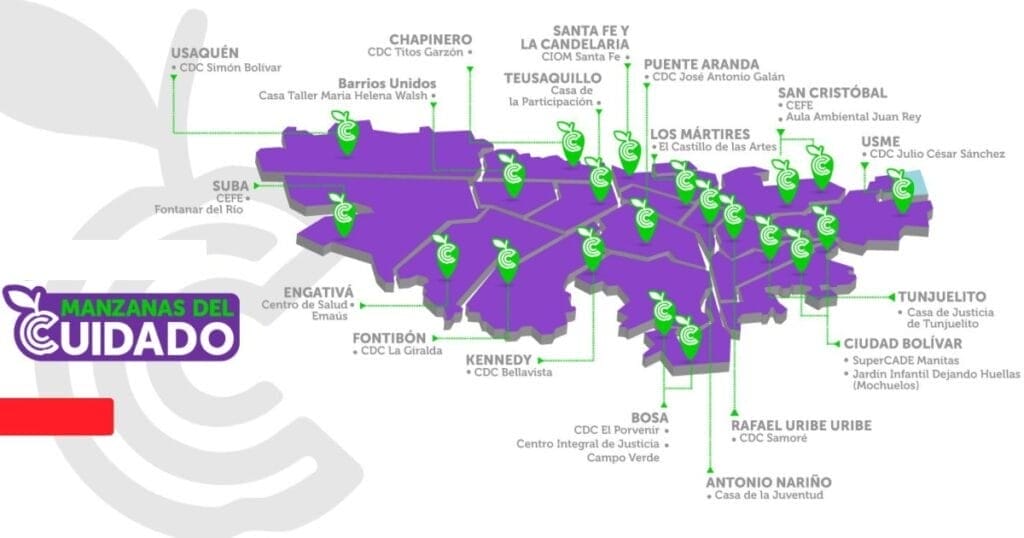
In 2020, Bogotá began to build a network of neighborhood Care Blocks (Manzanas del Cuidado). These facilities provide an array of services for nearby caregivers, most of whom are women, including access to free, professional care for their dependents—children, ailing elders, relatives with disabilities—and opportunities to take part in education, counseling, training, or wellness programs. While they are intentionally located in walkable areas, the city has also provided Care Buses for those who live farther away.
The Manitas Care Block in Ciudad Bolívar opened in 2020, the first of more than 20 new facilities in the city designed to provide services for caregivers. Credit: LLANOFOTOGRAFIA (www.llanofotografia.com).
The underlying idea, initially conceived by Diana Rodríguez Franco, the city’s former secretary for women’s affairs, was to offer much needed relief, respect, and opportunity for the caregivers whose invisible labor keeps the rest of the city running.
Thirty percent of women in Bogotá, 1.2 million people, are full-time caregivers who average 10 hours a day of unpaid labor. Most live in poverty and haven’t had a chance to pursue an education beyond primary school or start a career, denying them the opportunity for economic autonomy.
“That, in Bogotá, seems normal, because of religion, machismo, cultural norms,” López says. “It’s so ingrained in society that this overburden is normal. So [we are] saying, ‘That’s not normal. That is not ethically normal, it’s not socially normal, it cannot be economically normal—it’s actually counterproductive for society that we lose 52 percent of the labor force. So we’re going to change that.’”
Colombia had passed a first-of-its-kind law in 2010 requiring the government to track the economic value of unpaid care work, finding that the care economy represents 20 percent of the nation’s gross domestic product. A later Oxfam study estimated that, if women received even minimum wage for unpaid care work globally, it would amount to $10.8 trillion a year. “We are the basic economic sector that allows all the other economic sectors to function,” López says.
The crisis of the pandemic quickly brought even greater attention to the importance of caregivers, as offices and other formal workplaces shut down, the city’s informal economy ground to a halt, and children stayed home for remote learning. “We went from 900 or 1,000 full-time caregivers to 1.2 million full-time caregivers in four months,” says María-Mercedes Jaramillo, former secretary of planning for Bogotá and a 2024 Loeb Fellow at the Harvard University Graduate School of Design. “So this issue became very tangible.”
Planning and implementing a citywide caregiver support system without an existing model to work from—translating an abstract idea into physical reality—wasn’t easy. But López, Jaramillo, and Franco worked to get the entire city government behind the program. “And when the first Care Block actually got functional,” Jaramillo says, “it really changed, in a very concrete way, the lives of the women who were able to go there.”
Care, There, Everywhere
The Manitas Care Block was the first to open, in the fall of 2020, in Ciudad Bolívar—a low-income neighborhood in the hills of south Bogotá. Laura Mullahy, senior program manager at the Lincoln Institute, says she was “extremely impressed” when she visited the facility this spring as part of a Lincoln Institute course on urban finance and land policy.
“We took the TransMiCable gondola to get there,” Mullahy says, referring to the public cable-car system that connects the steep hillside neighborhoods of Ciudad Bolívar to the city’s bus rapid transit network kilometers below. “Passengers get on and off the gondolas on one floor of the building, and downstairs is the area where government services are offered.”
In addition to professionally provided care and recreational programs for children, elders, and people with disabilities, the free services available to caregivers include medical consultations, legal and psychological counseling, fitness and yoga classes, and educational opportunities. There are even certificate programs for caregivers, intended to formally recognize and elevate the role’s societal status and to train more men in the practice.
Bogotá’s network of Care Blocks is designed to be walkable from most neighborhoods, but Care Buses are available for those who live on the outskirts of the city. Credit: City of Bogotá Secretary for Women’s Affairs.
Available services also include “a community laundry, a computer center, and urban agriculture,” Mullahy says. “The menu of educational offerings is expansive; a few examples are flexible classes to earn high school degrees, job-oriented training, and financial education oriented toward purchasing a home.”
Nearly 50,000 people live in close proximity to the Manitas Care Block, including 5,416 female caregivers—but it’s not just women who benefit. The facility also serves the neighborhood’s 3,838 children under five years old, 3,516 elderly residents, and 2,448 people with disabilities.
Mullahy was also impressed by the employees she spoke to. “They were extremely passionate about their work—and in general, there was a palpable sense of pride in the Care Blocks, both from the staff and the community,” she says. “We were told that vandalism of both the Care Blocks and the associated transportation infrastructure is very low because the community values the system so much.”
Indeed, the Care Blocks have proven immensely popular, even among the politicians who campaigned to succeed López as mayor. And because the Care system is written into the POT, the master plan guiding the city’s urban development through 2035, its impact will outlast any one mayoral term.
All Part of the Plan
As of June, 23 Care Blocks were operating throughout Bogotá. More than 400,000 residents have received free services, including more than 800 women who have completed their high school diploma. The POT includes budgeting and specific plans to establish 22 more locations by 2035. “It’s not cosmetic, it’s really structural,” Jaramillo says. “The Care Blocks are not a marginal thing in the land use plan.”
López uses a more domestic metaphor: “It’s not just the cherry on the cake, it’s actually a strong part of the cake,” she says. “The Care Blocks are just one aspect of a new epistemology of the city, where we have been introducing a different perspective: the perspective of the oppressed. Except that the oppressed are the majority—more than 50 percent of the population.”
Embedding a social program into the master planning process “is very innovative—it’s a brand-new model,” says Anaclaudia Rossbach, the Lincoln Institute’s outgoing director of programs for Latin America and the Caribbean (LAC) and soon-to-be executive director of UN-Habitat. “They are on the frontier of master plans—I think it’s something that the Global South can contribute to the Global North and to other areas.”
It also cemented into place a long-absent feminist perspective on development. “The cities that we have were not planned by, with, and for women,” Rossbach notes. “Incorporating the Care Blocks into the master plan means incorporating a strong gender perspective about the use of space, and it institutionalizes this social policy.”
Rossbach sees hope in the way Bogotá has successfully put abstract principles into practice. “It’s easy to say we need to plan cities so that they work better for women. But the how is more difficult,” she says. “With the case of Bogotá and the Care Blocks, we have a very concrete example that can inspire other cities. And it can also inspire cities to understand that they can be creative in their own way—that they can create something totally different.”
Jon Gorey is a staff writer at the Lincoln Institute of Land Policy.
Lead image:
Caption: Former Bogotá Mayor Claudia López, in light purple, celebrates with caregivers who have completed educational programs offered through the city’s Care Blocks. Credit: City of Bogotá Secretary for Women’s Affairs via Instagram.
Lincoln Institute’s Director of Latin America and the Caribbean Anacláudia Rossbach Named Executive Director of UN-Habitat
The Lincoln Institute of Land Policy today announced its director of Latin America and the Caribbean, Anacláudia Rossbach, has been elected by the United Nations General Assembly as executive director of the United Nations Human Settlements Programme (UN-Habitat).
Anacláudia Rossbach is an economist with more than 20 years of experience working on housing issues including informal settlements, land, and urban policy. In her current role, she has bolstered the Latin America and Caribbean program through efforts such as establishing partnerships with educational institutions, creating a new strategic alliance with the Latin American Faculty of Social Sciences (FLACSO) in Ecuador, launching a new Community of Practice (CoP) model of technical assistance in Paraguay, and inaugurating the Lincoln Prize for Journalism on Urban Policy, Sustainable Development, and Climate Change.
“I am deeply honored by this appointment and grateful for the trust placed in me by the UN member states and the UN secretary-general—I am eager to bring my experience to the global stage,” said Anacláudia Rossbach. “In these two years working for the Lincoln Institute, I significantly expanded my knowledge about land policies—ratifying my previous recognition of the centrality of land in overcoming the great challenges we face as humanity. I appreciate the opportunity I had to be ‘at home’ at Lincoln, exchanging knowledge and ideas with my colleagues and the robust network of professionals in Latin America and the Caribbean.”
Prior to joining the Lincoln Institute, Rossbach was the regional manager for Latin America and the Caribbean at Cities Alliance. In that role, she promoted the transfer and exchange of knowledge and provided advisory services on housing and urban policies in the Global South. She was responsible for establishing the Urban Housing Practitioners Hub (UHPH), a network of experts, practitioners, and researchers working in urban development and housing.
Previously, she worked as a senior housing specialist for the World Bank in Brazil and internationally. In that role, she served as a high-level consultant and provided technical assistance to develop and implement Brazilian housing and slum-upgrading policies, including the Growth Acceleration Program for Favelas and the housing subsidies program Minha Casa, Minha Vida (“My House, My Life”).
Throughout her career, Rossbach has also worked on projects including designing one of the world’s most significant municipal-level slum-upgrade programs in São Paulo, Brazil, designing institutional and operational strategies to expand access to adequate housing in Peru with the Inter-American Development Bank, and leading a global program on informality as a response to the COVID-19 pandemic. She holds a bachelor of science in economics and a master of science in political economy from Pontifícia Universidade Católica in Brazil.
“Anacláudia’s impact at the Lincoln Institute over the past two years is palpable, and can be evidenced through advances in research, partnerships, and technical assistance that we have been able to bring to Latin America and the Caribbean focusing on key issues such as fiscal systems, climate change, spatial equity, and land conservation,” said George W. McCarthy, president and CEO of the Lincoln Institute. “We will miss her deeply, but are excited to support her efforts to build inclusive, safe, resilient, and sustainable cities and communities through this new role with UN-Habitat.”
Rossbach succeeds Maimunah Mohd Sharif of Malaysia, executive director of UN-Habitat from January 2018 to January 2024. She will serve a four-year term, and her appointment date will be announced soon.
Image: Courtesy of Anacláudia Rossbach
Nuevas investigaciones sobre políticas de suelo y desarrollo urbano en América Latina
En el marco de la reciente convocatoria de investigación sobre políticas de suelo y desarrollo urbano en América Latina, el Instituto Lincoln de Políticas de Suelo se complace en anunciar los proyectos seleccionados para recibir apoyo financiero. Estas propuestas se destacan por su potencial de generar nuevos conocimientos sobre cómo las políticas de suelo pueden contribuir a la superación de desafíos sistémicos para el desarrollo sostenible en la región, tales como la asequibilidad de la vivienda, la equidad socioespacial, el mejoramiento integral de barrios informales, la autonomía fiscal de los municipios y la adaptación al cambio climático.
Adicionalmente, los proyectos seleccionados resaltan por su alta capacidad de incidir en debates de política pública vigentes en América Latina en temáticas de interés para el Instituto, incluyendo lecciones en la implementación de instrumentos de financiación en base al valor del suelo, políticas para reducir déficits cualitativos y cuantitativos de vivienda, y condiciones propicias para la incorporación de soluciones basadas en la naturaleza para la acción climática.
A continuación, se mencionan los proyectos y equipos de trabajo que reciben una comisión del Instituto Lincoln y que resultarán en informes científicos a presentarse en abril de 2025:
María Mercedes Di Virgilio, Felipe Gonzalez, María Vitoria Boix, Nicolás Ferme y María Victoria Marco, todos integrantes del Centro de Implementación de Políticas Públicas para la Equidad y el Crecimiento (CIPPEC), realizarán una medición de niveles de vivienda vacante y recomendaciones de políticas públicas en las ciudades de Buenos Aires, Córdoba y Rosario, en Argentina.
Ernesto Lopez-Morales, Luis Inostroza, Lien Rodríguez, Nicolás Herrera y Vicente Mosso investigarán aumentos de valor de suelo generados por proyectos de infraestructura azul-verde y la provisión de servicios ecosistémicos en la región de Patagonia, Chile.
Aurora Echavarria y Paavo Monkkonen generarán una base de datos de tasas del impuesto predial aplicadas en más de 200 municipios de México, para evaluarlas contra niveles de progresividad y de cumplimiento en pagos, así como su relación con costos fiscales por exenciones y frecuencia de estimaciones de la base gravable.
Ciro Biderman y Luis Antonio Fantozzi Alvarez evaluarán variaciones en cobros de derechos de edificabilidad y sus impactos en valores de suelo y edificios en São Paulo, Brasil.
Pedro Abramo, Adriana Hurtado, Juan Cabrera, Denisse Brikman, María Mercedes Di Virgilio y Julia Queiroz realizarán un estudio comparativo de procesos de densificación en áreas de origen informal en cinco países—Bolivia, Perú, Colombia, Argentina y Brasil—con el objetivo de identificar modelos de política pública para gestionar los procesos actuales de crecimiento vertical informal.
Daniel Kozak, Demián Rotbart, Hayley Henderson, Mariana Giusti, Rodolfo Aradas y Esteban Otto Thomasz analizarán el costo-beneficio de un sistema urbano de drenaje sostenible, incluyendo su potencial como solución basada en la naturaleza y mecanismo de recuperación de plusvalías, en el municipio de General San Martín, Argentina.
Oscar Eduardo Pérez Moreno, Catalina Hinestroza Gallego, Jean Carlo Figueroa Santamaría y Susana Aguilar Cuartas analizarán los marcos jurídicos e institucionales de instrumentos de recuperación de plusvalías para la financiación de acciones de resiliencia climática, con enfoque en el proyecto “Paisajes de Agua” del municipio Rionegro, Colombia.
Ivo Gasic, Néstor Garza y Clemente Larraín realizarán una estimación de la tasa de variación general del precio del suelo de Santiago de Chile, con el objetivo de ser utilizada en investigaciones sobre estimaciones de plusvalías que genera la inversión pública en esta ciudad.
Fernando Mello Franco, Alexandre Fontenelle-Weber, Giselle Mendonça Abreu, Joyce Reis Ferreira da Silva, Rafael Chasles y Bárbara Frutuoso explorarán la función socioambiental de azoteas en São Paulo, Brasil, generando una tipología en base a morfologías y usos.
Beatriz Toribio, Gastón Gertner, y Guadalupe Dorna, compararán los efectos de obras para control de inundaciones en valores de propiedades en zonas de alto riesgo en la ciudad de Buenos Aires, Argentina.
Luis Felipe Quintanilla es analista de políticas para el Instituto Lincoln de Políticas de Suelo.
Lead image: Casas en Buenos Aires, Argentina. Credit: Gustavo Enrique Cortez via iStock/Getty Images Plus.
Exploring Sustainable Development in Latin America
By Carina Arvizu Machado, May 14, 2024
SHARE
Latin America and the Caribbean (LAC) is the most urbanized region in the developing world, with 81 percent of its population—539 million people—living in cities, according to UN-Habitat. While there are differences in urbanization patterns across the region—for example, countries in Central America are less urbanized, but experiencing one of the fastest urbanization rates in the world, while South America is already home to major cities—poverty and inequality have characterized this growth regionwide, leading to the creation of precarious settlements whose populations face multiple vulnerabilities. These settlements are the result of insufficient access to adequate housing and unjust distribution of wealth and opportunities. The resulting vulnerabilities get reinforced and magnified by external factors such as migration and climate change.
To reflect on and tackle these related challenges, the Lincoln Institute’s Program on Latin America and the Caribbean (LAC) and the Special Program for Urban and Regional Studies (SPURS) at the Massachusetts Institute of Technology (MIT) co-organized a one-day workshop in early 2024. This event was part of an emerging initiative led by the Lincoln Institute and MIT that seeks to foster a call to action and build a regional vision that addresses critical challenges and advocates for systemic change.
Rooted in the experiences of team members from both institutions who have worked on these issues in their respective countries—Lincoln Institute LAC Program Director Anaclaudia Rossbach (Brazil), SPURS fellow Agustina Rodriguez Biasone (Argentina), and SPURS fellow Carina Arvizu Machado (México)—the workshop was designed to bridge the gap between academia and practical experience. It was an opportunity, said SPURS program director Bish Sanyal, to “theorize from practice.”
The workshop explored the multifaceted challenges facing vulnerable territories in Latin America and the Caribbean. One in five individuals in the region (110 million people) live in informal settlements. These areas face conditions of poverty and social exclusion, marked by inadequate housing, poor public services, and limited access to urban infrastructure and green spaces. In addition, the region is particularly vulnerable to climate change and has experienced significant migration flows in the past decades. LAC hosts approximately 3 million migrants from other areas and about 11 million internal migrants. Drawing inspiration from four case studies, the workshop explored innovative and integrated approaches that are paving the way for sustainable development and systemic change.
The workshop brought together over 50 individuals from diverse backgrounds, spanning academia, government, nonprofit organizations, and more, with a slate of speakers that included over 20 experts from Latin America and the Caribbean. Among them were former government ministers, executive directors, and professors from institutions such as Oxfam Mexico, the Harvard University Graduate School of Design, Yale University, The New School, Columbia University, and more.
The real-world cases showcased innovative approaches to addressing urban challenges. From the Neighborhood Integration program in Buenos Aires led by María Migliore (former Buenos Aires minister of Human and Housing Development), to México’s Urban Improvement Program spearheaded by Martha Peña Ordóñez (current head of the planning unit of the Secretariat of Agrarian, Land, and Urban Development, SEDATU), passing by the Utopias project for rehabilitation of public spaces in Iztapalapa, Mexico City, implemented by Raúl Basulto (current head of Urban Development of Iztapalapa), and the Manzanas del Cuidado, or care blocks, championed by Maria-Mercedes Jaramillo (former Bogotá secretary of Planning). After participating in discussions about the challenges in the region and exploring the four case studies, attendees imagined and discussed integrated strategies for effective solutions. Participants engaged in lively debates, shared best practices, and explored ways to leverage interdisciplinary approaches for positive impact.
Basketball court at Utopía Aculco, a fitness facility, cultural venue, and social services center in Iztapalapa, Mexico. Credit: Government of Mexico City.
Participants also explored the relationships among interventions in informal settlements, city planning, and the broader urban system, reimagining the relationship between nature and cities. Rethinking planning scales and alternative territorial governance, such as through elements like water supply and management, was at the forefront of the discussions, especially on the panel about climate change, moderated by Amy Cotter, director of climate strategies at the Lincoln Institute. Looking back to move forward, the panelists and participants drew inspiration from the historical constitution of cities through migration, and past interventions in informal settlements.
The resounding commitment echoed among participants was a determination to forge a more equitable and sustainable future for urban communities in Latin America and the Caribbean. As Enrique Silva, chief program officer at the Lincoln Institute, mentioned, this workshop was a great opportunity to build upon similar events in the past, such as the 2018 symposium “Slums: New Visions for an Enduring Global Phenomenon,” held at the Harvard Graduate School of Design, and consolidate a more robust community of practice. The group agreed to continue this journey together, building bridges and creating lasting impact for the vulnerable territories of the region, forging new paths toward systemic change.
Key themes for future discussion based on the reflections at the workshop include:
Exploring further the links and interdependencies of informality and informal settlements with migration, climate change and inequality, and the implications and complication of political polarization in the region.
Connecting interventions in informal settlements to city planning, and the broader urban system.
Reimagining the relationship between nature and cities, considering and integrating indigenous communities and their concepts and practices.
Rethinking the scales of planning and alternative territorialities of governances, through alternative elements such as water.
Looking back to better move forward, including looking at indigenous knowledge, how migration has affected the growth and development of cities, and previous interventions around informal settlements.
This initiative was made possible thanks in part to a grant from MIT’s Office of Experiential Learning.
Carina Arvizu Machado is a 2024 SPURS fellow at MIT and former Cities Director for Mexico and Colombia at the World Resources Institute, Mexico. She is the former national deputy secretary of Urban Development and Housing for Mexico, sustainable urban mobility consultant for the Inter-American Development Bank, and chief of urban projects for Mexico City.
Lead image: Utopía Aculco, part of the Utopía series of 12 parks and public cultural and sports facilities in Mexico City’s Iztapalapa neighborhood. The name doubles as an acronym for Unidades de Transformación y Organización Para la Inclusión y la Armonía Social (Units of Transformation and Organization for Inclusion and Social Harmony). Credit: Government of Mexico City.