Mike Johnston, a onetime high school English teacher, became the 46th mayor of Denver in 2023. He took the helm during a period of significant growth in one of the Intermountain West’s most prominent cities, and has been managing the growing pains that come along with that popularity—including high housing costs, homelessness, and municipal budget woes.
The road to the mayor’s office included teaching English in the Mississippi Delta, leading three different schools in the Denver Metro area as principal, and serving two terms in the Colorado State Senate. The Colorado native was also a senior education advisor to President Obama and CEO of Gary Community Ventures, a local philanthropic organization with a focus on education and housing.
Johnston, 50, was part of the Lincoln Institute’s mayors panel at the American Planning Association’s National Planning Conference in Denver in spring 2025, along with Boulder Mayor Aaron Brockett and Fort Collins Mayor Jeni Arndt. Senior Fellow Anthony Flint caught up with him several weeks later for this interview; their full conversation is available as a Land Matters podcast.
Anthony Flint: Like a lot of booming metropolitan regions, Denver is facing a housing affordability problem. What are the key elements for addressing this crisis?
Mike Johnston: We have folks from all over the country and all over the world who want to move to Denver. And that is a great problem to have. I have friends who are mayors in cities facing very different challenges, with declining populations and lots of vacant buildings. Denver is now, I think, the number two destination for people under age 30 in the United States. That’s driving a lot of economic growth. It also drives lots of housing demand.
We have to add a lot more housing supply, and we think there are three ways to do that. One is to make it faster to build housing. That means an aggressive strategy to make our permitting process take 180 days instead of two to three years. The second is reducing the costs of building. We’re doing more to provide tax abatements and tax programs. We launched a middle-class housing strategy [that provides] property tax abatements for up to 10 years in exchange for a 30-year commitment on deed-restricted affordability for middle-class Denverites. And then, of course, we are investing more in affordable housing. We know the city can’t solve this alone, and the market can’t solve it alone. We have to be aggressive about bringing on a lot more housing, a lot more quickly and a lot more affordably.
The Denver metro region added more than 80,000 residents between 2020 and 2024, leading to higher housing costs. Credit: Pgiam via iStock/Getty Images Plus.
AF: Your campaign to address homeless encampments in Denver triggered a bit of backlash, including some criticism of the expense. Can you explain your approach, and how it might apply to other cities? And is there anything you would do differently?
MJ: When cities have high housing costs, more people can’t afford to pay. That is just a mathematical fact. That means many of the cities that are growing and in high demand, like Denver, San Francisco, Austin, or Seattle, are the places where we see this struggle. But this problem can be solved by addressing core needs. We set an ambitious goal to try to end street homelessness in my first term. Four years. That seems impossible. Well, we’re two years in now, and we have reduced our street homelessness in Denver by 45 percent. That is … the largest reduction of street homelessness in any city in American history over two years, and we’re very proud. But it’s also a clear sign that we’re halfway through the term and [only] halfway to our goal. We think other cities should be ambitious. And believing that this is a solvable problem, let me talk about the way we’ve done this, which we think is also scalable.
First, we’ve focused on bringing on transitional housing units, which are dignified, individual private units. A lot of these are hotels we’ve bought and converted. They’re tiny home villages that we’ve built. It’s not like a shelter, [where you’re] sleeping on a gym floor with 100 people on a mat. It is a place where you have a locked door, privacy, and access to showers and bathrooms and kitchens. You can store your stuff when you go to work for the day.
And we brought on wraparound services on each of these sites, like mental health support, workforce training, and long-term housing navigation. And once we brought those units on, we went to the encampments in Denver, and instead of sweeping those encampments from block to block, which causes them to just show up in front of someone else’s house or church or hospital, we would actually move all 50 people or 100 people into housing, then keep that block or region of the city permanently closed to future camping. Two years in, we’ve now closed every encampment in the city. We haven’t had a single tent in our downtown business district for more than a year and a half, and we have cut family homelessness by 83 percent. We’ve become the largest city ever to end street homelessness for veterans. We think it can work for other cities, and we’ll share these lessons with anyone who’s willing to take them on, because we think we should set the expectation in every American city that street homelessness can be a solvable problem.
AF: Turning to transportation: Are you satisfied with the number of people using the light rail network in Denver Metro, and the number of people living in transit-oriented development? Any lessons learned from the relatively light ridership on the free bus on the 16th Street Transit Mall, which is finally concluding its renovation after long delays?
MJ: We’re not satisfied yet, because transit and housing have to be connected strategies. Housing is a transit strategy. So we had this great transit network built. We did not have density of housing around any of those spots. Now we’re undertaking a series of large catalytic investments on our light rail lines so we can build thousands of units of housing along that corridor. We just acquired the largest piece of private property in city history to turn into a 155-acre public park. It is right next to a light rail stop, so we can now add housing density all around that site—beautiful location, and people can get on the light rail and get right to downtown or to a Broncos game or anything else.
We’re building a new women’s soccer stadium also, at a transit-oriented development site … we’re rebuilding in a historically Latino part of North Denver, and that’ll allow us to add about 60 acres of new housing, public spaces, and commercial activation, also all on public transit. So our belief is, you have to actually be deliberate about building real density around your public transit, as much as you want to build your public transit around well-traveled lines of travel.
Part of that is our downtown strategy. You mentioned our 16th Street bus, [which is] free downtown. We’re making the largest investment in our downtown of any city in the country, per capita …. We’re going to add about 4,000 units of housing in our city center, using funds from our downtown Denver authority, because we know that means more people will use that bus every day to get to and from work or to go to see friends. We’re working on filling about 7 million square feet of vacant office space [with residential conversions and recruiting businesses to come downtown] …. We want to make it easy to get downtown and around downtown.
The 16th Street bus in downtown Denver in 2024. Credit: Elena Treshcheva via iStock Editorial/Getty Images Plus.
AF: Given the current municipal fiscal challenges, what is your thinking about alternative financing systems such as a land value tax or value capture, as seen in the 38th and Blake Incentive Overlay?
MJ: We are interested in every incentive we can find to encourage folks to build more housing. The 38th and Blake Incentive Overlay was really kind of a density bonus, where we allow folks to build higher buildings than what the zoning might allow in exchange for adding more affordable housing. And we are always looking at ways to incentivize folks to add more affordable housing, as I mentioned with our property tax abatement.
We’re also looking at partnership on public land. We’re looking at working with city-owned land, working with Denver public schools that have land, and our regional transit system, if they have land. We’re always looking to contribute public land to incentivize more affordability. We want to do all of the above strategies, but wherever we can add more housing without investing more dollars—that’s a big help.
AF: How would you assess the progress of your climate action plans? Do you see a tangible embrace at the local level for addressing climate change, especially in the context of federal retrenchment?
MJ: We don’t see any change in our city’s commitment to climate action or our conviction that this is an existentially important effort. We’re committed to an aggressive vision to meet our climate goals, which for us is a plan to be entirely carbon free by 2040, to have 100 percent renewable energy. And to make sure we’re driving economic growth. We want to do both.
AF: Can local and state government take over this planet-wide issue and really be effective?
MJ: We don’t believe we should give up here or step away. We’re doing a whole public campaign on behavior change …. We want to encourage people to take more local action now, in the face of federal abandonment of this …. We’re building out charging station infrastructure to make it easier for us to convert our fleet to electric and to get more Ubers and Lyfts and FedExes and Amazons to do the same, and to convince regular residents do the same. We’ll keep building the infrastructure to do this. We’ll keep incentivizing people to do it. We’ll keep changing behavior to do it, and we’ll keep setting our own targets for how our vehicles, our businesses, and our residents try to hit aggressive climate goals—knowing that we’re still all in this together, even if the president doesn’t want to make it a priority.
Anthony Flintisa senior fellow at the Lincoln Institute of Land Policy, host of theLand Matters podcast, and a contributing editor ofLand Lines.
Lead image: Denver Mayor Mike Johnston. Credit: Denver Mayor’s Office.
Oportunidades de bolsas para estudantes graduados
2025–2026 Programa de becas para el máster UNED-Instituto Lincoln
El máster está dirigido especialmente a estudiantes de posgrado y otros graduados con interés en políticas urbanas desde una perspectiva jurídica, ambiental y de procesos de participación, así como a funcionarios públicos. Los participantes del programa recibirán el entrenamiento teórico y técnico para liderar la implementación de medidas que permitan la transformación sostenible de las ciudades.
Plazo de matrícula ordinario: del 8 de septiembre al 28 de noviembre de 2025
El inicio del máster es en enero de 2026. La fecha exacta se anunciará antes del 28 de noviembre de 2025.
El Instituto Lincoln otorgará becas que cubrirán parcialmente el costo del máster de los postulantes seleccionados.
Términos de las becas:
Los becarios deben haber obtenido un título de licenciatura de una institución académica o de estudios superiores.
Los fondos de las becas no tienen valor en efectivo y solo cubrirán el 40 % del costo total del programa.
Los becarios deben pagar la primera cuota de la matrícula, que representa el 60 % del costo total del máster.
Los becarios deben mantener una buena posición académica o perderán el beneficio.
El otorgamiento de la beca dependerá de la admisión formal del postulante al máster UNED-Instituto Lincoln.
Si son seleccionados, los becarios recibirán asistencia virtual para realizar el proceso de admisión de la Universidad Nacional de Educación a Distancia (UNED), el cual requiere una solicitud online y una copia del expediente académico o registro de calificaciones de licenciatura y/o posgrado.
Aquellos postulantes que no obtengan la beca parcial del Instituto Lincoln podrán optar a las ayudas que ofrece la UNED, una vez que se hayan matriculado en el máster.
Fecha límite para postular: 10 de octubre de 2025, 23:59 horas de Boston, MA, EUA (UTC-5)
Anuncio de resultados: 22 de octubre 2025
Detalhes
Prazo de inscrição
October 10, 2025 at 11:59 PM
Palavras-chave
Mitigação Climática, Desenvolvimento, Resolução de Conflitos, Gestão Ambiental, zoneamento excludente, Favela, Henry George, Mercados Fundiários Informais, Infraestrutura, Regulação dos Mercados Fundiários, Especulação Fundiário, Uso do Solo, Planejamento de Uso do Solo, Valor da Terra, Tributação Imobiliária, Tributação Base Solo, Governo Local, Mediação, Saúde Fiscal Municipal, Planejamento, Tributação Imobiliária, Finanças Públicas, Políticas Públicas, Regimes Regulatórios, Resiliência, Reutilização do Solo Urbano, Desenvolvimento Urbano, Urbanismo, Recuperação de Mais-Valias
Eventos
National Association for County Community and Economic Development (NACCED) Conference 2025
The National Association for County Community and Economic Development (NACCED) will host its 50th Annual Educational Conference and Training in Mesa, Arizona, September 8–11, 2025. NACCED is a supporting organization of the National Association of Counties (NACo), which focuses on the county community and economic development profession.
The Lincoln Institute and Claremont Lincoln University will host a booth during the conference, where attendees will be able to see publications and resources, learn about scholarship opportunities for new degree and certificate students, and get more information about the Lincoln Vibrant Communities program.
On September 10, Lincoln Institute President and CEO George McCarthy will give the keynote speech for the conference, titled “Reclaiming Land, Rebuilding Trust: Who Owns the Land and Housing in America’s Counties? Should We Care?” In his address, he will highlight the shift in land and housing ownership happening across the US and will introduce Who Owns America—an innovative tool tracking landownership at the parcel level.
In Denver, Mike Johnston Confronts Success: The City’s Popularity Has Made It Pricey
July 9, 2025
SHARE
Listen on:
Denver Mayor Mike Johnston speaks with people at a homeless encampment. Johnston has made ending homelessness a goal of his administration. Credit: Denver Mayor's Office.
Mike Johnston, a one-time high school English teacher, has been overseeing a significant boom in one of the most prominent cities in the Intermountain West. Denver has been attracting people and businesses with its temperate climate and outdoorsy quality of life, but this popularity has also caused growing pains, starting with increasingly high housing costs, homelessness, and recently some significant municipal budget woes.
Johnston has tackled the challenges one by one, beginning with a permitting process overhaul, steps to reduce costs in building, and tax abatements and other incentives, like a density bonus, to encourage more construction.
“We have a lot of people that want to move to Denver. That’s driving a lot of economic growth. We’re thrilled about it. It also drives lots of housing demand,” Johnston said in an interview for the Mayor’s Desk series, recorded on the Land Matters podcast. “The overarching theme is, we have to add a lot more housing supply.”
In the wide-ranging interview, Johnston also reflected on his aggressive campaign to clear out homeless encampments in the city. As part of this effort, officials have provided customized relocations to private transitional housing units with services and support for the unhoused.
“When you have high cost of housing cities, you get more people who can’t afford to pay that cost. That is just a mathematical fact. And so that means many of the cities that are growing and are in high demand, like the Denvers, or the San Franciscos, or the Austins, or Seattles, are the places where we see this struggle.”
The strategy of individualized housing solutions, while expensive, has been working, he said. “We think it can work for other cities, and we’ll share these lessons with anyone who’s willing to take them on, because we think we should set the expectation in every American city that street homelessness can be a solvable problem.”
He also expressed confidence that the state and the metropolitan region will have continued success fighting climate change, as federal policy backs away from addressing that global crisis. He said incentives for electrification, electric vehicle infrastructure, and energy-efficiency upgrades like heat pumps are contributing to the city’s goal of being carbon neutral by 2040.
“We don’t want to make it too expensive to do business in Denver, and yet we still want to be aggressively committed to hitting climate goals,” he said. “People do care. And there’s a lot we can do,” such as encouraging residents to take more trips by bike or walking, or to consolidate trips made in single occupancy vehicles.
“We want to encourage people to take more local action now, in the face of federal abandonment of [climate action] … we’ll keep setting our own targets for how our vehicles, our businesses, and our residents try to hit aggressive climate goals, knowing that we’re still all in this together, even if the President doesn’t want to make it a priority.”
Being mayor is the latest step in a professional journey that began with teaching English in the Mississippi Delta. From there, Johnston returned to Colorado to become a school principal, leading three different schools in the Denver Metro area. In 2009 he was elected to the Colorado State Senate, where he served two terms representing Northeast Denver. He was also a senior education advisor to President Obama and CEO of Gary Community Ventures, a philanthropic organization, where he led coalitions to pass the state’s first plan for universal preschool and spearheaded efforts to fund affordable housing and address homelessness statewide. He lives in East Denver with his wife Courtney, who is a chief deputy district attorney, and their three children.
Johnston, 50, was part of the Lincoln Institute mayor’s panel at the American Planning Association’s National Planning Conference in Denver this spring, along with Aaron Brockett and Jeni Arndt, mayors of the Colorado cities of Boulder and Fort Collins, respectively. Senior Fellow Anthony Flint caught up with him several weeks later for this interview, which will also be available in print and online in Land Lines magazine.
Anthony Flint is a senior fellow at the Lincoln Institute of Land Policy, host of the Land Matters podcast, and a contributing editor of Land Lines.
Transcript
Anthony Flint: Welcome back to land matters, the podcast of the Lincoln Institute of Land Policy. I’m your host, Anthony Flint. On this show, we’re continuing our Mayor’s Desk series –- our Q&A’s with municipal chief executives from around the world — with Denver Mayor Mike Johnston, who was inaugurated as the 46th mayor of that city pretty much 2 years ago this summer in July 2023. It’s fair to say he’s been overseeing a significant boom in one of the most prominent cities in the Intermountain West, which has been attracting people and business with its temperate climate and outdoorsy quality of life. Yet Denver has had its growing pains, too, with increasingly high housing costs. We see modest bungalows in several neighborhoods in Denver, easily selling for a million dollars or more … a not-unrelated homelessness problem, and recently some significant municipal budget woes.
Mayor Johnson started his career as a high school English teacher in the Mississippi Delta, and returned home to Colorado to become a school principal, leading 3 different schools in the Denver Metro area. He later served as a senior education advisor to President Obama. In 2009 he was elected to the Colorado State Senate, where he served 2 terms representing Northeast Denver, working on issues, including immigration, gun safety and the clean energy transition. He later served as the CEO of Gary Community Ventures, a local philanthropic organization where he led coalitions to pass the State’s 1st plan for universal preschool and spearheaded efforts to fund affordable housing and address homelessness statewide. Mayor Johnston grew up in Colorado, speaks Spanish and lives in East Denver with his wife Courtney, who is a chief deputy district attorney and their 3 kids. Your honor, thank you for joining the conversation at Land Matters, and being part of the Mayor’s Desk series.
Mayor Mike Johnston: I’m delighted to be on. Thank you so much for having me.
Anthony Flint: Well, as I mentioned in the intro, like a lot of booming metropolitan regions, Denver is facing down a housing affordability problem. So, first question, what are the key elements for addressing this crisis?
Mayor Mike Johnston: You bet, Anthony, and again thank you for having me, and I think the opening frame for me which you mentioned … My dad used to say, the only thing worse than being hated is being loved, you know, and what we know for Denver is, we do have folks from all over the country and all over the world who want to move to Denver. And that is a great problem to have. I have friends who are mayors and cities facing very different challenges, which is declining populations and lots of vacant buildings, because people don’t want to move there. Denver is now, I think, the number 2 desired destination for people under age 30 in the United States. And so we have a lot of people that want to move to Denver. That’s driving a lot of economic growth. We’re thrilled about it. It also drives lots of housing demand.
So for us there are three big top priorities here. The overarching theme is, we have to add a lot more housing supply, as you know, but we think there are three ways to do that. One is to make it faster to build housing for us. That means an aggressive strategy on permitting reform to make our permitting system go from what was a two and a half to three-year process to now, what will be a commitment from us to have every permit only take 180 days of time in the city’s hands. We created a new citywide permitting office that unifies all of the functions of permitting that were spread across seven departments, now into one director, who reports directly to me so part of that is making it easier to build in Denver.
The second is reducing the costs of building wherever we can. And so we’re doing that, obviously making the process faster. Reduce the cost. But also we’re doing more to provide our own tax abatements and our own tax programs. We launched a middle class housing strategy this week. That’s focused on providing property tax abatements for up to 10 years in exchange for a 30 year, commitment on deed, restricted affordability for people that are middle class Denverites who need to be able to afford to live in the city. So we think those incentives matter. And then, of course, we are investing more in affordable housing. We know that the city can’t solve this alone, and the market can’t solve it alone. We need a partnership where we will invest city resources into projects where we can be hopefully a smaller and smaller part of the capital stack. But just enough of the stack to be able to buy long-term affordability in the form of deed restrictions. And so for us, it’s making the city build faster. It’s making costs cheaper. And it’s making more public investment with really clear public goals. We’ve set a clear public goal to bring on 3,000 affordable units every year, and provide access for 3,000 households to affordable units every year. That’s about twice the rate what the city was bringing on before we got into office. And so we know we have to be really aggressive about bringing on a lot more housing, a lot more quickly and a lot more affordably.
Anthony Flint: Your campaign to address homeless encampments in Denver triggered a little bit of backlash, including some criticism of the expense. Can you explain your approach, and how it might apply to other cities? And is there anything you would do differently?
Mayor Mike Johnston: Yeah, I think this is one that we are really excited about, because I think many Americans have given into the belief that homelessness is an unsolvable problem that we are just stuck with this as a component of modern life. And, as you said accurately, Anthony, what we know is homelessness exists in the greatest acuity in cities, not because there’s high rates of poverty, not because there’s high rates of unemployment, not because of the political ideology of those cities. It exists in direct correlation to the cost of housing. In those cities. When you have high cost of housing cities, you get more people who can’t afford to pay that cost. That is just a mathematical fact. And so that means many of the cities that are growing and are in high demand, like the Denver’s, or the San Francisco’s, or the Austins, or Seattle’s, are the places where we see this struggle. But what we have really seen is that this is a problem that can be solved by addressing those core needs. And so I’ll lead with the headline that … we set an ambitious goal to try to end street homelessness in my 1st term. Four years. That seems impossible. Well, I’ll tell you, we’re two years in right now, and we have now reduced our street homelessness in Denver by 45% in a little less than two years. That is … the largest reduction of street homelessness in any city in American history, over two years, of which we’re very proud. But it’s also a clear sign that halfway through the term. We’re halfway on the path of that goal. We think other cities should be ambitious. And believing that this is a solvable problem, let me talk about the way we’ve done this, which we think is also really scalable.
What we’ve done is first really focused on bringing on what we call transitional housing units which are dignified, individual private units. A lot of these are hotels we’ve bought and converted. They’re tiny home villages that we’ve built. But critically, it’s not shelter like sleeping on a gym floor with 100 people on a mat. It is a place where you have a locked door. You have privacy, you have access to showers and bathrooms and kitchens. You can store your stuff when you go to work for the day.
And we brought on wraparound services on each of these sites. So our first big effort was to bring on 1,000 units of transitional housing, you know, like many cities, previous Administration fought this battle, and took 2 or 3 years to fight, to put one tiny home village of about 40 units into one neighborhood with a number of lawsuits. We said, we have to bring on units at the scale of the problems. We brought on a thousand units, and (over) six months I did 60 town halls all across the city, talking to neighbors and all of those locations about why this would make such a big difference. We put wraparound services — mental health addiction, support, workforce training, long-term housing navigation — on each of those sites. So people don’t have to always return just to downtown to get those services. And once we brought those units on, then we went geographically to the places where encampments existed in Denver, and instead of sweeping those encampments from block to block, where they just show up in front of someone else’s house or someone else’s church or hospital, we would actually go to those encampments and resolve them. We would close that encampment entirely by moving all 50 people or 100 people. In one case we had almost 200 people in one encampment, closing those encampments, resolving them, moving all those folks into housing, and then importantly keeping that block or that region of the city permanently closed to future camping. So the result is, two years in, we’ve now closed every encampment in the city. We haven’t had a single tent inside of our downtown business district for more than a year and a half we have cut family homelessness by 83%. We’ve become the largest city ever to end street homelessness for veterans. We have no veterans anymore on the streets who can’t get access to housing, and, importantly, anyone can walk down any street or sidewalk or public park, and none of them have tents or encampments in them, so we’ve both made sure there’s a real change in the experience for residents of Denver and those people who are most at risk of starving to death, freezing to death, overdosing on the streets … we moved off of the streets into transitional housing that has really worked for us. We think it can work for other cities, and we’ll share these lessons with anyone who’s willing to take them on, because we think we should set the expectation in every American city that street homelessness can be a solvable problem.
Anthony Flint: Are you satisfied with the number of people using this very impressive and extensive light rail network in Denver Metro, and the number of people living essentially in transit oriented development? Or is the system facing growing pains, and if so, why? A related question … any lessons learned from the relatively light ridership on the free bus on the 16th Street Transit Mall, which is finally concluding its renovation after long delays? But first the light rail network, transit-oriented development … How is it going.
Mayor Mike Johnston: As you, said, Anthony, we’re not satisfied yet, and that is because, as you know, transit and housing have to be connected strategies. Housing is a transit strategy. If you’re mindful about actually building housing and building density of housing around our public transit networks. And so we had this great transit network built. We did not have density of housing around any of those spots. And so what we’re doing now is undertaking a series of very large catalytic investments in a number of areas around the city that are on these light rail lines. So we can build thousands and thousands of units of housing along that corridor. We just, for instance, acquired the largest piece of private property in city history to turn into a public park. It will be a 155-acre park. It is right next to a light rail stop, so we can now add housing and housing density all around that site — beautiful location, and people can get on light rail and get right to downtown or do a Broncos game or anything else. We just won a franchise expansion, the one franchise expansion for the National Women’s Soccer League, and so we’ll have a new women’s soccer franchise. We’re building a new women’s soccer stadium also at a TOD site that we’ll have on that campus … a lot of dense housing commercial activities also connected to public transit. We’re rebuilding our stock show in a historically Latino part of North Denver — Globeville, Elyria, Swansea — that’ll allow us to add about 60 acres of new housing, public spaces, commercial activation also all on public transit. So our belief is, you have to actually be deliberate about building real density around your public transit as much as you want to build your public transit around well traveled lines of travel in the city. And so that’s a big part of our strategy. When we add that density, we know most of the major cities like ours that aren’t yet a New York, or a DC, with a full functioning subway line. You can’t just throw in that infrastructure and hope the city accommodates because people have lots of places to go to. You have to build nodes of real density around the city. So even though you might have 3 or 4 different jobs over the next 10 years, those jobs can be concentrated among different regions, and your housing can, and your activities can (as well). So that’s our big strategy around that. And you’ll see us make historic investments in doing that in the next couple of years.
But a part of that is downtown, is our downtown strategy. And you mentioned our 16th Street bus that we have, that’s free downtown. We’re making the largest investment in our downtown, also of any city in the country, per capita. Right now, about $600 million through a tax increment financing system that will focus on one getting more people to live downtown. We want downtown to be a neighborhood, not just a business district. And so we’re going to add about 4,000 units of housing in our city center, using these funds that we have from our downtown Denver authority, because we know that means more people that will use that bus every day that we’ll get to and from work they will go to see friends. So that’s a big part of our strategy. We’re working on filling up about 7 million square feet of vacant office space — like many cities, have about 4 million of that, we will use with residential conversion. We think one of the most ambitious residential conversion plans in the country. The other 3 million we’ll use by bringing people back to the office, recruiting businesses to come downtown, stay downtown, we think the more we activate that location the more folks will use the public transit, and the more people can use the connected public transit of coming from a neighborhood in East Denver or North Denver, take the light rail down to downtown, use the 16th Street ride to get up and down 16th Street … we have the second largest theater complex in the country off of Broadway. We have 5 professional sports franchises in our city center. We have Michelin Star restaurants. We’ll have the Sundance film festival coming to Colorado. There’s so much to be attracted to seeing. We want to make it easy to get to downtown and around downtown, and this will do that.
Anthony Flint: Given the current municipal fiscal challenges in Denver, what is your thinking about alternative financing systems such as a land value tax or value capture, as seen in the 38th & Blake incentive overlay? I’m hoping you might explain the concept as you see it and how or whether its rationale makes sense to you.
Mayor Mike Johnston: We are interested in every incentive we can find to encourage folks to build more housing. The 38th and Blake overlay was really kind of a density bonus, where we allow folks to build higher buildings than what the zoning might allow in exchange for adding more affordable housing, and we are always looking at ways to incentivize folks to add more affordable housing. So we’re delighted to do that. I think that also links to the program I described briefly which is our our middle class housing program we launched yesterday, which is also focused on a property tax abatement. We’ll offer up to 10 years of property tax abatement for people that are going to build middle class affordable housing. So think about that as people making sixty to a hundred thousand a year as an individual … and that’s about a 10 year property tax abatement for a 30-year commitment of affordability. So that’s a great deal for us. We’re also looking at partnership on places where we have public land. We’re looking at working with city-owned land, working with Denver public schools where they have land, our regional transit system, if they have land. And so we’re always looking to contribute public land as a way to incentivize more affordability. But we want to do a all of the above strategy. But wherever we can add more housing without having to invest more dollars in these fiscal times that’s a big help
[Re-stated] Our belief is we want to do an all of the above strategy on every way we can incentivize people to build more affordable housing. So for us, that means we want to use city land. Whenever we can do that, we’ll use public land to be able to incentivize a deal. We’ll partner with other public agencies like the Denver public schools, or like the regional transit system or the State. That’s always a great way for us to incentivize. And that’s why we’ve used strategies like this middle class housing program we launched, which is a property tax abatement where folks can get 10 years of property tax abatement for a 30 year, commitment of deed, restricted affordability through a special limited partnership. So we’re going to use every strategy we have, particularly in tough economic times, and you don’t have big new dollars to invest in supporting affordable housing. We have to find other creative ways and density. Bonuses are a great way, and we’ll keep doing that as well as everything else we can.
Anthony Flint: Finally, how would you assess the progress of your climate action plans which I see includes incentives for electrification, electric vehicle infrastructure, hot and cold weather heat pumps, energy efficiency … Do you see a tangible embrace at the local level for addressing climate change, especially in the context of retrenchment at the federal level. I mean, just as a practical matter, the federal government is getting out of the climate business. So can cities and states take that over and be effective?
Mayor Mike Johnston: We don’t see any change at all in our city’s commitment to climate action or our conviction that this is a still existentially important effort for us to undertake. And so we are not slowing down at all. We’re not changing our path, and what we are doing is trying to make sure we’re committed to an aggressive vision to meet our climate goals, which for us is a 2040 plan to be entirely carbon free by 2040, to have 100% renewable energy. And also to make sure we’re driving economic growth. We want to do both. And so we don’t want to make it too expensive to do business in Denver, and yet we still want to be aggressively committed to hitting climate goals. And we’re doing that. We’ve done things like we had, I think, one of the nation-leading efforts on making our commercial buildings more energy efficient through a program we have called Energize Denver. We also had concerns from the business community about how to comply with the cost to make those adjustments to buildings. And so we spent a lot of time with our landowners and building owners and business leaders, and we revised that plan to both decrease the penalties, extend the amount of time folks can comply, put a cap on the overall amount of changes they have to make, which drops the cost dramatically for our business partners, but still keeps us on path to hit aggressive 2040 climate goals. So people do care. And there’s a lot we can do. There’s behavior change. We’re doing a whole campaign on behavior change, to encourage folks to take more trips by bike or walking … Can they consolidate or condense the number of single occupancy vehicle trips that they take. And so part of it is about awareness. Part of it’s about behavior change and part of it’s about a good policy on things like banning plastic bags. Obviously, and being able to incentivize more and more solar and wind. So we think this is purely a part of Denver’s brand. We want to be able to be a great city and a good city. We want to be able to have a great economy, and also have great connection to the natural environment of the outdoors. And so for us, it’s it’s good climate and good business, and we’ll continue to do both.
Anthony Flint: And local and state government taking this over, are you optimistic about that? The question is, can they really take this over, a planet-wide issue, and really be effective.
Mayor Mike Johnston: I think we don’t believe that we should give up here or step away. Our campaign, we call, do more or do less, but do something, whether it’s going to do more in the way of recycling, or less in the way of using a single occupancy vehicle or doing something in terms of being able to make decisions about where and how you use energy. We want to encourage people to take more local action now, in the face of federal abandonment of this. The things that we’ll need help on are the things that made a big difference. The federal tax credits on electrical vehicle purchases — those are big drivers of behavior change. I sponsored when I was in the Senate a state credit that does the same thing — provide incentives, tax incentives for electric vehicle purchases. Here we’re building out aggressively, charging station infrastructure to make it easier for us to convert our fleet vehicles to be electric to get more Ubers and Lyfts and Fedexes and Amazons and UPS (vehicles) to do the same. And to convince regular residents do the same. So we’ll keep building the infrastructure to do this. We’ll keep incentivizing people to do it. We’ll keep changing behavior to do it, and we’ll keep setting our own targets for how our vehicles, our businesses, and our residents try to hit aggressive climate goals, knowing that we’re still all in this together, even if the President doesn’t want to make it a priority.
Anthony Flint: Mike Johnston, Mayor of Denver, Colorado. Thank you once again for this conversation.
Mayor Mike Johnston: Thanks so much for having me, Anthony. It’s great to meet you.
Anthony Flint: You can learn more about all the issues we covered — strategies for affordable housing, sustainable urbanism, transit-oriented development, value capture, and of course, the challenge of climate change, pursuing both mitigation and resilience — all of that and more at the Lincoln Institute website, www.lincolninst.edu. While you’re there, scroll to the bottom and join our mailing list to get periodic updates on our work. And also on social media, the handle is @landpolicy. Finally, don’t forget to rate, share and subscribe to the Land Matters podcast. For now, I’m Anthony Flint, signing off until next time.
El dia después de que el huracán Katrina tocara tierra en la costa del golfo en agosto de 2005, Jessica Dandridge-Smith cumplió 16 años. Pero, en lugar de celebrar su cumpleaños en su casa, ella y su familia habían evacuado Nueva Orleans con lo que quedaba de sus posesiones en una sola maleta. Cuando pudo regresar a la ciudad, el sufrimiento que vio, de manera desproporcionada en los vecindarios negros y acompañado por una lenta respuesta de ayuda federal, la enojó. El dolor y el daño fueron obra de una tormenta violenta, sí, pero notó que Katrina había encontrado un cómplice despiadado en siglos de racismo estructural y fracasos políticos.
Así comenzó una carrera de dos décadas en organización y defensa de la comunidad. Durante los últimos cinco años, como directora ejecutiva de Water Collaborative of Greater New Orleans, Dandridge-Smith ha estado trabajando para “convertir el agua en un derecho humano” en el sureste de Luisiana, dice. Eso implica hacer valer la opinión de la comunidad en busca de cambios sistémicos y sostenibles en torno a los problemas del agua, desde soluciones de aguas pluviales y de reducción de riesgo de inundaciones basadas en la naturaleza hasta garantizar el acceso al agua y su capacidad de pago. Dice que una de las preguntas que guían su trabajo es: “¿Cómo sería convertir las perspectivas de la comunidad en políticas?”.
Su dedicación a responder esa pregunta llevó a Dandridge-Smith a Cambridge la primavera pasada, donde el Instituto Lincoln de Políticas de Suelo y la Universidad de Massachusetts Amherst celebraron una reunión sobre migración climática. Alrededor de dos docenas de personas de todos los rincones de los Estados Unidos asistieron al evento en representación de instituciones académicas y de investigación, organizaciones sin fines de lucro, gobiernos municipales, empresas de servicios públicos y agencias de planificación regional, entre otras organizaciones.
Durante su tiempo juntos, compartieron conocimientos vividos y aprendidos y perspectivas únicas de sus comunidades. Y hablaron sobre cómo planificar y prepararse para lo inevitable: a medida que se intensifican los impactos del cambio climático, lo que hace que la vida se vuelva incómoda o intolerable en lugares más propensos a la sequía, los incendios forestales o las inundaciones, las personas se reubicarán en lugares cada vez más seguros. Estos movimientos pueden ocurrir de manera lenta, con previsión, si se cuenta con los medios; o de forma abrupta, por necesidad, frente al desastre. Y pueden llevar a las personas a cualquier lugar cercano por carretera o a lugares que se han promocionado como “paraísos climáticos”, como la región de los Grandes Lagos o el norte de Nueva Inglaterra.
Algunos de los asistentes, como Dandridge-Smith, provenían de áreas propensas a desastres. Otros viven en comunidades receptoras, lugares que anticipan una afluencia de recién llegados desplazados por el cambio climático. “Hemos tenido un crecimiento demográfico estancado en el condado durante años y años”, dice Mike Foley, quien dirige Cuyahoga Green Energy en Ohio, una empresa de servicios públicos propiedad del condado encargada de crear microrredes de electricidad renovable. Foley señala que Cleveland tenía tres veces más residentes hace solo 60 años. “Así que, en teoría, podemos ser una comunidad receptora”.
Sin embargo, durante los dos días en los que transcurrió el evento, surgieron algunos temas recurrentes, como se describe en un documento de trabajo reciente. Una de las conclusiones más sorprendentes que surgió fue muy sombría: no hay tal cosa como un paraíso climático: ningún lugar está completamente protegido del riesgo climático.
A dónde va la gente y por qué
Los asistentes de Vermont, una ciudad conocida como un paraíso climático, relataron cómo el miedo y las inundaciones que enfrentaron durante el huracán Irene en 2011 regresaron poco más de una década después, en julio de 2023, cuando fuertes lluvias inundaron la capital del estado y otras áreas, lo que causó una pérdida de USD 2.200 millones en daños en el norte de Nueva Inglaterra y Nueva York. Se llegó a la misma conclusión el año pasado, cuando el oeste de Carolina del Norte, que durante mucho tiempo fue considerado un paraíso climático con un riesgo bajo de sequía, incendios forestales o aumento del nivel del mar, sufrió inundaciones catastróficas como secuela del huracán Helene. La tormenta y las inundaciones repentinas dejaron al menos 96 muertos en Carolina del Norte y causaron una pérdida de USD 53.000 millones en daños.
Estos eventos dejan claro que ningún lugar puede considerarse inmune al cambio climático, lo que hizo que todas esas tormentas fueran más fuertes y dañinas. Pero con proyecciones que muestran que, para el año 2100, al menos 13 millones de estadounidenses serán desplazados solo por el aumento del nivel del mar, por no hablar de incendios forestales, calor extremo o sequía, se podría decir que algunas áreas presentan riesgos menores o más tolerables que otras. Eso no solo hace referencia a los llamados “paraísos climáticos” que están en la otra punta del país. Estas áreas más tolerables pueden ser vecindarios un poco alejados de la ciudad que son menos susceptibles a las inundaciones o bloques de apartamentos en el centro que están más seguros contra los incendios forestales que los que se encuentran a las afueras de una ciudad.
Los propietarios de viviendas del centro de Vermont que se enfrentan a los daños causados por una inundación se reúnen con el senador estadounidense Peter Welch, a la derecha. El estado, que fue considerado durante mucho tiempo un paraíso climático, se ha visto cada vez más afectado por fenómenos meteorológicos extremos. Crédito: Oficina del Senador Welch.
Entonces, ¿qué pueden hacer las ciudades y las regiones para prepararse para los cambios de población a gran escala inducidos por el clima? Con la convocatoria de este grupo intersectorial y multidisciplinario, que puede haber sido el primero de su tipo dedicado a la movilidad climática, dice Amy Cotter, directora de sostenibilidad urbana en el Instituto Lincoln, se obtuvo información valiosa que puede guiar a los planificadores, funcionarios electos e investigadores que intentan responder esa pregunta. “Sacamos provecho de esa conversación, porque éramos un grupo con perspectivas muy variadas”, dice Cotter, y señala que los participantes compartieron muchas lecciones aprendidas con esfuerzo y participaron en un tipo de intercambio de ideas políticas que ayuda a impulsar tanto estrategias creativas como aquellas que ya han sido probadas en el tiempo.
Una de las primeras ideas que surgió del debate fue que las personas y las comunidades afectadas por la movilidad climática tienen necesidades muy diferentes, según el contexto. Un californiano que acepta un nuevo trabajo en el Medio Oeste después de haber estado cerca de un incendio demasiadas veces llega en circunstancias muy diferentes a las de una familia que acaba de perder su hogar por un huracán, por ejemplo.
Por este motivo, resulta útil distinguir entre reubicación “rápida” y “lenta”. La reubicación rápida suele ocurrir en un estado de urgencia después de un desastre, como resultado del desplazamiento y, a menudo, puede ser de naturaleza temporal. La reubicación climática lenta, por otro lado, tiende a ser una decisión más permanente y deliberada, influenciada por innumerables factores. Por ejemplo, las preocupaciones típicas, como oportunidades de trabajo y costos de vivienda, y también la fatiga por los sucesivos impactos del cambio climático, como advertencias repetidas de evacuación por incendios o incidentes de inundaciones en días soleados.
Esa distinción tiene importantes implicaciones de equidad, dice Cotter, y determina qué tipo de apoyo y recursos necesitarán los recién llegados y sus comunidades receptoras. “Las personas que se enfrentan a una crisis no tienen más remedio que reubicarse. Pero la migración lenta es algo que también está ocurriendo; no se habla mucho del tema y quienes la llevan a cabo son personas que tienen los medios para tomar la decisión de mudarse”, dice.
Sin embargo, en la mayoría de los casos, las personas tienden a trasladarse a lugares donde pueden encontrar oportunidades, seguridad y conexiones, ya sea que se trate de familiares, amigos o un entorno cultural conocido.
A veces eso significa mudarse a solo unos pocos kilómetros de distancia, al lugar seguro más cercano dentro de la misma área metropolitana. Otras veces, se elige un lugar más distante, pero que comparte la misma cultura del lugar que se deja atrás. Por ejemplo, después de que el huracán María devastara Puerto Rico en 2017, decenas de miles de residentes abandonaron la isla, muchos de los cuales se reasentaron en Florida, Pensilvania, Nueva York y Massachusetts.
“Sin importar si se están moviendo en respuesta a una crisis o porque están tomando una decisión para evitar una situación futura en la que sea imposible vivir, las personas van a donde tienen algún tipo de conexión”, dice Cotter. “Y es por eso que vemos que las personas se trasladan a lugares cercanos, lugares que podrían estar distantes o, incluso, . . . otros lugares que podrían estar en peligro. Porque ahí es donde tienen conexiones o pueden encontrar algo asequible, pero no porque estén eligiendo un lugar que se ha demostrado que tiene un riesgo menor”.
Esas vías culturales y económicas existentes podrían proporcionar indicios sobre quién migrará a dónde y brindar datos sobre los tipos de infraestructura, tanto de infraestructura dura como el tránsito, las redes eléctricas y el suministro de agua, como de infraestructura blanda o social, como la salud y los servicios humanos, que las comunidades necesitan para asentar a los recién llegados de una manera sostenible y equitativa.
Lo que el sur puede enseñar al norte
Si hablamos de desplazamiento y reubicación rápida, los participantes estuvieron de acuerdo en que las ciudades del norte de los Estados Unidos podrían aprender mucho de sus contrapartes del sur que, durante mucho tiempo, han lidiado con desastres con más frecuencia. Por ejemplo, los cinco estados de la costa del golfo, Texas, Luisiana, Mississippi, Alabama y Florida, han experimentado tantos desastres con un costo de miles de millones de dólares en los últimos cinco años como toda la región noreste entre 1980 y 2018 (incluso ajustado por inflación), según datos de 2025 de la Oficina Nacional de Administración Oceánica y Atmosférica (NOAA, por su sigla en inglés).
Pero el cambio climático ha dejado al norte cada vez más vulnerable. Después de promediar solo uno o dos desastres importantes al año durante tres décadas, el noreste ahora se ve afectado por alrededor de siete de ellos al año. (Los estados de la costa del golfo promediaron un costo de casi 2.000 millones de dólares en desastres por mes en 2023). Y debido a que la mayoría de las personas tienden a irse al lugar seguro más cercano donde tienen familiares o amigos, las ciudades y organizaciones del sur tienen lecciones para compartir con las comunidades receptoras en el norte.
Por ejemplo, las organizaciones de asistencia legal sin fines de lucro en el sur tienen más experiencia en programas federales de asistencia en casos de desastre y en la obtención de fondos de ayuda para las comunidades y los evacuados. Dandridge-Smith y otros asistentes del sur también se sorprendieron al escuchar que pocos participantes del noreste tenían planes de evacuación sólidos, incluso si tales planes existen de manera formal, no son prioridad como en las zonas más propensas a desastres, y que la coordinación regional en tales asuntos es limitada.
“Sin duda fue una gran experiencia esclarecedora”, dice Dandridge-Smith. “Los miembros de la comunidad no sabrán cómo reaccionar sin esa planificación de preparación para emergencias, teniendo en cuenta que preparar a las personas con anticipación y después de que ocurra algo requiere comunicación, en todos los niveles de gobierno”.
Nueva Orleans siempre ha sido un lugar desafiante para vivir, desde hace cientos de años, dice. Pero esa redundancia ayuda a construir resiliencia, tanto a nivel municipal como personal. “Estar en Luisiana después de un huracán es una experiencia increíble, porque ha ocurrido tantas veces que no hay pánico. Hay tristeza y frustración, y tal vez incluso miedo, pero nunca he visto a la gente unirse de la manera en que lo hacen los residentes de Luisiana”, dice. “Pase lo que pase en el futuro de la crisis climática, los habitantes de Luisiana seguiremos allí. Podemos sobrevivir a cualquier desastre. Y eso no es solo un testimonio de nuestra resiliencia, también es un testimonio de la resiliencia aprendida”.
Los habitantes de Luisiana pueden “sobrevivir a cualquier desastre” dice activista Jessica Dandridge-Smith, quien dice que el sur puede ayudar al norte acerca de la respuesta ante desastres y movilidad climática. Crédito: Foto de cortesía.
A Dandridge-Smith y otros no les gusta la forma en que la conversación actual sobre el clima tiende a centrarse en la resiliencia, ya que, con sutileza, impone a las personas la carga de soportar más dificultades de las que deberían. Pero en el debate destacó que la tenacidad ganada con tanto esfuerzo de la comunidad de Nueva Orleans ayudó a desencadenar una iniciativa innovadora que tiene el potencial de replicarse.
“Después del huracán Ida, algunas personas no tuvieron electricidad durante varias semanas”, explica Dandridge-Smith. “Lo que terminó sucediendo es que las personas que tenían electricidad, ya sea debido a que estaban en una red diferente o que tenían un generador, tomaron cables de extensión y los pusieron en la parte delantera de su vivienda, y la gente podía ir y cargar su teléfono, computadora o equipo médico. Y muchas de las iglesias también hicieron lo mismo”.
Eso inspiró a un grupo llamado Together New Orleans a formar el programa Community Lighthouse, una coalición de 85 organizaciones religiosas que actuarán como centros de resiliencia comunitaria durante los cortes de energía. Cada centro “faro”, incluidas iglesias, templos, mezquitas y otras instituciones de la ciudad, estará equipado con paneles solares a escala comercial y baterías de respaldo, para que pueda actuar como centro de refrigeración o calefacción de emergencia durante los cortes de energía y proporcionar alimentos, cargar equipos médicos ligeros y dispositivos de comunicación, y otros servicios esenciales.
El programa Community Lighthouse (Faros Comunitarios) en Nueva Orleans es una coalición de 85 organizaciones religiosas que han acordado servir como centros de resiliencia comunitaria durante los cortes de energía después de grandes tormentas. Crédito: Together New Orleans.
Después de que el huracán Francine causara cortes de energía en septiembre, nueve de los primeros centros de Community Lighthouse, cuatro de ellos completamente alimentados por energía solar y baterías, recibieron a unos 2.300 residentes. Cada centro piloto cuenta con un equipo de respuesta ante desastres capacitado, la “infraestructura humana” que es tan crucial en este tipo de crisis, y puede proporcionar a las organizaciones de ayuda, como la Agencia Federal para el Manejo de Emergencias (FEMA, por su sigla en inglés) o la Cruz Roja, un lugar de confianza desde el cual distribuir suministros, alimentos, formas de comunicarse y otras maneras de asistir a los residentes. Dichos centros de respuesta centralizados también pueden establecerse en las comunidades que reciben a los evacuados, ya que los recién llegados suelen necesitar ayuda para encontrar vivienda, solicitar asistencia por desastres climáticos, inscribir a sus hijos en las escuelas locales y, en general, establecerse y estabilizarse en una nueva comunidad.
Vivienda asequible y reubicación climática
Si bien todavía hay muchas incógnitas en torno a la migración lenta, por ejemplo, ¿cuáles son los puntos de inflexión que empujan a las personas a reubicarse y a dónde o qué tan lejos van?, Cotter sostiene que los costos de vivienda son un tema central. “Ya estamos viendo la reubicación climática en acción, pero las tendencias muestran que las personas se han estado moviendo hacia el peligro en lugar de alejarse de él”, dice, a menudo atraídas por la capacidad de pago de la vivienda. Los condados más propensos a incendios e inundaciones en los Estados Unidos, en particular los de Texas y Florida, siguen registrando una afluencia neta de nuevos residentes, según Redfin.
“Si se observan los mapas de migración nacional y carestía de la vivienda, es imposible ignorar el hecho de que las personas están aceptando más riesgos para encontrar un lugar que sea asequible para sus familias”, dice Cotter. “Y esa es una desventaja que se ven obligados a aceptar debido a las políticas que dejan como resultado la falta de viviendas asequibles, en particular, en lugares de bajo riesgo”.
Los estadounidenses se han estado mudando al Cinturón del Sol durante décadas, desde que el aire acondicionado doméstico se convirtió en algo común en la década de 1960. Por ejemplo, en el área metropolitana de Phoenix, la población se duplicó con creces entre 1950 y 1970 (a más de 1 millón), luego se duplicó otra vez en 1990 (a 2,2 millones) y, luego, se duplicó de nuevo en 2020 (a 4,8 millones), a pesar de las olas de calor cada vez más largas y abrasadoras que, hoy en día, se cobran la vida de cientos de residentes cada año. Una casa promedio en Phoenix se vendía por USD 451.000 en octubre, según Redfin; eso ronda el promedio nacional, pero es menos de la mitad del precio de las casas en San Diego (USD 950.000) o Los Ángeles (USD 1.040.000).
Un cartel da la bienvenida a visitas a Phoenix, Arizona (población 620.000) en la década de los 1970. En las décadas recientes, la población de la ciudad se ha más que duplicado y la población del área metropolitana ha aumentado a casi 5 millones. Crédito: Hum Images/Alamy Stock Photo.
Mientras tanto, en California y otros lugares de los Estados Unidos, a medida que la expansión urbana descontrolada (combinada con la zonificación restrictiva y las normativas de estacionamiento) empujó la construcción de nuevas viviendas a áreas exurbanas, es decir, a la interfaz urbano-forestal, donde la naturaleza y los humanos colisionan, millones de personas más se mudaron a áreas en riesgo de incendios forestales en las últimas décadas, momento en el que el cambio climático estaba haciendo que esos incendios fueran más frecuentes y más severos. Los incendios forestales del condado de Los Ángeles a principios de 2025 sirvieron como un trágico recordatorio de esta verdad.
Entonces, lograr que más personas elijan una seguridad relativa por sobre el riesgo climático significa crear hogares y vecindarios más asequibles en lugares más seguros.
Ese es un desafío que Maulin Mehta está tratando de abordar como director para Nueva York de Regional Plan Association. En términos de movilidad climática, el área metropolitana de Nueva York, como muchas otras, podría verse como una comunidad receptora y de origen. Partes de la ciudad ya han sucumbido a los efectos del cambio climático —cientos de propietarios de viviendas de Nueva York participaron en programas voluntarios de compra y adquisición después del huracán Sandy, una tormenta que se volvió más severa por el cambio climático— y el aumento del nivel del mar amenaza a muchas más viviendas. Según Climate Central, unas 52.000 viviendas de la ciudad de Nueva York estarían en riesgo si ocurre una inundación de un metro y medio (que pronto será habitual). Sin embargo, la fuerza de gravedad económica y cultural de la metrópolis más grande de los Estados Unidos sigue atrayendo un flujo constante de recién llegados.
La región ya está sumida en una crisis de vivienda, dice Mehta, y el cambio climático solo la exacerbará a medida que más áreas se vuelvan inhabitables. Por lo tanto, crear las condiciones para fomentar más viviendas es fundamental para el futuro de la región, en especial en los suburbios que durante mucho tiempo han utilizado la zonificación exclusiva para sofocar el crecimiento.
“Hemos estado tratando de averiguar cómo podemos promover la reforma de la zonificación a escala para crear una oferta de vivienda más amplia, sin concentrarnos en comunidades y áreas específicas que podrían estar más abiertas al desarrollo, porque un vecindario no resolverá la crisis de vivienda de todo el estado”, dice Mehta. “Hay casos de desplazamiento hacia el trabajo inverso, es decir, desde la ciudad de Nueva York a los suburbios, porque no hay lugar para vivir en los suburbios. Así que solo estamos tratando de averiguar cómo podemos abordar la necesidad práctica de vivienda de manera más amplia”.
Para hacer eso, para lograr que los residentes suburbanos reticentes renuncien a las prácticas de zonificación excluyentes y permitan el tan necesario desarrollo de viviendas, Mehta dice que la narrativa en torno a las viviendas asequibles y densas debe cambiar. “Una cosa que hemos estado tratando de hacer es replantear el significado de vivienda asequible”, dice Mehta. “La gente se resiste cuando cree que su vecindario unifamiliar será invadido por [extraños]. Pero no creo que relacionen el concepto de viviendas asequibles a la problemática que aluden cuando dicen ‘Oh, los maestros de mi hijo ni siquiera pueden darse el lujo de vivir aquí, nuestros oficiales de policía y bomberos no pueden darse el lujo de vivir aquí’”.
La mayoría de las reubicaciones climáticas hasta la fecha se han dado dentro de una localidad o una región, lo que significa que los migrantes climáticos de Nueva York pueden ser tanto de Long Island como de Houston. “Podemos decir que no se trata de la llegada de personas nuevas, sino de nuestros propios vecinos, de los miembros de nuestra propia familia, que están en peligro”, dice Mehta. “Parte del cambio narrativo requiere que las personas replanteen la forma en que ven los nuevos tipos de vivienda, que dejen de pensar en los extraños y que piensen en las personas que les importan”.
Cables, tuberías y bombas, y cómo pagarlos
Si bien el área de Cleveland podría beneficiarse de un aumento de la población y tiene mucha agua dulce en sus alrededores y viviendas más asequibles que la mayoría de las ciudades de los Estados Unidos, a Foley le preocupa la preparación de la infraestructura anticuada del área, gran parte de la cual no ha recibido la suficiente inversión en las últimas décadas, para recibir a decenas de miles de nuevos residentes. Dice que, después de una tormenta el verano pasado, unas 350.000 personas estuvieron sin electricidad durante varios días. “Nuestra red eléctrica sigue siendo bastante frágil en casi todas partes”, dice.
Pero la región también tiene una ventaja clave para crecer de manera sostenible: los derechos de paso existentes para nuevas infraestructuras. Si bien algunas áreas se enfrentan a batallas legales para tratar de ubicar nuevas líneas de generación y transmisión de energía renovable, Foley dice: “Tenemos una red bastante madura de derechos de paso legales, por lo que no tenemos que inventar nada nuevo, ni gastar mucho tiempo y dinero en honorarios de abogados para averiguar dónde colocar los cables, las líneas y las tuberías”.
En ese sentido, gran parte del trabajo necesario se basa en mejorar y modernizar el servicio a lo largo de los corredores actuales que están fuera de peligro. Pero, si bien contar con derechos de paso simplifica las acciones, no las abarata. “Electrificaremos los vehículos, electrificaremos los sistemas de calefacción de los hogares”, dice Foley. “Tenemos infraestructura integrada en muchos hogares y edificios que dependen del gas natural, y para abordar el cambio climático tenemos que empezar a electrificar todo, lo cual es caro y no es sencillo. . . . Y, además, agregar unas posibles 100.000 o 200.000 personas más en la región, y eso es un estrés aún mayor”.
Dado que Cuyahoga Green Energy es una empresa de servicios públicos recién creada, aún no está agobiada por el costoso mantenimiento de equipos viejos o defectuosos, dice Foley, “pero tendremos que construir nueva infraestructura”. Foley espera que el modelo de asociación públicoprivada que ha desarrollado la empresa de servicios públicos (con dinero de subvención federal) ayude a lograr eso de una manera rentable.
Un operador externo construirá y será el propietario de los proyectos iniciales “bajo los auspicios de la empresa de servicios públicos, y luego de haber recuperado la inversión, tendremos el derecho de tomar el control y la propiedad de esa infraestructura”, explica. “Así que, si actuamos con inteligencia, ese modelo nos puede permitir construir la infraestructura del futuro sin hacer saltar la banca del gobierno local”.
Inversiones en infraestructura serán críticos para enfrentar el cambio climático, especialmente en regiones que esperan una afluencia de nuevos residentes, dice Mike Foley de Cuyahoga Green Energy en Ohio. Crédito: Foto de cortesía.
En Vermont, Green Mountain Power amplió su popular programa de baterías de respaldo hace poco tiempo. La empresa de servicios públicos ofrece alquileres con grandes descuentos o rebajas de hasta USD 10.500 en baterías de respaldo instaladas si los propietarios se inscriben para compartir la energía almacenada durante los períodos de mayor demanda, por ejemplo, las horas más calurosas de una tarde de julio. Esto ayuda a localizar y estabilizar la red en general, permite que se almacene el exceso de energía solar y otras energías renovables, y reduce el uso de una energía más costosa y más sucia generada en las centrales eléctricas “de punta”.
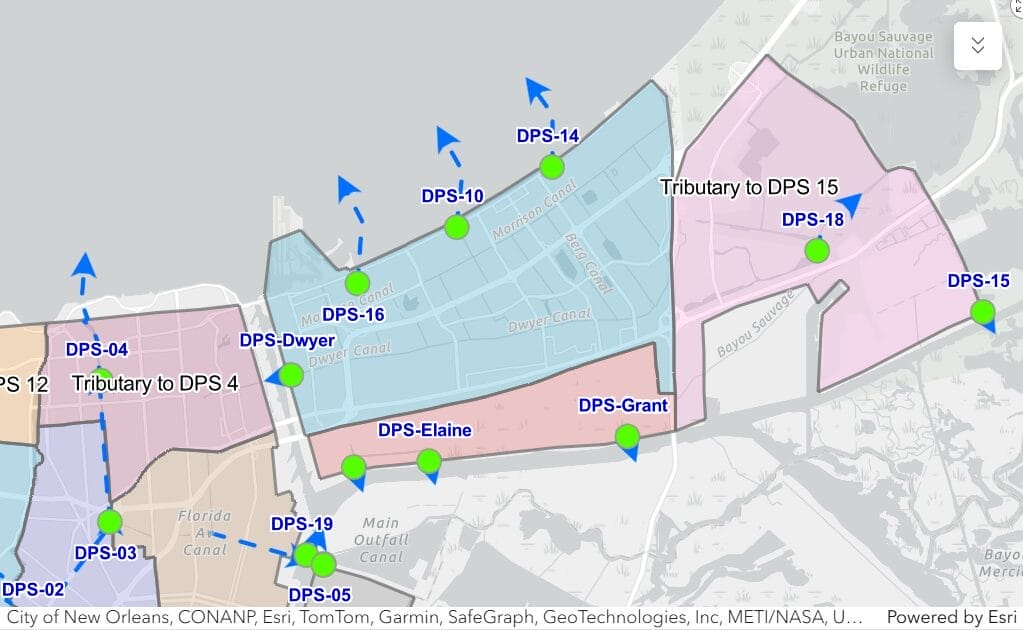
Y en Nueva Orleans, Water Collaborative ha estado presionando por aplicar una tarifa de aguas pluviales, llamada Water Justice Fund, para pagar de manera más equitativa por su gran sistema de drenaje y servicio de agua antiguo y costoso.
Nueva Orleans debe su existencia moderna a 97 bombas de drenaje, dos docenas de las cuales operan todos los días, dice Dandridge-Smith, convirtiendo lo que una vez fue una ciénaga y un pantano en tierra seca (que se hunde con lentitud). Las bombas son “una bendición y una maldición”, dice ella.
Un mapa parcial de las estaciones de bombeo de drenaje. La ciudad depende en el sistema de bombas para mitigar la lluvia de tormentas e inundaciones. Crédito: Sewerage and Water Board de Nueva Orleans.
Por un lado, son viejas, han estado en uso desde 1913 y su operación es costosa. Y, además, luchar contra la naturaleza es una tarea difícil. “Este lugar fue hecho para ser blando, húmedo y estar en constante contacto con el agua. Si se le quita el agua, se hunde”, dice. La mayor parte de la Nueva Orleans del siglo XIX estaba sobre el nivel del mar; hoy en día, algunas áreas se encuentran a un metro y medio por debajo del nivel del mar.
La empresa de servicios públicos de agua de Nueva Orleans no solo drena la ciudad, sino que también se encarga de la calidad del agua y las aguas residuales. “Es tan grande que tiene su propia compañía eléctrica”, dice Dandridge-Smith, “por lo que su operación es costosa”. Con el tiempo, ese costo ha sido financiado a través de impuestos a la propiedad pagados por empresas y propietarios de viviendas, pero no por organizaciones sin fines de lucro y otros grandes propietarios de tierras. “Somos una economía basada en el turismo. No tenemos trabajos de alta tecnología para pagar esta costosa empresa que es Nueva Orleans”, agrega. “Así que necesitábamos encontrar una manera de financiarla y, a la vez, de financiar las bombas”. El Water Justice Fund, que los que están a favor esperan que llegue a la boleta electoral de la ciudad en 2025, cobraría a todas las propiedades de la ciudad una tarifa de aguas pluviales basada en el total de metros cuadrados de superficies impermeables.
La tarifa de aguas pluviales financiaría no solo la operación y el mantenimiento de la infraestructura de aguas grises de la ciudad, sino también los proyectos de infraestructura verde y gestión de aguas pluviales, la reforestación urbana, los programas de capacitación laboral azul y verde, las innovaciones en seguros y otras inversiones con visión de futuro en los vecindarios. Los propios residentes ayudaron a dar forma al plan, lo que aseguró una mayor participación de la comunidad.
“Las principales recomendaciones surgieron de una serie de talleres divididos en 10 partes en los que los residentes habituales, con edades comprendidas entre los 16 y los 82 años, aprendieron los conceptos más esenciales, aburridos y técnicos sobre la infraestructura y los sistemas, y ayudaron a construir lo que conocemos como Water Justice Fund”, dice Dandridge-Smith. “Las personas pueden resolver los problemas de las personas, por lo que hacer cualquier tipo de trabajo de migración climática requiere interacción humana y autenticidad. La gente teme no poder opinar. Pero si le dices a la gente que puede hacerlo, que puede participar cuando desee, de repente la experiencia se transforma”.
En busca de la seguridad y la justicia
Tanto en las comunidades de origen como en las receptoras, la migración climática está plagada de problemas de justicia. ¿Para empezar, por qué alguien estaba en peligro? ¿Cuánta ayuda se destina a los propietarios de viviendas en lugar de a los inquilinos? ¿Cómo pueden las comunidades reasentar a los recién llegados sin desplazar a los residentes existentes?
En cierta medida, siglos de injusticia moldearon la topografía moderna del riesgo climático y la movilidad. Los vecindarios que a lo largo de la historia han sido discriminados (aquellas áreas que las entidades crediticias alguna vez consideraron demasiado riesgosas como para otorgarles préstamos por la composición racial de los residentes) están más expuestos al calor extremo y las inundaciones en la actualidad. Las personas de color continúan experimentando una exposición desproporcionada a peligros medioambientales dañinos, como productos químicos tóxicos y contaminación del aire, debido al lugar donde viven.
Muchos de los vecindarios de la ciudad de Nueva York que se identificaron como los más vulnerables a calores intensos son los mismos vecindarios que se consideran no deseables o peligrosos por entidades crediticias. Esta categorización ha causado impactos económicos negativos que han afectado generaciones de residentes. Crédito: City of New York Heat Vulnerability Index.
Incluso después de que la Ley de Vivienda Justa hiciera que la discriminación en la vivienda fuera ilegal, muchos lugares emplearon reglas de zonificación exclusivas, grandes requisitos mínimos de lote y otras tácticas para mantener alejados de forma eficiente a los residentes en función de la raza y los ingresos. Aquellos que lograron construir riqueza generacional a través de la propiedad de la vivienda a pesar de estos obstáculos, ahora enfrentan la posibilidad de perder sus hogares por el cambio climático.
Por ejemplo, los padres de Dandridge-Smith poseen propiedades que han sido heredadas de varios miembros de la familia a lo largo de los años. “En un escenario normal, algún día adquiriría esa riqueza y podría venderla, cuidarla o alquilarla”, dice. “Pero pienso en cómo, no solo yo, sino todos en Luisiana perderemos generaciones de creación de riqueza” si la región sucumbe a las inundaciones. “Conociendo la historia de este país y la forma en que se ha tratado a Luisiana en particular, nos echarán la culpa y no nos protegerán ni cuidarán de nosotros. Y me cuesta mucho lidiar con eso, porque sé que no está bien, pero es lo que sucederá”, dice.
En Nueva York, dice Mehta, los precios de las viviendas son tan altos que un propietario de bajos ingresos que acepta vender de manera voluntaria puede no obtener suficiente dinero como para comprar otra casa sin asumir una nueva hipoteca. “Si así es como construimos riqueza como sociedad, ¿ahora les estamos diciendo a las personas en áreas en riesgo que es posible que vivan allí debido a políticas históricas que las han empujado a estar en ese lugar, que este activo suyo ya no es viable? ¿Cómo es que un plan de venta no garantiza un intercambio uno a uno de la casa existente por una casa más segura?” Dice Mehta. “No estamos creando suficientes oportunidades para propietarios de hogares de bajos ingresos en general y si ahora estamos diciendo que incluso los activos que tienen deben venderse, ¿cuál es la estrategia? El alquiler puede funcionar para algunas personas, pero ¿qué pasaría si quisieran pasar estas viviendas a sus hijos?”.
Mehta dice que las comunidades y los planificadores necesitan un marco reflexivo para tomar el tipo de decisiones difíciles que les esperan. “Se volverá cada vez más difícil y si no somos proactivos al respecto ahora, ya hemos visto lo que sucede”, dice. “Esperamos el desastre, se produce el caos, las comunidades desaparecen o se desplazan, y repetimos ese ciclo una y otra vez, lo que deteriora a toda la región”.
Herramientas de planificación y políticas
Cuando finalizó el debate, los participantes hicieron sugerencias sobre qué tipos de herramientas políticas, enfoques de planificación e investigación podrían ayudar a garantizar que las comunidades estén mejor preparadas para un mundo acosado por el movimiento climático.
Cotter dice que la incertidumbre inherente en torno a la reubicación climática (si las personas se mudarán, cuántas serán, cuándo, a dónde, en qué circunstancias y cómo una afluencia o éxodo masivo podría desplazar o desestabilizar a las comunidades) se presta a la planificación exploratoria de escenarios (XSP, por su sigla en inglés). Esta técnica de planificación ayuda a las comunidades a considerar una variedad de posibles futuros y a prepararse para lo desconocido. La conferencia del Consorcio para la Planificación de Escenarios del Instituto Lincoln de enero incluyó talleres sobre recuperación y resiliencia ante desastres, entre otros temas.
Con una planificación más reflexiva, cooperativa e impulsada por la comunidad, Cotter espera que este desafío disruptivo también pueda presentar una oportunidad. “¿Cuáles son los enfoques de planificación que pueden ayudar a aprovechar este fenómeno para lograr un cambio positivo y transformador?”, se pregunta. “Tanto para facilitar que las personas se muden a lugares fuera de peligro, cuando toman esa decisión, como para que los lugares que las reciban lo hagan de manera equitativa sin causar una carga a los residentes existentes”.
Cotter dice que las herramientas de políticas de suelo, como la transferencia de los derechos de desarrollo (TDR, por su sigla en inglés), mediante la cual los propietarios de una propiedad en riesgo podrían vender su derecho legal a construir una estructura más grande a un propietario en un lugar más seguro que desee construir un desarrollo más alto de lo permitido, por ejemplo, también podrían ayudar a desempeñar un papel en la reorientación del desarrollo y la creación de más viviendas en áreas más seguras.
La ciudad de Nueva York ha permitido esta práctica durante décadas en ciertos casos. Por ejemplo, los propietarios de teatros históricos de Broadway que acordaron preservar sus propiedades como lugares de entretenimiento podrían vender sus “derechos de aire” a desarrollos cercanos. Arlington, Virginia, permitió a los propietarios de apartamentos con jardines históricos vender los derechos de desarrollo no utilizados a otros constructores, a cambio de preservar los apartamentos como viviendas asequibles durante al menos 30 años. Y el mercado de TDR en Seattle ha ayudado a preservar 59.500 hectáreas de una posible expansión urbana descontrolada en el condado de King, ya que se redirigió el desarrollo desde los bosques y las tierras agrícolas hacia el centro de la ciudad. Si bien la TDR siempre se ha utilizado para preservar espacios abiertos o monumentos históricos, no hay razón para no emplearla para crear viviendas más asequibles y resilientes ante el cambio climático.
“A decir verdad, una de las mejores estrategias que se puede aplicar para prepararse para una afluencia de población es asegurarse de estar construyendo viviendas e infraestructura que no corran peligro, de hacer que el entorno y la infraestructura existentes sean más resistentes, porque eso será mejor tanto para la población existente como para cualquier recién llegado”, dice Cotter.
Y agrega que, ya sea que el cambio climático genere o no una afluencia de nuevos residentes a una comunidad, hacer inversiones para prepararse nunca es un desperdicio.
“Viviendas fuera de peligro, infraestructuras sólidas y adecuadas y un sistema de respuesta ante los desastres, todo servirá para el bien de la población existente”, dice Cotter. “Y si se recibe una afluencia de población, estarán preparados para hacer lo que los gobiernos deberían hacer: asegurar que los residentes y propietarios de negocios tengan lo que necesitan para prosperar. Eso incluye estar a salvo frente a un clima cambiante”.
Jon Gorey es redactor de planta del Instituto Lincoln de Políticas de Suelo.
Imagen principal: Se evacúan autos antes de un huracán. Crédito: Darwin Brandis vía iStock/Getty Images Plus.
Como 39.º alcalde de Providence, Rhode Island, Brett Smiley aborda la seguridad pública, la vivienda asequible, la educación y la resiliencia ante el cambio climático. Antes de ser elegido en 2022, Smiley, quien nació y creció en el área de Chicago y se mudó a Rhode Island para trabajar en política en 2006, fue jefe del Departamento de Administración del estado, director ejecutivo de operaciones de Providence y jefe de personal de la exgobernadora de Rhode Island, Gina Raimondo.
Con una población de alrededor de 191.000 habitantes, Providence es la tercera ciudad más grande en Nueva Inglaterra después de Boston y Worcester, Massachusetts. Esta ciudad, que alguna vez albergó una gran cantidad de fábricas y molinos, en los últimos años se hizo conocida por adoptar el nuevo urbanismo, la preservación histórica y la reutilización adaptativa, así como por sus innovaciones culinarias, culturales y artísticas.
Anthony Flint entrevistó al alcalde Smiley esta primavera en el ayuntamiento. Escuche la conversación completa, que aquí se editó por motivos de longitud y claridad, en el pódcast Land Matters.
La ciudad postindustrial de Providence ha visto crecimiento en población y en ingreso familiar en los últimos años, gracias en parte a una afluencia de residentes con trabajos híbridos o remotos en otras partes. Crédito: Alex Potemkin vía iStock/Getty Images Plus.
Anthony Flint: El arco narrativo de Providence en los últimos 30 años ha sido notable: una ciudad secundaria recuperada del estancamiento económico mediante el desmantelamiento de carreteras, la iluminación de los ríos y el foco en el diseño urbano. Ahora hay preocupaciones sobre la capacidad de pago, comenzando por la vivienda. ¿Hacia dónde se dirige la ciudad ahora?
Brett Smiley: Le agradezco que haya mencionado el notable progreso que ha tenido la ciudad. Hemos recorrido un largo camino, y mientras muchas ciudades postindustriales continúan luchando, Providence está en una trayectoria muy diferente. Gracias a la pandemia, tuvimos una afluencia de personas que comenzaron a reclamar servicios urbanos, arte, cultura, diversidad y transitabilidad a pie, sin que eso conlleve la cantidad de esfuerzo y dinero que implica vivir en Manhattan o Brooklyn, o incluso en Boston.
Uno de los puntos competitivos de la ciudad es que era menos costosa. Pero no pudimos seguir el ritmo desde la construcción y, como resultado, los precios de la vivienda se están disparando. Estamos entre las cinco primeras ciudades en cuanto a afluencia migratoria neta, pero estamos en el puesto 50 de 50 en cuanto a nuevas construcciones de viviendas. Nuestra tarea es facilitar una construcción más densa en el contexto mundial en el que nos encontramos, lo que significa incorporar infraestructura verde para prepararse para el cambio climático y, al mismo tiempo, permitir un mayor crecimiento.
Creemos que podemos liderar el camino para lograr ambos objetivos. Es un momento emocionante para la ciudad. No nos cuesta promocionar Providence. Lo que nos cuesta es asegurarnos de que haya una vivienda disponible para todos los que quieran una.
AF: Hay muchos terrenos vacíos en los que se puede construir, incluidos algunos estacionamientos. Hay lugares que no requieren derribar nada.
BS: Tenemos muchos lugares en donde construir. Uno de nuestros desafíos económicos siempre ha sido que, desde una perspectiva de costos, estamos en el mismo mercado económico que Boston; sin embargo, nuestros alquileres o precios de venta son mucho menores que los de Boston. Tenemos un vacío que llenar en términos del precio que la unidad de vivienda puede exigir y el costo que se necesita para construirla . . . es por eso que estamos trabajando mucho en medidas como incentivos por aumentar la densidad y la flexibilización de los requisitos mínimos de estacionamiento. De esta forma permitimos que los emprendedores inmobiliarios ayuden a que los proyectos sean más viables en cuanto al financiamiento. Además, analizamos algunas soluciones innovadoras que las ciudades de todo el país están probando, como cambios en el código de incendios y otras cuestiones que reducirán el costo de construcción mediante la flexibilización de algunos de los requisitos reglamentarios.
AF: A diferencia de los alcaldes de Boston o París, no ha estado tan entusiasmado con el concepto de calles completas con carriles para peatones, bicicletas y autobuses. ¿Cómo ha evolucionado su forma de pensar?
BS: Sabemos que solo entre el 2 y el 4 por ciento de la población va al trabajo en bicicleta. Aspiramos a duplicar o cuadruplicar ese número. Y, aun así, menos del 10 por ciento de las personas viajarían al trabajo en bicicleta. Queremos que más personas elijan la bicicleta como un medio de transporte alternativo, pero estamos hablando del 5 por ciento de las personas que viajan al trabajo, no del 75 por ciento, aunque a veces se sienta así. Trato de dedicar tiempo y recursos a los medios y métodos de transporte que la mayoría de la gente usa de verdad.
AF: ¿Puede hablar sobre el desafío de retener a los principales empleadores, como el fabricante de juguetes Hasbro, y la práctica de ofrecer beneficios como exenciones fiscales para el desarrollo económico?
BS: Las tácticas para el desarrollo económico han cambiado. El crecimiento significativo que hemos visto en la última década, y en particular desde la pandemia, es que las personas se mudan aquí con buenos trabajos que se encuentran en otro lugar, o directamente en ningún lugar. La forma de pensar en el desarrollo económico ha cambiado, por eso es que la vivienda es una de mis prioridades, porque la vivienda es, de hecho, una estrategia de desarrollo económico.
Sin embargo, los principales empleadores con sede en la ciudad siguen siendo importantes. Las empresas que la gente conoce pueden ser muy relevantes para las perspectivas económicas de la ciudad y su marca, si se quiere. También es valioso asegurarse de que haya una comunidad corporativa central que ayude a apoyar y sostener a las instituciones cívicas, las organizaciones artísticas y otros grupos que dependen del apoyo filantrópico corporativo.
AF: En un estudio reciente, se observó que la vida nocturna de Providence genera casi 1.000 millones de dólares al año en actividad económica, pero se señaló que muchos trabajadores no pueden tomar un autobús para ir a su casa después de que cierran los bares y restaurantes. Ya que carece de un tren o metro ligero, ¿qué puede hacer Providence para mejorar el transporte público?
BS: Es importante que hablemos de la vida durante la noche en general, no solo de la vida nocturna como un entretenimiento. Hay miles de empleados que trabajan durante lo que denominamos “el otro turno de nueve a cinco”: 21:00 a 5:00. Es decir que no solo hablamos de restaurantes, hospitalidad y clubes nocturnos, sino también de las personas que trabajan en el turno noche en un hospital y otros trabajos similares.
No tenemos un sistema de tren o metro ligero aquí en Providence, ni en ningún otro lugar de Rhode Island. Tenemos un sistema de autobuses que funciona bastante bien durante el día, pero es menos frecuente o, en el caso de algunas líneas, deja de funcionar tarde por la noche. Las soluciones son buscar otros medios de transporte, como viajes compartidos y micromovilidad, y que nuestro sistema de autobuses, RIPTA, brinde un mejor servicio a estos grandes centros de empleo. No necesitamos innovaciones de vanguardia. Solo tenemos que pensar en la prestación de servicios para este período que, a menudo, se pasa por alto y se olvida.
Una parada de autobús de la Autoridad del Transporte Público de Rhode Island (RIPTA, por su sigla en inglés) en la Casa del Estado en Providence. Crédito: Christopher Shea/Rhode Island Current.
AF: Dada la experiencia de tener que cerrar un puente importante debido a problemas de integridad estructural, ¿qué piensa sobre la inversión en infraestructura, en particular ahora que las ciudades se podrían enfrentar a un marco diferente del gobierno federal?
BS: Parte de la historia del Puente de Washington en la I-95, que es una arteria importante aquí en la ciudad, es que es un puente de propiedad estatal y un proyecto financiado por el Departamento de Transporte de Rhode Island, que no tuvo el mantenimiento adecuado. La lección que saco de eso es la importancia del mantenimiento continuo para evitar un precio mucho más alto por tener que reemplazarlo. Necesitamos asegurarnos de que todos nos ocupamos de esta infraestructura, en especial después de cuatro años de inversión importante en algunos grandes proyectos de infraestructura aquí en la ciudad y en todo el país. En segundo lugar, necesitamos ingresos predecibles [como las tarifas de los peajes para camiones pesados] para poder pagar estos proyectos. Puedes reparar algo hoy o reemplazarlo mañana, pero el reemplazo siempre es la peor inversión.
AF: Del mismo modo, ¿le preocupa la situación de las instituciones ancla de educación y salud, que siguen siendo un componente clave del renacimiento de Providence, ante las interrupciones en el financiamiento federal?
BS: Estoy muy preocupado por la estabilidad financiera de la educación y la salud. El cambio de la recuperación de costos indirectos para las subvenciones de los Institutos Nacionales de Salud (NIH, por su sigla en inglés) ya está afectando a Providence. Tanto nuestros hospitales como nuestra principal institución de investigación, que es la Universidad de Brown, dependen de esos fondos. Cambiar las reglas a mitad de camino es muy perjudicial.
Los mayores empleadores de la ciudad son el hospital y las facultades. Estos recortes afectarán a nuestra comunidad de una manera u otra, ya sea por la pérdida de empleos, la disminución de los valores inmobiliarios o la menor inversión. Además de todas las oportunidades que podrían no darse como resultado de esto: curas para enfermedades que pueden no descubrirse y soluciones a problemas reales de las que ninguno de nosotros se beneficiaría, si la investigación nunca sucede. Es un problema serio y una verdadera vergüenza. No es forma de tratar a socios importantes.
AF: Usted es un tipo de político diferente en comparación con algunos dirigentes anteriores de Rhode Island que podrían describirse como más de la vieja escuela. ¿Cómo se calificaría en términos de participación con los constituyentes? En una entrevista reciente, dijo: “Hay momentos en que los dirigentes públicos necesitan decir ‘basta, ya hemos escuchado suficiente. Esto es lo que haremos’”.
BS: Suelo abordar los problemas desde dos enfoques: uno relacionado con las prioridades y otro con el estilo. Con respecto a las prioridades, el difunto alcalde de Boston, Tom Menino, a quien no conocí, hablaba de ser un mecánico urbano, [y esa] siempre ha sido una frase con la que me identifico. He tratado de establecer mis prioridades en temas centrales de calidad de vida, cuestiones que afectan la vida cotidiana de las personas, para tratar de mejorarla. Intento solucionar los problemas que en verdad les importan a las personas.
Creo que habrá una gran erosión en la confianza en el gobierno en general. El antídoto para eso es mostrar competencia, eficiencia y eficacia, en particular a nivel local, porque nuestros residentes nos conocen por nuestros nombres. No les avergüenza decirnos lo que creen que no está funcionando. Trato de mantenerme enfocado en esas cuestiones y no en resolver todos los problemas del mundo, sino en resolver los problemas de un vecindario.
En términos de estilo, soy una persona bastante discreta y no tengo altas expectativas, no soy grandilocuente, trato de escuchar a la gente. Estamos muy comprometidos con la comunidad. Tratamos de involucrar a la comunidad de nuevas maneras [como usar Zoom y encuestas en línea]. Pero llega un momento en que el líder debe tomar una decisión y seguir adelante. Para eso me eligieron. Volveré a estar en la boleta el próximo año. Si a los votantes de Providence no les gusta, pueden elegir a otra persona.
Siento que es mi trabajo decir: “De acuerdo, hemos escuchado los comentarios de todos. Hicimos modificaciones donde fue necesario. Podemos estar de acuerdo en no estar de acuerdo en otras cuestiones. Esto es lo que haremos en el futuro y el día de la rendición de cuentas será el día de las elecciones”. Me siento muy cómodo con eso. Creo que eso es lo que se necesita para pasar a la acción.
Eso es lo que creo que nuestros residentes quieren que hagamos: pasar a la acción. La inacción es el enemigo del progreso. Es algo de lo que no quiero ser víctima.
Anthony Flint es miembro sénior del Instituto Lincoln de Políticas de Suelo, conduce el ciclo de pódcast Land Matters y es editor colaborador de Land Lines.
Imagen principal: Alcalde Brett Smiley. Crédito: Ciudad de Providence.
Eventos
2025 National Conference of State Tax Judges
Outubro 23, 2025 - Outubro 25, 2025
Little Rock, AR United States
Offered in inglês
Speakers: Quinn Yeargain, Justice Courtney Hudson, Paul Bidanset, Matthew Fix, Hayes Holderness, Richard Marchitelli, Kirk Stark, and Richard Pomp
SHARE
The National Conference of State Tax Judges meets annually to review recent state tax decisions, consider methods of dealing with complex tax and valuation disputes, and share experiences in case management. This meeting provides an opportunity for judges to hear and question academic experts in law, valuation, finance, and economics, and to exchange views on current legal issues facing tax courts in different states. This year’s program includes sessions on state administrative law, explaining valuation to self-represented parties, constitutional issues in property taxation, and office and commercial property valuation.