Este curso interdisciplinario aborda la salud fiscal municipal en ciudades de América Latina y el Caribe, con énfasis en su papel para la estabilidad financiera, la provisión de servicios y el desarrollo urbano sostenible de las ciudades. Ofrece herramientas para evaluar la salud fiscal, identificar riesgos de estrés financiero y mejorar la selección y gestión de instrumentos de financiamiento. Se analizan impuestos, tasas, transferencias intergubernamentales, asociaciones público-privadas y, de manera especial, los instrumentos basados en el valor del suelo como fuentes de financiamiento para los gobiernos locales. Asimismo, se examina la capacidad de endeudamiento, la importancia de reservas fiscales y la promoción de la transparencia y la responsabilidad fiscal para construir ciudades más justas, resilientes y sostenibles.
Relevancia
La relevancia de este curso se enmarca en los desafíos del desarrollo urbano y de financiamiento que enfrentan las ciudades de América Latina y el Caribe. La descentralización fiscal, intensificada desde los años ochenta, transfirió amplias responsabilidades de gasto a los gobiernos municipales en la región sin dotarlos de fuentes de financiamiento adecuadas y estables, por lo que se generó una alta dependencia en transferencias y vulnerabilidad fiscal. Esta situación se ve agravada por déficits históricos en infraestructura y servicios, que afectan con mayor intensidad a los sectores más vulnerables. La crisis derivada de la pandemia de COVID-19 profundizó el estrés financiero municipal y el riesgo de insolvencia, lo que dificultó aún más la provisión de servicios básicos. En este contexto, monitorear la salud fiscal, fortalecer capacidades institucionales a nivel local y adoptar instrumentos de financiamiento más eficientes y progresivos —especialmente el impuesto predial y otros basados en el valor del suelo— resulta clave para sostener servicios de calidad, reducir desigualdades territoriales y promover ciudades más resilientes en términos fiscales.
As state and local governments struggle to make progress on challenges including affordable housing and climate change amid dramatic policy shifts at the federal level, reporters and editors learned more about those efforts—and the solutions to be found in land policy—at the 2025 Lincoln Institute Journalists Forum.
The two-day workshop, the latest installment in a series held for more than twenty years, was put on in December in partnership with the Bloomberg Center for Cities and Arnold Ventures. More than 30 working press attended, representing outlets including Bloomberg, Politico, Slate, Fast Company, Pro Publica, and Governing magazine, as well as the Boston Globe, Miami Herald, Texas Tribune, Baltimore Banner, and Substack. The Journalists Forum is designed to allow reporters and editors to take two days away from their pressing deadlines to gain perspective on the issues they are covering; the last two workshops had a focus on housing, in 2023, and climate, in 2022.
In welcoming remarks, Lincoln Institute President and CEO George W. “Mac” McCarthy said that the organization has been committed to supporting local government through technical assistance and other means since David C. Lincoln, son of founder John C. Lincoln, established it in Cambridge in 1974. “From our first days, our interest has been in … making it possible for local governments to do their job, because for us, we think that the quality of life is delivered by your local government.”
Anaclaudia Rossbach, executive director of UN-Habitat, delivered the opening keynote online from Dakar, Senegal, highlighting the importance of local initiatives around the world to build safe and affordable housing and environmentally resilient metropolitan regions. “Localization has been a key principle for us,” she said, noting how cities and nations worldwide are putting together action plans on what she views as an intertwined crisis of housing and climate change.
Lincoln Institute President and CEO George W. “Mac” McCarthy introduces keynote speaker Anaclaudia Rossbach, executive director of UN Habitat, at the 2025 Lincoln Institute Journalists Forum. Credit: Anthony Flint.
In the US, however, as the first panel revealed, state and local governments trying to pursue their own policies have encountered vigorous opposition by the federal government, in the form of halting offshore windfarms, freezing or clawing back funding for clean energy and mitigation initiatives, and initiating lawsuits against setting vehicle emissions standards or holding polluters liable for compensation. That has state and local governments playing a lot of defense and in some cases punching back, said Nestor Davidson, a professor at Harvard University’s Graduate School of Design.
But states are also engaging in pre-emption of their own, inherent in the zoning reform mandates that override local control of land use. Those kinds of initiatives aren’t ideological as much as a practical attempt to streamline bureaucracy and prompt more housing to be built amid the constraints of a not-in-my-backyard stance in established neighborhoods, Davidson said. “A lot of what states are trying to do is overcome fragmentation and overcome local parochialism,” he said. Tracy Loh, fellow at the Brookings Institution, observed that the tumultuous array of pre-emptions, legal challenges, and regulatory reversals are making it harder for metropolitan regions to manage rapidly changing economies. The panel was moderated by Enrique Silva, chief program officer at the Lincoln Institute.
Having heard those perspectives on the current political environment, the journalists then explored challenges and opportunities for state and local governments in three categories—housing, climate, and local public finance—and discovered several interconnected policy elements among those topics.
Housing. As the Trump administration calls for reducing rental assistance and other programs under US Housing and Urban Development, state and local governments have been tackling the urgent issue of housing affordability on their own. In a panel moderated by Solomon Greene, director of Land and Communities at the Lincoln Institute, Charles Gardner, senior research fellow at the Mercatus Center at George Mason University, reported that 33 states enacted legislation aimed at expanding the supply of housing through zoning and code reform, a big increase since 2023. The measures—such as allowing accessory dwelling units, reducing minimum parking requirements, banning single-family only zoning, increasing density at transit stations, and streamlining permitting so housing projects don’t get bogged down—constitute a “great land use realignment,” he said, and are getting popular support in red and blue states alike.
New housing still faces pushback in established neighborhoods, and some local leaders have decried any diminishing of local control over land use and development. But as more communities understand the outdated land use rules they have in place, zoning reform becomes more legible as a way to create a range of housing types that are more affordable, said Sara Bronin, law professor at George Washington University and founder of the National Zoning Atlas, a database of zoning conditions in 9,000 jurisdictions. Even as they push to increase housing supply, local leaders need to understand flooding and sea level rise to halt “nonsensical” development in vulnerable areas, she said.
Colin Higgins, executive director of the National Housing Crisis Task Force, a bipartisan coalition promoting innovations in the production and preservation of housing, said that in pursuit of the goal of producing up to 8 million new homes, communities need to include subsidized and mixed-income projects alongside the luxury market-rate housing that upzoning enables. That would help address growing skepticism about filtering—the theory that wealthier homebuyers who move into high-end housing open up apartments, condos, and smaller single-family homes that are lower in price.
In a second panel on housing moderated by George W. “Mac” McCarthy, practitioners talked about alternative pathways to affordability, including pre-assembled and manufactured homes, community land trusts (CLTs), and homes built on government-owned land.
Reina Chano Murray, associate director at the Center for Geospatial Solutions (CGS), demonstrated recent efforts to help municipalities identify land they own that is suitable for housing. CGS identified 276,000 acres of buildable, government-owned land in transit-accessible urban areas with existing infrastructure, across the US. These public lands present many opportunities for the potential development of affordable housing options, including establishing a community land trust, which allows buyers to purchase homes on leased land and agree to restrictions on resale profit.
According to a 2024 analysis by the Center for Geospatial Solutions, more than 276,000 acres of publicly owned land in transit-accessible, urban areas could be redeveloped for housing or other purposes. Credit: CGS.
Charles Dillard, director of planning for the City of Burlington, said that Vermont city is testing what’s possible in developing city-owned land, and has one of the longest-running community land trusts, the Champlain Housing Trust, as a model. John Smith, executive director of the Dudley Street Neighborhood Association in the Roxbury section of Boston, said the bulwark against gentrification is community control of land.
While new construction is an obvious path to expanding affordable housing options, cities and towns must also strive to preserve existing housing stock, some of which gets snapped up by institutional investors, said McCarthy. A recent report published by the Lincoln Institute revealed that nearly 9 percent of residential parcels across 500 urban counties have corporate owners, who often jack up rents and outmaneuver first-time homebuyers. The Trump administration recently moved to restrict purchases of housing stock by institutional investors.
Nature-Based Solutions. Two panels of experts examined the question of whether local and state climate action can have any impact on what’s happening to the whole planet. The retrenchment at the federal level is breathtaking, said Jody Freeman, professor at the Harvard Environmental and Energy Law Program, including withdrawal from international emission reduction treaties, the deregulation of fossil fuels and their impacts by the Environmental Protection Agency, the termination of collection of climate data, and the dismantling of the Inflation Reduction Act and its promotion of clean energy.
The panelists and moderator Peter Colohan, director of partnerships and program innovation at the Lincoln Institute, described a federal rollback defined by unprecedented maneuvers. Freeman offered, as an example, “the executive orders from the president directing the attorney general to identify state climate policies that the administration disagrees with … as somehow unlawful or unconstitutional, and sue the states in order to block them.”
Bradley Campbell, president of the Conservation Law Foundation, said advocates are spending a lot of time in court defending “a legacy of victories” once thought secure, on fronts including offshore drilling, the Endangered Species Act, or Vermont’s use of the Superfund law to collect money from fossil fuel companies to pay for climate action.
“It’s going to take a lot of resources to just maintain [previous wins],” he said. “Fortunately the advocacy community is very well organized … I think we have a pretty solid front for defending against a lot of those rollbacks.”
The dramatic redirection from Biden administration climate policies has prompted state and local government to fill the gap with dedicated funding for emissions reductions, clean energy like solar and wind power, and what Melissa Hoffer, chief of the Massachusetts Office of Climate Innovation and Resilience, described as a “nature-forward but engineered” approach to building coastline resilience. By establishing statewide codes that promote geothermal heating and a switch from fossil fuels to renewable-powered electricity, she said, states can prove that “clean energy and energy efficiency is really the pathway to affordability.”
“Cities have been leading the charge on climate long before state and federal governments were ever involved,” said Brian Swett, Boston’s chief climate officer. “Gina McCarthy, one of our great EPA administrators and the first and only domestic climate czar, used to say … that’s where innovation happens.” He cited the city’s Building Emissions Reduction and Disclosure Ordinance, which sets requirements for large existing buildings to reduce their greenhouse gas emissions over time. “You pilot at the city level, and we’ve been proud of what we’ve been able to do in Boston. So we’re back in that moment again. We are used to leading the charge.”
State, local, and regional initiatives promoting land conservation, biodiversity, and ecosystem protection preservation are similarly continuing apace despite policy reversals at the federal level, as a second climate panel revealed. Peter Stein, principal at Lyme Timber Company, acknowledged the termination of the Biden administration’s 30×30 initiative and moves to expand resource extraction on public lands, but said land conservation has widespread support among voters.
“A little more than a year ago … Donald Trump got elected, but $18 billion worth of local public finance was passed by voters in the U.S. in red, purple, and blue counties and states to support land conservation,” he said. “There’s a long history of voters voting to tax themselves … to pay for land conservation. Eighty percent of all the public money that’s invested in conservation comes from local and state governments.”
Chandni Navalkha of the Lincoln Institute, left, moderated a panel on nature-based solutions with Peter Stein of Lyme Timber, Deb Davidson of the Center for Large Landscape Conservation, and Vincent Gauthier of the Environmental Defense Fund. Credit: Catherine Benedict.
Regional collaboration on land conservation is partly filling the vacuum at the federal level, including a pact between New England governors and eastern Canadian premiers, as well as targeted efforts to protect ecosystems and wildlife corridors, said Deb Davidson, chief strategy officer at the Center for Large Landscape Conservation. In Massachusetts, Governor Maura Healey launched a package of initiatives promoting biodiversity and wildlife protection. Efforts are also underway to make agriculture more climate-friendly, said Vincent Gauthier, senior manager at the Environmental Defense Fund. Agricultural communities are working with environmental advocates to “develop solutions that find the right trade-offs for everyone, for the climate, and for farmers and ranchers whose livelihoods are on the line every day.”
The land conservation panel was moderated by Chandni Navalkha, director of conservation and stewardship at the Lincoln Institute.
Public Finance and the Property Tax. In two sessions, panels of experts examined the extraordinary fiscal squeeze being felt by cities and towns nationwide, with pandemic aid winding down and future federal funding in doubt, the cost of providing services soaring, and the bedrock source of local revenue—the property tax—under threat. Moderator Bethany Paquin noted that “lawmakers all over the country are exploring how they can provide meaningful property tax relief without undermining … essential local services,” but proposals making headlines in Florida, Texas, Pennsylvania among other places would scale back the property tax dramatically or eliminate it altogether.
The new wave of property tax revolts is driven in part by booming housing markets and significant increases in assessed home values that have prompted nearly a doubling of property tax bills in some cases, said Jared Walczak, vice president of the Tax Foundation. “It’s not surprising that people have some really strong, robust responses to this. I don’t blame them,” Walczak said, though he added: “I do think that the solutions they’re talking about are irresponsible and will not work.”
Because the property tax is the primary source of revenue for local governments and school systems, it is hard to imagine what would take its place, said Billy Hamilton, deputy chancellor emeritus at Texas A&M University. Big increases in a sales tax, or the income tax, seem politically infeasible. Targeted property tax relief in the form of circuit breakers can help those who struggle to pay rising bills, the panelists agreed.
Meanwhile, cities and towns struggle each year to keep a balanced budget, said Katie McCue, deputy executive director at the Massachusetts Municipal Association. Property tax revenues in Massachusetts are capped each year by Proposition 2 1/2, but the cost of providing services, including employee health care and retirement funding, continues to rise. Municipalities have had to rely on voter-approved overrides to bolster funding for services or to build a new school, she said.
Experts in the second public finance panel, moderated by Luis Quintanilla, program analyst at the Lincoln Institute, suggested there are precious few other ways for local governments to raise revenue. Andrew Reschovsky, professor emeritus at the LaFollette School of Public Affairs at the University of Wisconsin, reviewed the practice of charging user fees, partly making up for the post-pandemic drop in commercial property tax revenue in struggling downtowns. Daphne Kenyon, principal at D.A. Kenyon & Associates, said payments-in-lieu of taxes (PILOT) agreements with nonprofit institutions can bolster municipal coffers, but only to a point.
Other tactics include establishing a vacancy tax or a land value tax, said Nathan Seegert, professor of finance at Northeastern University. Municipalities that are responsible for an increasing array of obligations, from filling potholes to educating kids, need to diversify their revenue portfolio to have any hope of functioning in that role, he said. “If we’re going to have this trend of pushing the services further down the chain, we’re going to have to be creative in what kind of revenue sources we look for, that can provide that stability.”
At an evening reception at Harvard’s Kennedy School, Jorrit de Jong, director of the Bloomberg Center for Cities, introduced Harvard professor Michael Sandel, who shared reflections on the current state of American democracy, including the bare-knuckle tactics being deployed as different levels of government fight with each other. Sandel, who wrote The Tyranny of Merit and was recently awarded the Berggruen Prize for Philosophy and Culture, said the public discourse might be less polarized if educated elites would “listen more” and avoid technocratic slogans like “follow the science.” He also said that while more than a century old, the ideas of Henry George, the 19th century political philosopher who inspired Lincoln Institute founder John C. Lincoln, are critical to understanding the high home prices and real estate speculation of today.
Author and Harvard political philosopher Michael Sandel, right, speaks with Anthony Flint of the Lincoln Institute as part of the 2025 Journalists Forum.
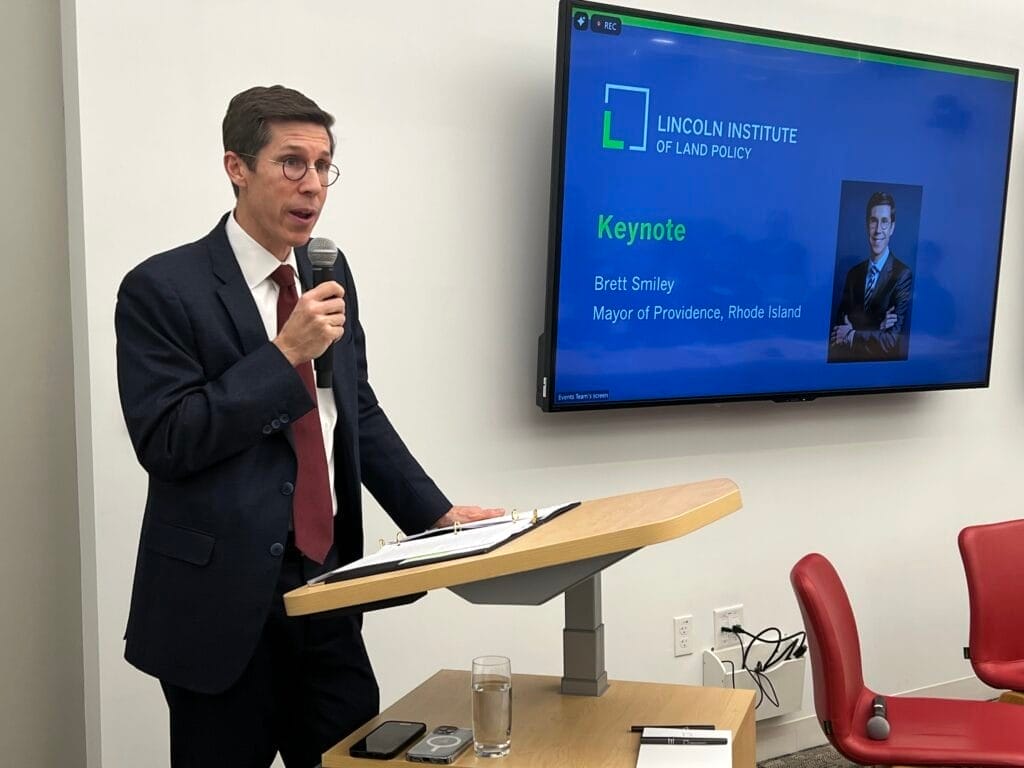
The journalists also heard from Brett Smiley, the mayor of Providence, Rhode Island, who referred to Sandel’s description of state and local governments as historically laboratories of democracy, but now seen more as “outposts or sanctuaries of democracy. I found that pretty meaningful and certainly motivating for the work that we’re doing in the environment that we’re in right now.” As a classic second city in the orbit of Boston, Providence is daylighting rivers, taking down freeways, and promoting arts and culture to attract those seeking an alternative to larger cities, Smiley said. More affordable housing is a key part of the city’s economic development strategy.
Brett Smiley, mayor of Providence, Rhode Island, describes the city’s efforts to address affordability and sustainability. Credit: Anthony Flint.
Finally, a panel of journalists and publishers in the closing “Practicing the Craft” roundtable addressed a troubling dilemma: that while the actions of state and local governments are more important than ever, many communities lack the capacity to cover those activities.
Over the last 20 years, about 3,500 newspapers have shut down, most of them weeklies that provided the kind of granular, hyper-local neighborhood coverage that community democracy depends on, said Dan Kennedy, a professor at Northeastern University. Some 50 million Americans are left with limited or no access to a reliable source of local news, according to the Local News Initiative at Northwestern University’s Medill School of Journalism.
Kennedy cited several successful examples of independent digital startups based on a nonprofit model, though he added “they tend to be located in affluent suburban communities, and urban communities of color and rural areas are struggling.” Success stories included Brookline.News, which co-founder Ellen Clegg reported was gaining in circulation covering local stories in that Boston suburb of 65,000 people. Dale Anglin, representing Press Forward, a national local news network funded by the MacArthur Foundation, reported “strengthening information networks that keep communities engaged and informed” through chapters in 32 states, and suggested that not only formal news outlets but video influencers and others deserve support.
Local reporters and editors can do their jobs better if they have access to training for covering complicated issues like housing, said Jon Greenberg of the Poynter Institute. Charles Sennott, co-founder of Report for America and publisher of the Martha’s Vineyard Times, suggested that local outlets—just like cash-strapped local governments—need to work smarter and more efficiently, and could make judicious use of artificial intelligence.
Participants in the 2025 Lincoln Institute Journalists Forum connect during a break in the action. Panel members Tracy Loh of the Brookings Institution and Nestor Davidson of the Harvard Graduate School of Design stand at left (facing away from the camera). Credit: Anthony Flint.
Anthony Flint is a senior fellow at the Lincoln Institute of Land Policy, host of the Land Matters podcast, and a contributing editor of Land Lines. Jon Gorey is a staff writer at the Lincoln Institute of Land Policy. Catherine Benedict is the digital communications manager at the Lincoln Institute of Land Policy.
Lead image: 2025 Journalists Forum panelists shared their work with reporters from media outlets across the country. Credit: Catherine Benedict
The 2026 Lincoln Institute Scholars Program provides an opportunity for recent PhDs (one to two years post-graduate) specializing in public finance or urban economics to work with senior academics.
Lincoln Institute Scholars will be invited to the institute for a program on April 29–May 1, 2026, that will include:
presentations by a panel of journal editors on the academic publication process;
a workshop in which senior scholars comment on draft papers written by the Lincoln Institute Scholars;
an opportunity for the Lincoln Institute Scholars to make presentations on their research; and
a seminar in which leading scholars in public finance and urban economics present their latest research.
El río Connecticut se extiende más de 640 kilómetros, atraviesa 4 estados de Nueva Inglaterra y talla un valle largo y fértil entre las montañas, las ciudades universitarias y las ciudades postindustriales de Vermont, New Hampshire, Massachusetts y Connecticut en su camino hacia el estrecho de Long Island. La cuenca del río abarca más de 2,8 millones de hectáreas, en su mayoría bosques y tierras agrícolas cruciales para la captura de carbono y la biodiversidad.
Por lo tanto, cuando Mass Audubon recibió una subvención de USD 25 millones del Departamento de Agricultura de Estados Unidos (USDA, por sus siglas en inglés) en octubre de 2024, una de las 92 subvenciones otorgadas a través del Programa de Asociación para la Conservación Regional del USDA ese año, la organización de conservación más grande de Nueva Inglaterra planeó usar la inyección de fondos federales para proteger 4.000 hectáreas de tierras agrícolas en funcionamiento y paisajes naturales a lo largo de la cuenca del río Connecticut.
Ocho meses después, la administración Trump anuló la subvención del Programa de Asociación para la Conservación Regional (RCPP, por sus siglas en inglés), junto con 68 otras ayudas económicas que el programa había otorgado, lo que canceló un total de más de USD 1.000 millones en subvenciones para la conservación. La cancelación fue parte de un ataque más amplio de la administración a la regulación medioambiental, la contratación de personal y el financiamiento, y significó la anulación de fondos destinados a organizaciones sin fines de lucro e instituciones educativas en todo el país que ya habían sido aprobados.
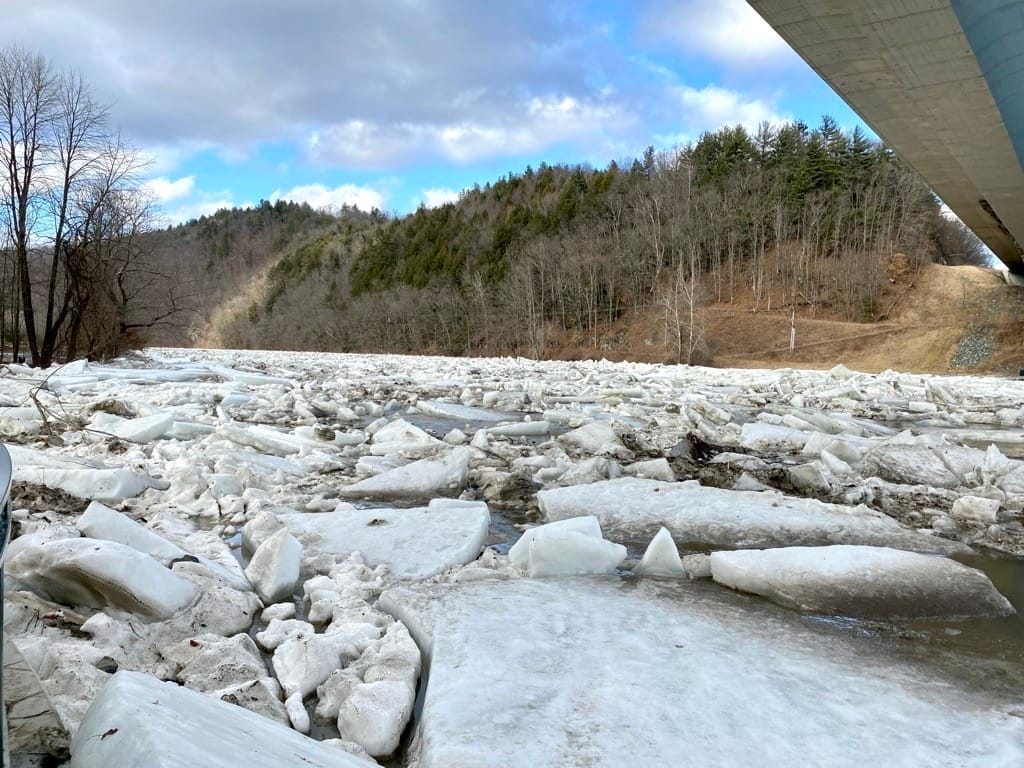
Hielo a lo largo del río Connecticut en el sur de Vermont. El gobierno federal anuló una subvención de USD 25 millones destinada a ayudar a proteger 4.000 hectáreas en la cuenca. Crédito: Jon Gorey
La reducción masiva del apoyo federal para la conservación del suelo en Estados Unidos está obligando a los grupos conservacionistas a ser creativos con el financiamiento disponible, ya que proteger los paisajes naturales a la escala y ritmo necesarios para evitar la pérdida de biodiversidad en forma masiva no se ha vuelto menos costoso.
“Actualmente, estamos en un punto de inflexión realmente crítico, donde la pérdida de esos fondos federales afectará la escala de la conservación”, afirma Peter Howell, director de la Red de Financiamiento para la Conservación (Conservation Finance Network, CFN). “Generó incertidumbre y puso énfasis en la innovación, cómo hacer más con menos”.
La Red de Financiamiento para la Conservación puso el foco en descubrir y difundir nuevas formas de pagar los trabajos de conservación en todo el mundo, desde que Peter Stein, Story Clark y Brad Gentry fundaron la red, luego de una reunión convocada a mediados de la década de 2000 por el Instituto Lincoln de Políticas de Suelo.
En aquel momento, recuerda Stein, director gerente de Lyme Timber Company, él y Clark, exdirector de Jackson Hole Land Trust, y más tarde autor del libro A Field Guide to Conservation Finance, habían estado organizando sesiones sobre el financiamiento de la conservación en las conferencias de la Land Trust Alliance. Era un área de interés incipiente que crecía rápidamente. “Ambos éramos de la ciudad de Nueva York, por lo que podíamos hablar muy rápido, pero nunca pudimos abordar todo lo que estaba sucediendo con respecto a las innovaciones del financiamiento de la conservación en 90 minutos”, sostiene Stein.
Con la ayuda de Gentry, un biólogo, abogado y profesor de la Facultad de Silvicultura de Yale, quien también asistió a la reunión del Instituto Lincoln, surgió la idea de planificar un programa de educación ejecutiva de una semana, una especie de campamento de financiamiento para la conservación. Tal idea se convirtió en una serie de eventos que, con el tiempo, se transformaría en la Red de Financiamiento para la Conservación, la cual cuenta con un pequeño equipo que conecta una amplia red de conservacionistas y socios a través de capacitaciones y reuniones.
El área ha avanzado mucho en 20 años; y a través de la asociación con la Red Internacional de Conservación del Suelo (ILCN, por sus siglas en inglés) en el Instituto Lincoln, la CFN ha organizado o inspirado campamentos de capacitación y redes similares en Europa, África y Australia, que conectan a conservacionistas de todo el mundo a fin de fortalecer la capacidad de diseñar e implementar enfoques de financiamiento efectivos y emergentes.
Participantes en un campamento de capacitación para el financiamiento de la conservación inspirado en la Red de Financiamiento para la Conservación en Angofa, Rumania, en 2024. Crédito: Eurosite.
Reforzar los tres pilares fundamentales
El objetivo de la CFN es ampliar la protección de los recursos naturales mediante la generación, el intercambio y la enseñanza de estrategias de financiamiento innovadoras. Cada contexto es diferente, desde las perspectivas ecológica, económica y legal, pero los modelos comprobados a menudo se pueden adaptar y replicar en otros lugares. Independientemente del entorno, la mayor parte del financiamiento para la conservación proviene de una de tres fuentes clave.
“La verdadera base del financiamiento para la conservación consiste en tres pilares fundamentales que son financiamiento público, filantropía y capital privado”, expone el director de la CFN, Peter Howell.
Si bien los fondos públicos impulsan la mayor parte del financiamiento para la conservación, sostiene Howell, los modelos de financiamiento innovadores logran fortalecer o combinar varios pilares de esta estructura, por ejemplo, a través de asociaciones público-privadas. Con los importantes recortes en los fondos federales para la conservación, afirma, “vamos a tener que valernos más de otros tipos de fondos públicos, incluidos los estatales y locales, pero también de la filantropía y el capital privado. Sin embargo, estos pilares no son tan grandes ni tan resistentes”.
En los últimos años, un enfoque creativo para incrementar el dinero destinado a la conservación ha sido aprovechar las fuentes de fondos adyacentes o relacionados, siempre que sea posible. Por ejemplo, proteger los bosques y los humedales de la urbanización también puede tener beneficios demostrables para la calidad del agua local, la disminución del riesgo de incendios o la prevención de inundaciones, objetivos para los que puede haber más fondos disponibles que para la protección tradicional de la vida silvestre y los ecosistemas.
Howell menciona como ejemplo la cuenca del Sebago de 97.000 hectáreas en su mayoría boscosas, en Maine. En medio de la preocupación de que el aumento del desarrollo y la fragmentación forestal en los tramos superiores de la cuenca comprometerían la calidad del agua en el área más poblada de Portland y requerirían la construcción de una costosa planta de filtrado de agua, una coalición de conservacionistas se asoció con una empresa regional de agua con el fin de formar Sebago Clean Waters para financiar la compra de servidumbres de conservación aguas arriba. El programa reúne capital público y filantrópico con fondos de la empresa de agua, que reconoce que el bosque, a través de su proceso de filtrado natural, está llevando a cabo un trabajo heroico y rentable en su nombre.
“Esta innovación surgió a partir de mucho trabajo en torno a la pregunta: ‘¿Cómo cambiamos las prácticas aguas arriba para beneficiar a los usuarios aguas abajo y cómo logramos que dichos usuarios colaboren con los fondos, a fin de incentivar a los propietarios de terrenos aguas arriba a hacer lo correcto?’”, explica Howell.
Los fondos de agua protegen las vías fluviales en su origen, lo que beneficia a las partes interesadas aguas arriba y aguas abajo. Crédito: Sebago Clean Waters.
Un enfoque similar respalda los innovadores “bonos de resiliencia forestal” creados por la organización sin fines de lucro Blue Forest. Su modelo de financiamiento consta de invitar a compartir el costo de los proyectos de restauración a los diversos grupos públicos, privados y filantrópicos que se beneficiarán de bosques resilientes y gestionados de forma sostenible, incluidas las compañías de seguros y las empresas de servicios públicos, para ayudar a financiar la poda de los bosques, la administración indígena y otros trabajos de restauración ecológica que disminuyen el riesgo de incendios forestales y contaminación del agua.
Lo que posibilita estos programas, sostiene Howell, “son los avances científicos que nos ayudan a comprender cuáles son las contribuciones de estas prácticas de cambio y cómo podríamos cuantificar los impactos económicos”.
Los mandatos modelan el mercado
Las herramientas financieras más efectivas basadas en el mercado a menudo dependen de marcos regulatorios, afirma Howell, como la idea de que la Agencia de Protección Medioambiental solicite a la empresa de servicios públicos de Maine que construya una planta de filtrado para cumplir con los estándares de calidad del agua. (Del otro lado del país, en Oregón, se prevé que una nueva planta de filtrado que se está construyendo en el otro Portland costará más de USD 2.000 millones). “El marco de políticas regulatorias es fundamental para el destino del financiamiento de la conservación”, sostiene Howell. “Sin la amenaza de acciones regulatorias, el fondo Sebago Clean Waters no existiría”.
Otro mecanismo de financiamiento privado innovador que se origina en el cumplimiento regulatorio proviene de Iowa, donde el Fondo de Resultados del Suelo y el Agua recompensa a los productores rurales por implementar mejores prácticas agrícolas, como la siembra de cultivos de cobertura o barreras vegetales, con el fin de reducir la escorrentía de fósforo y nitrógeno y mantener el agua limpia. Tales prácticas ayudan a que los servicios de agua y las plantas de filtración aguas abajo ahorren dinero, por lo que los productores rurales participantes pueden vender créditos de calidad del agua; pero dichos créditos por sí solos podrían no cubrir el costo y el esfuerzo adicional.
Sin embargo, la agricultura regenerativa beneficia más que solo a los servicios locales de agua. Después de que un tercero verifique los impactos ambientales cuantificables, como la captura de carbono, la protección de la biodiversidad y la mitigación de inundaciones, además de la calidad mejorada del agua, los productores mundiales de alimentos comprarán estos créditos que luego negocian en la Unión Europea, lo que requiere que las cadenas de suministro cumplan con ciertos estándares medioambientales. “No tenemos eso [en Estados Unidos], pero Pepsi, Danone, Archer Midland venden en todo el mundo”, afirma Stein.
“Lo que hizo el Fondo de Resultados del Suelo y el Agua fue acumular dichas contraprestaciones para ofrecer un beneficio significativo por acre a los productores rurales, para que no tengan que descifrar cómo vender nueve tipos de créditos diferentes a nueve tipos de compradores diferentes”, explica Stein. “Se trata de un único comprador y un solo mecanismo de medición”.
La regulación ambiciosa está generando un mercado completamente nuevo impulsado por el cumplimiento en Inglaterra, afirma Stein, donde las construcciones nuevas ahora deben entregar al menos un 10 por ciento de ganancia neta a biodiversidad o hábitat, ya sea en el sitio o fuera de él. Esta práctica implica que, si debido a una nueva carretera o desarrollo de viviendas se talan 10 hectáreas de árboles, por ejemplo, el desarrollador debe crear o restaurar al menos 11 hectáreas de bosque nuevo para mitigar la pérdida.
Si es imposible llevarlo a cabo en el sitio, “entonces deben recurrir a comprar los llamados créditos de naturaleza o de biodiversidad”, explica Stein. “Existe un grupo llamado Finance Earth que recaudó un fondo de capital privado, junto con una cantidad significativa de inversión del gobierno del Reino Unido, por lo que lo llamaremos financiamiento combinado, con el objetivo de llevar a cabo proyectos de restauración que entreguen créditos de biodiversidad de ganancia neta”.
Soluciones mundiales, contextos locales
Si bien las servidumbres de conservación y otras herramientas clave de financiamiento para la conservación fueron pioneras en EUA, los nuevos modelos de financiamiento para la conservación que se basan en el mercado y las políticas comenzaron a establecerse en todo el mundo en los últimos años.
“El financiamiento de la conservación está iniciando una nueva era, en la que la innovación, la colaboración y las soluciones financieras audaces movilizan el capital de todos los sectores”, afirma Chandni Navalkha, directora de la ILCN. “En todo el mundo, estamos viendo que líderes de África, Europa y América Latina ayudan a promover la conservación como una inversión compartida en nuestro futuro colectivo”.
En Sudáfrica, la Coalición de Financiamiento Sostenible ha desarrollado un modelo financiero flexible y duradero que produjo “17 soluciones financieras distintas que se han replicado 62 veces en 15 países africanos en 4 años y medio”, afirma la directora ejecutiva y fundadora Candice Stevens. El modelo se basa en tres acciones centrales: encontrar, diseñar y movilizar.
El primer paso se centra en encontrar las soluciones financieras más viables para el contexto. “A menudo, escuchamos que las partes interesadas persiguen un ideal irreal de financiamiento, invierten mucho tiempo, energía y dinero en algo que en realidad no es adecuado para su objetivo, por lo que tratamos de evitar esta situación”, señala Stevens. “Desglosamos diferentes tipos de soluciones de financiamiento en varios componentes: ¿cuáles son los elementos fundamentales que no pueden faltar, y que están disponibles en cualquier paisaje terrestre o marino, para comenzar a desarrollar una nueva solución de financiamiento?”
El paso del “diseño” del modelo consiste en establecer marcos para garantizar que las soluciones nuevas se implementen de manera eficaz. “Existe una amplia variedad de soluciones, pero el marco es estándar”, indica Stevens. “De lo contrario, sucede una de las siguientes: se desarrollan soluciones de financiamiento y se aumenta el dinero, pero en realidad no llega a las personas y lugares que más lo necesitan, o abordamos todas las áreas de impacto, pero no hay dinero real”.
Finalmente, el paso de “movilizar” se refiere al aprovechamiento del capital social, explica Stevens. “Si vamos a hacer algo innovador, como un bono apícola para una agricultura que promueva la polinización, tenemos que contar con especialistas en polinización y especialistas en bonos para desarrollar la idea”.
Las montañas Langeberg se elevan detrás de las colinas de Swellendam, Sudáfrica. El país ha implementado enfoques de financiamiento innovadores con el fin de conservar la tierra en esta y otras regiones. Crédito: Arnold Petersen a través de iStock/Getty Images Plus.
Ese modelo central ha producido todo tipo de soluciones de financiamiento en diferentes etapas de desarrollo en todo el continente africano. Una de las primeras y más exitosas soluciones fue el incentivo fiscal 37d de Sudáfrica, que permite a los propietarios de tierras que protegen su propiedad de manera permanente deducir el valor total del suelo de sus impuestos sobre la renta a una tasa del 4 por ciento anual durante 25 años, explica Stevens. Al diseñar la política, Stevens se inspiró en Philip Tabas de The Nature Conservancy y aprendió de su experiencia. Este contacto ocurrió a través de la ILCN, en donde Stevens ocupa un lugar en el comité directivo.
Los requisitos de conservación “son muy estrictos”, agrega Stevens, y los propietarios de tierra deben responsabilizarse por la implementación de las buenas prácticas y están “sujetos a la ley de propiedad y contratos”, lo que garantiza una protección del suelo duradera y a largo plazo. Hasta el momento, el incentivo fiscal ha protegido más de 500.000 hectáreas de suelo por un valor de USD 30 millones.
Stevens también muestra entusiasmo por el Blue Outcomes Fund, un fondo para el que la coalición está ultimando detalles tras la finalización de un programa de incubadoras en marzo. La idea es ayudar a proteger los entornos marinos y, a la vez, impulsar las pequeñas empresas y los medios de vida de la “economía azul” en las comunidades costeras, por ejemplo, mediante el desbloqueo de fondos para personas que participan en actividades de pesca o conservación marina sostenibles. “Los miembros de la comunidad que monitorean tortugas o caballitos de mar en la hierba marina generan puestos de trabajo realmente importantes en la localidad; y al mismo tiempo, cuidan especies dentro de áreas marinas protegidas”, sostiene Stevens.
Un caballito de mar Knysna en Sudáfrica, donde un nuevo Blue Outcomes Fund ayuda a proteger las especies marinas y apoya las economías locales. Crédito: Goddard_Photography a través de iStock/Getty Images Plus.
Más recientemente, la Coalición de Financiamiento Sostenible ha creado el primer inventario de financiamiento sostenible de África, mediante la recopilación de varias soluciones financieras y estudios de casos sistematizados y organizados por tipología. La legislación fiscal, la tenencia del suelo y las leyes de áreas protegidas varían según la jurisdicción, “pero los componentes básicos siguen siendo los mismos”, aclara Stevens, por lo que lugares como Chile, Kenia, Cataluña y la vecina Esuatini están aplicando una legislación fiscal similar creada a partir del modelo sudafricano.
“En un país como Zimbabue, cuando trabajamos con el gobierno nacional, su sistema tributario es casi nulo, por lo que nunca consideraríamos los impuestos como su principal solución de financiamiento”, explica Stevens. “Pero en países como Esuatini, ubicado justo al lado, tienen un sistema casi idéntico al de Sudáfrica, por lo que [una solución basada en los impuestos es factible]. La deducción de impuestos se verá diferente, pero los principios son los mismos”.
La conservación en las urnas
Por supuesto, el financiamiento público también puede provenir de fuentes estatales y locales. Y a pesar de los recortes implementados por la administración Trump, los resultados alentadores de las elecciones de EUA de 2024 muestran un apoyo constante y generalizado de los votantes para financiar la conservación del suelo en todo el país. Desde California hasta Carolina del Sur, los votantes aprobaron cada una de las 23 medidas definidas por plebiscito rastreadas por Trust for Public Land y se autorizó un total combinado de USD 16.000 millones en nuevos fondos públicos para la conservación del suelo y la protección del agua.
Entre las iniciativas aprobadas se incluían aumentos en los impuestos a las ventas y a la propiedad y bonos de conservación. “Algunos eran muy grandes, algunos eran pequeños, otros eran para condados, algunos para ciudades y otros para el estado”, indica Stein. “Pero es un indicio de que las personas estadounidenses están dispuestas a cobrarse impuestos a fin de que se aborde la conservación del suelo para sus comunidades”.
En Massachusetts, Mass Audubon lidera en la actualidad docenas de organizaciones en una campaña de doble enfoque llamada Nature for Mass. Los grupos abogan por una legislación que reserve USD 100 millones en ingresos del impuesto estatal existente sobre las ventas de artículos deportivos y lo asigne específicamente a la conservación del suelo y el agua, de manera similar a las leyes de Virginia, Georgia y Texas. No obstante, como opción de respaldo (y como una motivación para que los legisladores actúen), la misma coalición también está recolectando miles de firmas para trasladar la propuesta a la boleta electoral estatal en 2026.
“Esto ha sido algo en lo que varias organizaciones han estado trabajando durante varios años, y han pensado en cómo crear una fuente de fondos públicos dedicada exclusivamente a la conservación”, sostiene Jocelyn Forbush, jefa de conservación de Mass Audubon. “Somos la entidad líder en la puesta en marcha de este trabajo, pero tenemos más de 50 socios en esta coalición a quienes le ha convencido la idea de tener una fuente de financiamiento público para la conservación y la administración en todo el estado”.
Suelodaridad: potenciar las donaciones para cumplir los objetivos 30×30
En 2023, la gobernadora de Massachusetts, Maura Healey, firmó un decreto sobre biodiversidad y comprometió al estado a proteger el 30 por ciento de su paisaje para 2030 y, entre otros parámetros de referencia, se unió al ambicioso objetivo internacional establecido en la conferencia COP 15 un año antes. Fue en ese momento que Mass Audubon comenzó a analizar más en detalle lo que se necesitaría con exactitud para que el estado de Massachusetts alcanzara su objetivo 30×30. “La idea de la protección y administración del suelo se reconoce ahora como una de las mejores y menos costosas soluciones para abordar los problemas del cambio climático y la biodiversidad”, indica Forbush.
“Observamos en todo el país a algunos estados que están trabajando [para el 30×30] en diferentes lugares”, indica Forbush. “Maryland es el único que alcanzó la meta, pero muchos otros están cerca”. Para que Massachusetts alcance su objetivo, el estado deberá duplicar su ritmo de conservación para proteger 40.000 hectáreas en 5 años, indica. “Descubrimos que se necesitarán alrededor de USD 350 millones al año si hacemos este trabajo de conservación de manera equitativa y con una distribución uniforme en todo el estado”.
Sección de un mapa de suelos protegidos en Maryland, que ha cumplido su objetivo de conservación 30×30 en todo el estado. Crédito: Maryland Protected Lands Dashboard.
En junio de 2024, Mass Audubon recibió una donación de USD 25 millones de parte de MathWorks, una empresa privada con sede en Natick, Massachusetts. Con el impulso de esa ventaja inicial, Mass Audubon creó el Catalyst Fund, con el objetivo de recaudar USD 75 millones en donaciones empresariales e individuales.
La idea es aprovechar al máximo dicho capital inicial para garantizar donaciones y subvenciones equivalentes (como la subvención del USDA de USD 25 millones, ahora anulada, pero también fondos estatales y locales, como los recaudados de manera local gracias a la Ley de Preservación Comunitaria), a fin de otorgar préstamos de conservación o financiamiento puente a los asociados, o avanzar más rápidamente en la compra de propiedades en situaciones en las que una subvención tardará en desembolsarse.
El fondo “es esencialmente una reserva de dinero que se utiliza para la protección del suelo en todo el estado”, explica Forbush, enfocado en torno a la captura de carbono, la calidad de la biodiversidad y la escala y conectividad. “Somos un estado pequeño, pero nos percibimos a nosotros mismos como parte de este enorme y espectacular paisaje boscoso de los Apalaches, desde el sur de Georgia hasta Canadá, que se sabe que es una de las fuentes de carbono más importantes de EUA, si no del mundo, y también una de las zonas críticas de biodiversidad y rutas migratorias más significativas”.
Hasta ahora han recaudado más de USD 40 millones del objetivo de USD 75 millones, indica Forbush. “Con los fondos que tenemos, ya hemos protegido más de 2.400 hectáreas”, sostiene, incluidos algunos proyectos dirigidos por asociados.
Al determinar qué propiedades y proyectos buscar, Mass Audubon también analiza la tasa de coincidencia. “Originalmente establecimos que por cada dólar que invertimos en el Catalyst Fund, queremos que otros tres o cuatro dólares provengan de otras fuentes; fue una pauta que establecimos para nosotros mismos”, explica.
A raíz de la anulación de la subvención federal, dicha tasa es de alrededor de nueve a uno, al día de hoy, lo cual es increíble y alentador, agrega Forbush. “Por cada dólar que hemos invertido, hemos obtenido otros nueve dólares para un proyecto”, afirma. “Por lo que claramente estamos acelerando este trabajo”.
Jon Gorey es redactor del Instituto Lincoln de Políticas de Suelo.
Imagen principal: El río Connecticut fluye a través de Massachusetts. Crédito: Adventure_Photo a través de Getty Images/E+.
Farms, Forests, and Funding: Innovations in Conservation Finance
The Connecticut River flows more than 400 miles through four New England states, carving a long, fertile valley through the mountains, college towns, and postindustrial cities of Vermont, New Hampshire, Massachusetts, and Connecticut on its way to Long Island Sound. The river’s watershed encompasses over 7 million acres, much of it forest and farmland crucial for carbon storage and biodiversity.
So when Mass Audubon was awarded a $25 million grant from the US Department of Agriculture (USDA) in October 2024—one of 92 grants awarded through the USDA’s Regional Conservation Partnership Program that year—New England’s largest conservation organization planned to use the infusion of federal funding to protect 10,000 acres of working farmland and natural landscapes across the Connecticut River watershed.
Eight months later, the Trump administration rescinded that RCPP grant, along with 68 others the program had awarded—cancelling more than $1 billion in total conservation grants. The cancellation was part of the administration’s broader attack on environmental regulation, staffing, and funding, and its revocation of previously approved funding for nonprofits and educational institutions across the country.
Ice along the Connecticut River in southern Vermont. The federal government rescinded a $25 million grant intended to help protect 10,000 acres in the watershed. Credit: Jon Gorey.
The massive scaling back of federal support for land conservation in the United States is forcing conservationists to get creative with available funding or financing—because protecting natural landscapes at the scale and pace necessary to stave off massive biodiversity loss hasn’t gotten any less expensive.
“We’re at a really critical inflection point right now, where the loss of that federal funding is going to affect the scale of conservation,” says Peter Howell, director of the Conservation Finance Network (CFN). “It’s created uncertainty; it’s also putting a premium on innovation, on how to do more with less.”
Discovering and sharing new ways to pay for conservation efforts around the world has been the focus of the Conservation Finance Network since its founding two decades ago by Peter Stein, Story Clark, and Brad Gentry, after a meeting convened in the mid-2000s by the Lincoln Institute of Land Policy.
At that time, recalls Stein, who is managing director of Lyme Timber Company, he and Clark—former director of the Jackson Hole Land Trust, who would later author the book A Field Guide to Conservation Finance—had been hosting sessions on conservation finance at Land Trust Alliance conferences. It was a nascent, fast-growing field of interest. “We were both from New York City, so we could talk really fast, but we could never really cover all that was going on in conservation finance innovations in 90 minutes,” Stein says.
With help from Gentry, a biologist, lawyer, and professor at Yale’s School of Forestry who was also at the Lincoln Institute meeting, the idea of planning a full-week executive education program emerged—a sort of conservation finance camp. That idea evolved into a series that would eventually become the Conservation Finance Network, which is staffed by a small team that connects an expansive network of conservationists and partners through trainings and convenings.
The field has come a long way in 20 years, and through its partnership with the International Land Conservation Network (ILCN) at the Lincoln Institute, the CFN has since hosted or inspired similar training bootcamps and networks in Europe, Africa, and Australia, connecting conservationists from all around the world to strengthen capacity for the design and implementation of effective, emerging financing approaches.
Participants in a conservation finance boot camp inspired by the Conservation Finance Network in Angofa, Romania, in 2024. Credit: Eurosite.
Shoring Up the Three-Legged Stool
The aim of the CFN is to expand the protection of natural resources by surfacing, sharing, and teaching innovative finance strategies. Every context is different—ecologically, economically, and legally—but proven models can often be tweaked and replicated elsewhere. Because no matter the setting, most conservation financing comes from one of three key sources.
“Conservation finance is really built on a three-legged stool of public funding, philanthropy, and private capital,” says CFN Director Peter Howell.
While public funding drives the majority of conservation finance, Howell says, innovative finance models manage to strengthen or combine multiple legs of that proverbial stool, such as through public-private partnerships, for example. With the major cuts to federal funding for conservation, he says, “we’re going to have to lean more on other kinds of public funding, including state and local, but also on philanthropy and private capital. And those legs are not as big or as sturdy.”
One creative approach to boosting conservation dollars in recent years has been to tap into adjacent or related funding sources where possible. For example, protecting woodlands and wetlands from development can also have demonstrable benefits for local water quality, fire risk reduction, or flood prevention—goals for which more funding may be available than for traditional wildlife and ecological protection.
Howell offers the mostly forested, 240,000-acre Sebago watershed in Maine as an example. Amidst concern that increased development and forest fragmentation in the upper reaches of the watershed would compromise water quality in the more populous Portland area and require the construction of an expensive water filtration plant, a coalition of conservationists partnered with a regional water utility to form Sebago Clean Waters to fund the purchase of conservation easements upstream. The program blends public and philanthropic capital with funding from the water utility—which recognizes that the forest, through its natural filtration process, is doing cost-effective hero’s work on its behalf.
“That’s an innovation that came from a lot of work around the question of, ‘How do we change practices upstream to benefit downstream users, and how do we get downstream users to help pay to incentivize those upstream landowners to do the right thing?’” Howell says.
Water funds protect waterways at their source, benefiting both upstream and downstream stakeholders. Credit: Sebago Clean Waters.
A similar approach underpins the innovative “forest resilience bonds” created by the nonprofit Blue Forest. By inviting the many public, private, and philanthropic groups who will benefit from resilient, sustainably managed forests—including insurance companies, utilities, and others—to share in the cost of restoration projects, their financial model helps finance forest thinning, Indigenous stewardship, and other ecological restoration efforts that reduce the risk of wildfire and water contamination.
What makes these programs possible, Howell says, “is better science that helps us understand what the contributions of these change practices are, and how we might quantify their economic impacts.”
The Mandate Makes the Market
The most effective market-based finance tools often rely on regulatory frameworks, Howell says, like the prospect of the Environmental Protection Agency requiring the Maine utility to build a filtration plant to meet water quality standards. (Across the country in Oregon, a new filtration plant being built in the other Portland is projected to cost more than $2 billion.) “The regulatory policy framework is so critical to what happens in the world of conservation finance,” Howell says. “You wouldn’t have that Sebago Clean Waters fund without the threat of a regulatory action.”
Another innovative private financing mechanism that’s rooted in regulatory compliance comes from Iowa, where the Soil and Water Outcomes Fund rewards farmers for implementing better agricultural practices, such as planting cover crops or vegetative buffers, to reduce phosphorus and nitrogen runoff and keep the water clean. That saves money for downstream water utilities and their filtration plants, so participating farmers can sell water quality credits; but those credits alone may not cover the extra cost and effort.
However, regenerative agriculture benefits more than just local water utilities. After a third party verifies the quantifiable environmental impacts—including carbon sequestration, biodiversity protection, and flood mitigation, in addition to improved water quality—global food producers will purchase those credits because they do business in the European Union, which requires that supply chains meet certain environmental standards. “We don’t have that [in the United States], but Pepsi, Danone, Archer Midland—they’re selling around the globe,” Stein says.
“What the Soil and Water Outcomes Fund did was stack those payments to get to a meaningful per-acre payment to a farmer, so the farmer doesn’t have to figure out how to sell nine different kinds of credits to nine different kinds of buyer,” Stein explains. “It’s just one single buyer and one mechanism for measurement.”
Ambitious regulation is creating a whole new compliance-driven market in England, Stein says, where new construction must now deliver at least a 10 percent net gain in biodiversity or habitat, whether on site or off site. That means that if a new housing development or roadway cuts down 10 acres of trees, for example, the developer must create or restore at least 11 acres of new forest to mitigate the loss.
If that’s impossible to do on site, “then your option is to buy so-called nature credits or biodiversity credits,” Stein explains. “There’s a group called Finance Earth that has raised a private equity fund—with a significant amount of UK government investment as well, so we’ll call it blended finance—to pursue restoration projects that deliver biodiversity net gain credits.”
Global Solutions, Local Contexts
While conservation easements and other fundamental tools of conservation finance were pioneered in the US, new market- and policy-based conservation finance models have been taking root all around the world in recent years.
“Conservation finance is entering a new era—one where innovation, collaboration, and bold financial solutions are mobilizing capital from every sector,” says Chandni Navalkha, director of the ILCN. “Around the world, we’re seeing leaders from Africa to Europe to Latin America are helping advance conservation as a shared investment in our collective future.”
In South Africa, the Sustainable Finance Coalition has developed a flexible, durable finance model—one that has yielded “17 different finance solutions that have been replicated 62 times across 15 African countries in four and a half years,” says CEO and founder Candice Stevens. The model is based on three core pieces: find, design, and mobilize.
The first step focuses on finding the most viable finance solutions for the context. “Often we’ll hear of stakeholders chasing after some green finance unicorn, putting a lot of time, energy, and money into something that’s not actually fit for purpose, so we seek to avoid that,” Stevens says. “We break down different types of finance solutions into building blocks—what are the critical ingredients that have to be there, and are available in any given landscape or seascape, to start to develop a new finance solution?”
The “design” part of the model is about putting frameworks in place to ensure new solutions actually get implemented effectively. “The variety of solutions is vast, but the framework is stock standard,” Stevens explains. “Otherwise, one of two things happen: Finance solutions are developed, money is increased, but it doesn’t actually reach the people and places that need it the most—or, we tick all the impact boxes, but there’s no actual money.”
Finally, the “mobilize” portion refers to harnessing social capital, Stevens says. “If we’re going to do something innovative, like a bee bond for pollinator-friendly agriculture, we’ve got to have pollinator specialists and bond specialists sitting around the table developing it.”
The Langeberg Mountains rise behind the hills of Swellendam, South Africa. The country has used innovative financing approaches to conserve land in this and other regions. Credit: Arnold Petersen via iStock/Getty Images Plus.
That core model has yielded all manner of finance solutions in different stages of development across the African continent. One of the first and most successful of these was South Africa’s 37d tax incentive, which allows land owners who protect their property in perpetuity to deduct the full value of the land from their income taxes, Stevens explains, at a rate of 4 percent per year over 25 years. In crafting the policy, Stevens gained inspiration and expertise from The Nature Conservancy’s Philip Tabas, a connection made through the ILCN, for which Stevens serves as a steering committee member.
The conservation requirements “are very stringent,” Stevens adds, with landowners held to account for implementing best practices, and are “overlaid with property and contract law,” ensuring durable, long-term land protection. Thus far, the tax incentive has protected more than 1.2 million acres (500,000 hectares) of land valued at $30 million.
Stevens is also excited about a Blue Outcomes Fund the coalition is refining after an incubator program wrapped up in March. The idea is to help protect marine environments while boosting small businesses and “blue economy” livelihoods in coastal communities—for example, by unlocking funds for people involved in sustainable fisheries or marine conservation activities. “Community members who do turtle monitoring or seahorse monitoring in sea grasses create really important jobs locally—but at the same time, they’re protecting species within marine protected areas,” Stevens says.
A Knysna seahorse in South Africa, where a new Blue Outcomes Fund helps protect marine species while supporting local economies. Credit: Goddard_Photography via iStock/Getty Images Plus.
More recently, the Sustainable Finance Coalition has created Africa’s first sustainable finance inventory, collecting various finance solutions and case studies all in one place, organized by typology. Tax legislation, land tenure, and protected area laws all vary by jurisdiction, “but the building blocks remain the same,” Stevens says, so places such as Chile, Kenya, Catalonia, and neighboring Eswatini are pursuing similar tax legislation based on the South African model.
“In a country like Zimbabwe, when we work with the national government, their tax system is almost nonexistent, and so we’d never pursue tax as their primary finance solution,” Stevens explains. “But in countries like Eswatini, right next door, they have almost an identical system in place as South Africa, so [a tax-based solution is feasible]. Their tax deduction will look different, but the foundations are the same.”
Conservation on the Ballot
Public funding can also come from state and local sources, of course. And despite the cuts being implemented by the Trump administration, heartening results from the 2024 US elections show consistent and pervasive voter support for funding land conservation all over the country. From California to South Carolina, every one of the 23 conservation-related ballot measures tracked by the Trust for Public Land was approved by voters, authorizing a combined $16 billion in new public funding for land conservation and water protection.
The approved initiatives ranged from sales and property tax increases to conservation bonds. “Some were gigantic, some were small, some were at the county level, some were at the town level, some were at the state level,” Stein says. “But it’s an indication that Americans are willing to tax themselves to have land conservation delivered to their communities.”
In Massachusetts, Mass Audubon is currently leading dozens of organizations in a two-pronged Nature for Mass campaign. The groups are advocating for legislation that would set aside $100 million in revenue from the existing state sales tax on sporting goods, and allocate it specifically toward land and water conservation—similar to laws in Virginia, Georgia, and Texas. But as a backup option (and as a motivating nudge for lawmakers to act), the same coalition is also collecting thousands of signatures to get the proposal onto the statewide ballot in 2026.
“This has been something that a number of organizations have been working on for several years, thinking about how do you create a dedicated source of public funding for conservation?” says Jocelyn Forbush, chief of conservation at Mass Audubon. “We’re the lead entity in mobilizing this effort, but we have over 50 partners in this coalition who have bought into this idea of having a public funding source for conservation and stewardship across the state.”
Phi-land-thropy: Stretching Gifts to Meet 30×30 Goals
In 2023, Massachusetts Governor Maura Healey signed an executive order on biodiversity, committing the state to protect 30 percent of its landscape by 2030, among other benchmarks, joining in the ambitious international goal set at the COP 15 conference a year before. It was at that point that Mass Audubon started looking more closely at what, exactly, it would take for the state of Massachusetts to reach its 30×30 goal. “The idea of land protection and stewardship is acknowledged now as being one of the best solutions, and also one of the least expensive solutions, to address issues of climate change and biodiversity,” Forbush says.
“We looked around the country at a handful of other states that are working [toward 30×30] in different places,” Forbush says. “Maryland’s the only one over the finish line, but many others are making their way there.” For Massachusetts to reach its goal, the state will need to double its pace of conservation to protect 100,000 acres in five years, she says. “We found it’s going to take about $350 million a year if we do this conservation work in an equitable, evenly distributed way across the state.”
Section of a map of protected lands in Maryland, which has met its statewide 30×30 conservation goal. Credit: Maryland Protected Lands Dashboard.
In June 2024, Mass Audubon received a $25 million gift from MathWorks, a private company based in Natick, Massachusetts. Buoyed by that head start, Mass Audubon created a Catalyst Fund, aiming to raise $75 million in corporate and individual donations.
The idea is to stretch that seed money to secure matching donations and grants (such as the now-rescinded $25 million USDA grant, but also state and local funds, such as those raised locally by the Community Preservation Act), to provide conservation loans or gap financing to partners, or to move more quickly on property purchases in situations where a grant will be slow to pay out.
The fund “is essentially a pot of money that is mobilized for land protection across the state,” Forbush says, prioritized around carbon sequestration, biodiversity quality, and scale and connectivity. “We’re a small state, but we look at ourselves within this very large and spectacular forested landscape of the Appalachians—from down south in Georgia all the way up into Canada—which is known to be one of the most important carbon sinks in the US, if not in the world, and also one of the most important biodiversity hot spots and migratory pathways.”
So far they’ve raised over $40 million of the $75 million target, Forbush says. “With the funds we have, we’ve already protected over 6,000 acres,” she says, including some partner-led projects.
In determining which properties and projects to pursue, Mass Audubon also looks at the match ratio. “Originally we said, for every dollar that we put in on the Catalyst Fund, we want three or four other dollars to come from other sources—that was a guideline we set out for ourselves,” she explains.
Incredibly—and encouragingly, in the wake of the rescinded federal grant—that ratio so far is around nine to one, Forbush says. “Every dollar we’ve put in, we’ve seen nine other dollars come in for a project,” she says. “So we’re clearly accelerating this work.”
Jon Gorey is a staff writer at the Lincoln Institute of Land Policy.
Lead image: The Connecticut River winds its way through Massachusetts. Credit: Adventure_Photo via Getty Images/E+.

 SHARE