Topic: Finanças Públicas

Leader in a Land of Extremes

April 26, 2026

By Anthony Flint, April 26, 2026

The Lincoln Institute’s Mayor’s Desk series has featured municipal leaders from a wide range of metropolitan regions all over the world, but the latest installment may well be the most farflung: Fairbanks, Alaska, a city of about 30,000 people adjacent to Russia and the North Pole that was awarded the title of coldest city in America, having set a record low of minus 66 degrees Fahrenheit. Not counting any wind chill.

The place is “a land of extremes,” says Mayor Mindy O’Neall, who has had to manage a range of issues, from affordable housing to climate change, that land differently at the gateway to the Arctic. It’s a good thing, she observes, that living there brings out a special kind of resilience.

“At the heart of it is the people … who have grit and determination,” said O’Neall, the latest chief executive to be interviewed in the Mayor’s Desk series, recorded for the Land Matters podcast. The swing from frigid cold to surprisingly hot summers, and from deep darkness to strong sunlight, fosters a mindset of both abundance and scarcity. “We’re at the end of the line, we have three to four days of food security at any given time.”

O’Neall, 44, unseated an incumbent last year to become the city’s 53rd mayor. She campaigned on themes including downtown revitalization, affordable housing, and public safety, and has pursued strategies to promote generational wealth through homeownership and leverage government-owned land for affordable housing.

“Building homes and housing has been the game or the business of large, wealthy developers. And in our community, we just can’t really afford that. We don’t have enough folks for a large developer to make money here,” she said. “When we start to rethink about who’s investing in our own community and who can invest, then we start to, I think, build out that wealth, better.”

The freeze-and-thaw dynamics that have become more careening in a rapidly changing climate have also been a challenge, as the region must attempt to manage extreme occurrences ranging from floods to wildfires.

“They often call the Arctic the canary in the coal mine, because we start to see the issues of climate change far beyond and far before the lower 48 or other parts of the world. The Arctic has been saying that something’s happening in our environment for quite some time,” O’Neall said.

“I don’t think that there’s really much we can do about this now. It’s happening. We’re in a cycle of climatic disruption, for sure. But we can plan for extreme events, so we know what we’re going to do when the power goes out and it’s negative 30 degrees. We know what’s going to happen when our river floods in the middle of our town, and we’ve lost access to the hospital.

“We’re seeing less and less investment from the federal government,” she said. “So as Alaskans, it’s time for us to think really hard about how we want to protect… our assets. And that comes back to the values that we hold as a community.”

O’Neall grew up in Iowa and drove a stick-shift pickup truck up north, first working as an aide in the Alaska Legislature, then at the Fairbanks Economic Development Corporation and the Interior Gas Utility, and also founded Blue Canoe Media, a boutique communications and consulting firm. She holds a BA in Event Planning and Business Communication from Iowa State University and an MA in Professional Communications from the University of Alaska Fairbanks, where her research focused on governance and climate impacts on rural Alaska, including the relocation of Native communities.

Prior to her election as mayor, she served on the Fairbanks North Star Borough Assembly and was executive director of the Cold Climate Housing Research Center, and also serves on the boards of the Alaska State Homebuilders Association and Alaska Municipal League.

Aerial View of the Fairbanks, Alaska Skyline during Summer
Downtown Fairbanks, Alaska. Credit: Jacob Boomsma via iStock/Getty Images Plus.


She lives in downtown Fairbanks with her dog, Tito, who she pointed out is the true official dog of Alaska—the mutt. O’Neall visited Cambridge recently as part of the Just City Mayoral Fellowship at Harvard University’s Graduate School of Design, now in partnership with the Bloomberg Center for Cities.

An edited version of this Mayor’s Desk interview will appear online and in print in Land Lines magazine. The first 20 of these Q&As were compiled in the book Mayor’s Desk: 20 Conversations with Local Leaders Solving Global Problems, which includes a foreword by Michael Bloomberg.

Listen to the show here or subscribe to Land Matters on Apple Podcasts, SpotifyYouTube, or wherever you listen to podcasts.


Further Reading

Fairbanks Passes 2026 City Budget, Adds Positions | KTUU/KTVF

Climate Hazards Cost Fairbanks, Anchorage Homeowners Millions | University of Alaska News

Energy Crisis Faces Fairbanks as Well as Anchorage | Reporting from Alaska


Anthony Flint is a senior fellow at the Lincoln Institute of Land Policy, host of the Land Matters podcast, and a contributing editor of Land Lines. 


Transcript

[00:00:05] Anthony Flint: Welcome to Episode 3 of Season 7 of the Land Matters podcast. I’m your host, Anthony Flint. In our Mayor’s Desk series here at the Lincoln Institute, we interview municipal chief executives from around the world. Our latest conversation brings us all the way to Fairbanks, Alaska, a city of about 30,000 people, way up north near Russia, the gateway to the Arctic as it’s known, the second largest city in the state after Anchorage, and a metropolis that has been awarded the title of coldest city in America, having set a record low of minus 66 degrees Fahrenheit.

We’re talking with 44-year-old Mindy O’Neall, who recently replaced an incumbent and campaigned on themes including downtown revitalization, affordable housing, and public safety. She grew up in Iowa and drove a stick shift pickup truck up north, first working as an aide in the Alaska State Legislature, then the Fairbanks Economic Development Corporation and the Interior Gas Utility, and also founded Blue Canoe Media, a boutique communications and consulting firm.

She holds a BA in event planning and business communication from Iowa State University and an MA in professional communications from the University of Alaska Fairbanks, where her research focused on governance and climate impacts on rural Alaska, including the relocation of Native communities. Prior to her election as mayor, she served on the Fairbanks North Star Borough Assembly and was executive director of the Cold Climate Housing Research Center, and also serves on the boards of the Alaska State Homebuilders Association and Alaska Municipal League.

She lives in downtown Fairbanks with her dog, Tito, who, as she pointed out, is the true official dog of Alaska, the mutt. I first met her at a program for mayors at Harvard and followed up with this interview.

For the uninitiated, including those of us in the lower 48, what kind of place is Fairbanks, and why did you want to be mayor?

[00:02:22] Mayor Mindy O’Neall: Well, thanks, Anthony, and thanks for inviting me onto the show. I get this question a lot, especially for the uninitiated, as you said. That’s cute. You’re right. Fairbanks really is an exotic place. I would say we’re the land of extremes. We are extremely cold in the winter. We’re extremely warm in the summer. Some people may be surprised to learn that we can get up to 90 to 100 degrees in the summer. The force of the sun, the feeling of the sun, is so direct that it is just something you have to experience. We have exotic animals, grizzly bears, and polar bears. We have extreme industry like mining and gas and oil development. We are definitely a place of extremes.

At the heart of it is the people. It’s these people who have grit and determination, and oftentimes this mindset of abundance, where we have so much, as far as so much light, so much darkness. Then, a lot of times, this mindset of scarcity as well, where we’re at the end of the line, we have three to four days of food security at any given time. There’s things that also come into play that really just demonstrate how much of an extreme environment we live in.

Yes, wanting to be mayor. I’ve been in Alaska for over 23 years. I’m originally from Iowa, so I’m a land dweller from the middle of the United States. I came up here, just like a lot of other folks, looking for adventure. If you’ve ever been to the Midwest, they say, “Why would you ever want to leave the land, the heartland?” I said, “Don’t worry, I’ll be back in a year. I just want to go check it out.” After a year, it was painfully obvious that there was so much more to discover to Alaska that I just had to stay. I made my way up to Fairbanks from Anchorage after being there for seven years. I worked in the legislature and started to work for an interior gas utility that brought natural gas to our town.

During that time, I was an untraditional student and went back to our flagship university at the University of Alaska Fairbanks, and got a master’s in organizational development. I wrote my thesis on the politics of relocating Alaska Native villages due to climate change. At the time, I didn’t really realize how that was going to inform my career as much as it has, because after being a labor agent for the laborers. I was the executive director for the Cold Climate Housing Research Center. I spent the last four years doing that while also serving on the Borough Assembly.

One of the things that’s interesting about Alaska is we have seven boroughs that are like counties in the lower 48, and then we have cities within those boroughs. Fairbanks has a borough that has a governing body, which is the assembly, and a mayor. Then within the borough, there are two cities that have each their own mayor and each their own governing bodies. Now I am the mayor of the city of Fairbanks. I have a city council that’s a smaller council that’s located within the borough. The borough is about the size of New Jersey, with 130,000 folks in it. The city is 32,000 of those. Then the city located within the borough is the city of North Pole. They have about 2,500 folks in there.

Like a lot of places where you go from city to city in urban areas, you may or may not know what boundary you’re in. That can be sometimes a point of confusion. We always like to joke for a place that’s so against government and against overregulation, we have a lot of government regulating us.

After serving in the assembly for six and a half years, I started my public service during COVID. I think I had been appointed for about six months and then elected about four months before COVID happened. I really learned how to govern in an elected position through a screen. I do think that COVID was obviously and certainly a pivotal point in politics, but even just in the way that we communicate. That’s my passion, my heart and soul, is communication and journalism, and that sort of thing. We had a mayor that was on paper doing a fine job. He had gotten programs started and knew the city really well and led it, but he was very discriminatory to the Alaska Native population here.

After some comments and some blow-ups that he had on social media, I knew that if anybody was going to be able to beat him in an election, that I’d be able to do it. I just believe that public service is a privilege, and somebody who is in office has to have the respect of every population that is within their community. I’ve wrestled with this a little bit coming into office as, well, the last mayor, he wasn’t doing a bad job. He was actually doing a good job, but he wasn’t showing our community the respect.

I think sometimes we miss out on that key piece of public service is showing your community respect, even if you don’t understand them, even if you don’t agree with them. I think that we have lost that on a lot of levels of government these days. I believe in government. I believe that we have government for a reason. When you don’t have good governance, I do think that one of the benefits of being in this position in the last six months is being a female. This is the first time Fairbanks has had a female mayor in about two decades. I’m the fourth one since 1903.

It’s really touching to be able to be, and especially a young female in my 40s, leading this community and being a role model for other girls in our community to see that there’s somebody like them who treats a community with respect and can lead in an environment that is sometimes very hostile and sometimes very male-driven. That’s a long way of saying that’s how I ended up here.

[00:09:02] Anthony Flint: Everybody’s wrestling with affordability these days. One big part of that is housing. What are the policies that can help in your region, whether home buying or renting?

[00:09:14] Mayor Mindy O’Neall: I mentioned at the beginning that Fairbanks is at the end of the line. While that’s true, we also have an abundance of resources that are part of our economy. We have timber, we have renewable energy, we have access to gravel, and alternative methods such as mycelium. While we’re at the end of the road, we have these resources at our disposal to be innovative on how we approach housing. I think that those answers come in local manufacturing of our own resources, innovation, and then also building things like kind of part homes that have been tested for extreme environments.

We suffer from a housing stock that’s from the ’70s. Alaska really got its last big boom during the oil pipeline of the ’70s. What happened was there was such an explosion of Westerners coming up to the state that they built things the way that they knew how to build things, which was without a lot of insulation, built out of whatever they had. We suffer from very inefficient housing. When we talk about what affordable housing is, for us, it really has to include a component of energy efficiency, so we can even afford to heat our homes.

This year, we’ve had one of the coldest winters on record. I think it was the fourth coldest winter on record. We also got a remarkable amount of snow. It’s been very challenging for folks, especially now that oil prices are going up. We have about 1,200 folks in our community that are on natural gas. Everybody else is heating their homes with diesel fuel. If you think about that, we have folks who are getting delivery of diesel fuel to their homes, myself included. I live in the most urban part of our city.

Going back to affordable housing, it really does include this holistic look of what’s going to work and how we can be energy efficient with our housing, but also how we can use our local resources for innovation and how we can manufacture the resources that we have here. Secondly, and this is something that I think is really interesting, is this idea, this concept of building generational wealth outside of homeownership. That’s a model and a tool that I’d really like to explore more as we talk about how we’re building affordable housing in our community.

[00:11:45] Anthony Flint: This is this idea that not everybody has to buy a home. It’s perfectly fine to rent.

[00:11:50] Mayor Mindy O’Neall: Perfectly fine to rent, but then the next question is, how do renters gain generational wealth so they’re not just handing over money every month without anything in return? They get a house to live in, but there’s no equity in it after a while. In what ways — and I know there are models out there — when we’re building affordable housing, how can we lower the amount of investment for folks in a way that it might not come back to them for 30 to 50 years, but in 30 to 50 years, they’re on their second or third generation of family where they have security in their family in a form of tangible wealth?

[00:12:34] Anthony Flint: There’s also the community land trust model, where you have this more shared equity, and there’s limits on resale, but you still have it.

[00:12:43] Mayor Mindy O’Neall: I like that. There’s more and more folks talking about how to do this in innovative ways. I think typically building homes and housing has been the game or the business of large, wealthy developers. In our community, we just can’t really afford that. We don’t have enough folks for a large developer to make money here. When we start to rethink about who’s investing in our own community, and who can invest, then we start to, I think, build out that wealth better.

[00:13:17] Anthony Flint: The Lincoln Institute has been helping municipalities identify government-owned land that can be used for affordable housing. Do you see opportunities in that approach?

[00:13:29] Mayor Mindy O’Neall: Absolutely, I do. A few facts for you here. 60% of our land in Alaska is federal. 25% is owned by the state of Alaska. It’s about 580,000 acres. 10% is owned by Native corporations, and 1% is private. We have a lot of government land that’s available. Now, about 80 million of those acres are managed for conservation, but that’s still quite a bit of land left for us to use. I think what the Lincoln Institute is doing, exploring these different land-use models, including transportation and other components of community building, is fantastic. I can’t wait to get my hands on more of that information. I signed up for the newsletter.

We have a parking structure that has been mothballed for, gosh, probably five years. The university that used it ended up not needing it. They literally welded the doors shut, and this building has been sitting there deteriorating ever since. Through the Alaska Housing Finance Corporation, who is a statewide housing financing bank, they purchased that parking garage and have put it out for bid for affordable housing. They worked with us, saying, “Okay, we own this now, but it’s right in the middle of your city. What do you want to do with this?” We walked through the options that we have. Do we want senior housing? Yes, we desperately need senior housing. Is this the right place? We don’t think so. Okay. Next option, affordable housing, high-end housing, two bedrooms, apartment. What is it that we need? Through that process, we’ve put out an RFP for a developer to then build two or three stories on top of that parking garage, therefore activating the space using, again, the parking garage for parking, covered parking, which is very important in Fairbanks, Alaska, but also getting units into the downtown core.

That’s one example. There’s a few others that we have ongoing in town, but that’s one example that I’m really eager to see how that plays out.

[00:15:48] Anthony Flint: What are the unique challenges of living with climate change in Alaska, and what, at the state and local level, can be done about it?

[00:15:57] Mayor Mindy O’Neall: They often call the Arctic the canary in the coal mine because we start to see the issues of climate change far beyond and far before the lower 48 or other parts of the world. The Arctic has been saying that something’s happening in our environment for quite some time. I mentioned before what we’ve noticed is we have more wind in Fairbanks, which means that we have more risk for summer fires, wildfires. In the winter, we’ve had more snow than usual.

It’s also been very cold, so colder than usual, which means that our ground will not thaw quickly, meaning that when the temperature gets hot in the air, what’s going to happen? It’s all going to melt into water, but there’s going to be nowhere for it to go because the ground hasn’t unthawed yet. Now we miss out on that water. We get lots of floods, and then we don’t have moisture in the ground, and so it’s more susceptible to wildfires in the summer. That’s just one instance of the cycle of how climate change has affected the interior.

I don’t think that there’s really much we can do about this now. It’s happening. We’re in a cycle of climatic disruption, for sure, but we can plan for it. We can plan for extreme events, so we know what we’re going to do when the power goes out and it’s negative 30 degrees. We know what’s going to happen when our river floods in the middle of our town and we’ve lost access to the hospital or to hotels. We know what to do when we have an ice event because we got three or four inches of rain on top of three or four feet of snow in the middle of winter, and how that affects the animals, the moose. How it affects our ability to hunt and fish and gather berries or medicinal foods.

I think planning is a very big part of how we are prepared because, honestly, you don’t know what’s going to happen from season to season. The other thing is with planning comes money. Alaska is a place where we do not collect sales taxes on a statewide basis. Some municipalities do — we do not, as the municipality of Fairbanks — and income taxes. We pay property taxes, and that’s all we pay. As we address these more and more climatic, dramatic events, it’s costing us more and more to repair the roads, costing more and more to protect the utilities that are above and below ground, and somewhere that’s going to have to come from funding.

We’re seeing less and less investment from the federal government for events like that. As Alaskans, it’s time for us to think really hard about how we want to protect and at what level we want to protect our assets that we have, and what level of commitment that comes from our own pocketbooks.

[00:19:04] Anthony Flint: Yes, leading into that, figuring some of this stuff out at the local level or the local and state level seems to be really important right now. How have you navigated being a mayor at a time when the federal government is reducing funding and more or less withdrawing from being a partner on so many issues?

[00:19:26] Mayor Mindy O’Neall: Yes. It seems like we continue to ask our employees to do more with less. At the same time, the public expects services to be modern. That means we have to invest in technology. A lot of times, we just don’t have the funding for that. It’s a tough spot, I got to say. I have all of these ideas and plans for being mayor. Then you come into the office and you’re like, “Okay, how am I going to make this work with the operations that we already have going, the way we want to provide services and make things more efficient for our public with less and less funding from the state and from the federal government?”

Again, I do think that we’re going to have to look at ways that we contribute to ourselves, and that comes back to the values that we hold as a community. We’re a place where tourists want to be because that’s also a big part of our economy. It’s tough. I haven’t figured it out yet, but I have two and a half more years to go. It’s definitely something I’m working on a lot, and how we do more with less and how we increase, or how we explain the value of good governance with putting our own skin in the game.

[00:20:43] Anthony Flint: Mindy O’Neall is mayor of Fairbanks, Alaska, the latest leader to be interviewed in the Lincoln Institute’s Mayor’s Desk series. We love talking to mayors, and we’ve compiled 20 of these interviews in a book, Mayor’s Desk: 20 Conversations with Local Leaders Solving Global Problems, which includes a forward by Michael Bloomberg. Otherwise, Mayor’s Desk interviews appear in Land Lines magazine, in addition to most of them being broadcast here on the Land Matters podcast. You can find everything on the Lincoln Institute website. Just navigate to lincolninst.edu.

On social media, our handle is @landpolicy. Please go ahead and rate, share, and subscribe to Land Matters, the podcast of the Lincoln Institute of Land Policy. For now, I’m Anthony Flint signing off, until next time.

[00:21:41] [END OF AUDIO]

Read full transcript
Anúncio
Aerial photo of Billings, Montana, with buildings in the foreground and mountains in the background.

Report Finds New Homebuyers in Some Cities Pay Double the Property Taxes of Their Neighbors

By Kristina McGeehan, Abril 28, 2026

The Lincoln Institute of Land Policy and Minnesota Center for Fiscal Excellence released the annual 50-State Property Tax Comparison Study, the most comprehensive annual analysis of property taxes in the United States that offers a detailed, city-by-city analysis of property tax rates for the 2025 tax year. 

This annual study documents the wide range of property tax rates in more than 100 US cities and helps explain why they vary so much. The report identifies four key factors that explain most of the variation in property tax rates: property tax reliance, property values, the level of local government spending, and classification (whether cities tax homesteads at lower rates than they tax other types of property). 

The report shows that assessment limits, which restrict how fast a property’s taxable value can grow from year to year regardless of what is happening in the broader housing market, continue to drive inequities. This happens because when a home is sold, the taxable value typically resets to the current market value. Therefore, new buyers immediately face the full tax burden while neighbors in similar homes may pay taxes on a fraction of the actual market value. The tax inequities created by assessment limits only compound over time. The longer a homeowner stays in their house, and the faster local home values rise, the wider the gap grows. It is especially extreme in cities with hot real estate markets, like Miami, where the owner of a newly purchased, median-valued home would face a tax bill 3.2 times higher than would the owner of an equally valued home purchased in 2012: $10,024 versus $3,166. 

“Assessment limits are often presented as straightforward tax relief but our annual analysis continues to show that assessment limits have a number of negative consequences––they create large disparities in tax bills for similar homes and shift the burden to new homeowners,” said Adam H. Langley, associate director of Tax Policy at the Lincoln Institute of Land Policy. “As more states look to adopt these policies, our data shows clearly what the trade-offs are and who ends up paying the price.”

The study also highlights an increase in property tax classification in recent years, whereby office buildings face higher effective tax rates than do homesteads. An analysis of the largest cities in each state shows that commercial properties experience an effective tax rate that is 82 percent higher than the rate for homesteads, on average. 

“Property taxes are the backbone of local government finance, and this report gives policymakers, residents, and businesses the clearest possible picture of how these taxes actually work in practice,” said Mark Haveman, executive director at the Minnesota Center for Fiscal Excellence. “What stands out year after year is how much the design of the property tax system matters. These choices have real consequences for housing affordability, business competitiveness, and fiscal equity, and understanding each of these factors is the first step toward improving them.”

The analysis of the largest city in each state shows that the average effective tax rate on a median valued homestead was 1.213 percent in 2025 for this group of 53 cities. At that rate, a home worth $200,000 would owe $2,426 in property taxes (1.213 percent multiplied by $200,000). On the high end, three cities have effective tax rates at least two times higher than the average—Detroit, Aurora (IL), and Portland (OR). Conversely, seven cities have tax rates half the study average or less—Honolulu, Billings (MT), Denver, Salt Lake City, Boston, Charleston (SC), and Huntsville (AL).

Table showing five highest and lowest effective property tax rates on a median-valued home in 2025.
Note: Data for all cities: Figure 2 (page 21), Appendix Table 1a (page 54), and Appendix Table 2a (page 62).

Taking a closer look at the cities with the lowest property tax rates, Billings had by far the largest drop in property taxes for a median-valued home in this year’s report (37 percent). Montana created a graduated property tax structure in 2025 with three tax brackets, which slashed effective tax rates on homes worth $400,000 or less, with smaller decreases on homes worth up to $1.5 million, and increases on the most valuable homes. 

The study also includes estimates for each city’s effective tax rates and tax bills for commercial, industrial, and apartment properties. It shows how taxes changed in each city from 2024 to 2025, the effect of policies that shift the tax burden from homesteads to commercial properties and apartment buildings, and the level of tax inequities created by assessment limits.

To take a closer look at the property tax system in the United States and understand the implications for cities, read the 50-State Property Tax Comparison Study on the Lincoln Institute’s website.

Eventos

2026 Urban Economics and Public Finance Conference

Abril 30, 2026 - Maio 1, 2026

Cambridge, MA United States

Offered in inglês

The economic growth and development of urban areas are closely linked to local fiscal conditions. This research seminar offers a forum for new academic work on the interaction of these two areas. It provides an opportunity for specialists in each area to become better acquainted with recent developments and to explore their potential implications for synergy. 

This event is by invitation only.


Detalhes

Date
Abril 30, 2026 - Maio 1, 2026
Time
8:30 a.m. - 12:15 p.m. (EDT, UTC-4)
Location
Lincoln Institute of Land Policy
Cambridge, MA United States
Language
inglês

Palavras-chave

Desenvolvimento Econômico, Economia, Habitação, Inequidade, Uso do Solo, Planejamento de Uso do Solo, Valor da Terra, Tributação Imobiliária, Governo Local, Tributação Imobiliária, Finanças Públicas, Ordem Espacial, Tributação, Urbano, Valoração, Tributação de Valores

Course

Financiación Urbana y Políticas de Suelo: Conceptos, Juegos y Simuladores

Maio 31, 2026 - Junho 5, 2026

Oferecido em espanhol


Las ciudades de América Latina y el Caribe enfrentan desafíos importantes para orientar y financiar sus procesos de desarrollo urbano, ante los cuales la planeación territorial y el fortalecimiento de fuentes de financiación basada en el valor del suelo ameritan especial atención y consideración.

El curso “Financiación Urbana y Políticas de Suelo: Conceptos, Juegos, y Simuladores” examina las alternativas que ofrecen la gestión del suelo y la movilización de plusvalías para atender estos desafíos relacionados con la financiación de infraestructura y la provisión de vivienda asequible. Se centra en el análisis de las experiencias latinoamericanas y combina discusiones de aspectos conceptuales interdisciplinarios y un énfasis en el aprendizaje basado en juegos y simuladores.

El curso, además, promueve espacios de debate, análisis comparativos, aproximaciones al enfoque de desarrollo urbano orientado al transporte sostenible (DOT) y ejercicios de medición de las plusvalías y sus posibilidades de movilización, al tiempo que analiza los principales instrumentos de planificación y gestión en el marco de la financiación basada en el valor del suelo. Adicionalmente, se realizará una visita técnica para observar proyectos de movilidad, gestión del suelo y vivienda de interés social en la ciudad de Bogotá. El periodo de postulación terminará el 5 de abril de 2026.

Ver detalles de la convocatoria.


Detalhes

Date
Maio 31, 2026 - Junho 5, 2026
Application Period
Março 2, 2026 - Abril 5, 2026
Language
espanhol
Educational Credit Type
Lincoln Institute certificate
Related Links

Palavras-chave

Infraestrutura, Regulação dos Mercados Fundiários, Valor da Terra, Governo Local, Saúde Fiscal Municipal, Planejamento, Finanças Públicas, Políticas Públicas, Desenvolvimento Orientado ao Transporte, Desenvolvimento Urbano

Course

Salud Fiscal Municipal: Hacia Ciudades Más Justas, Resilientes y Sostenibles

Maio 18, 2026 - Junho 19, 2026

Oferecido em espanhol


Descripción 

Este curso interdisciplinario aborda la salud fiscal municipal en ciudades de América Latina y el Caribe, con énfasis en su papel para la estabilidad financiera, la provisión de servicios y el desarrollo urbano sostenible de las ciudades. Ofrece herramientas para evaluar la salud fiscal, identificar riesgos de estrés financiero y mejorar la selección y gestión de instrumentos de financiamiento. Se analizan impuestos, tasas, transferencias intergubernamentales, asociaciones público-privadas y, de manera especial, los instrumentos basados en el valor del suelo como fuentes de financiamiento para los gobiernos locales. Asimismo, se examina la capacidad de endeudamiento, la importancia de reservas fiscales y la promoción de la transparencia y la responsabilidad fiscal para construir ciudades más justas, resilientes y sostenibles. 

Relevancia 

La relevancia de este curso se enmarca en los desafíos del desarrollo urbano y de financiamiento que enfrentan las ciudades de América Latina y el Caribe. La descentralización fiscal, intensificada desde los años ochenta, transfirió amplias responsabilidades de gasto a los gobiernos municipales en la región sin dotarlos de fuentes de financiamiento adecuadas y estables, por lo que se generó una alta dependencia en transferencias y vulnerabilidad fiscal. Esta situación se ve agravada por déficits históricos en infraestructura y servicios, que afectan con mayor intensidad a los sectores más vulnerables. La crisis derivada de la pandemia de COVID-19 profundizó el estrés financiero municipal y el riesgo de insolvencia, lo que dificultó aún más la provisión de servicios básicos. En este contexto, monitorear la salud fiscal, fortalecer capacidades institucionales a nivel local y adoptar instrumentos de financiamiento más eficientes y progresivos —especialmente el impuesto predial y otros basados en el valor del suelo— resulta clave para sostener servicios de calidad, reducir desigualdades territoriales y promover ciudades más resilientes en términos fiscales.

Ver detalles de la concovatoria.


Detalhes

Date
Maio 18, 2026 - Junho 19, 2026
Application Period
Março 2, 2026 - Abril 10, 2026
Selection Notification Date
Abril 28, 2026 at 11:59 PM
Language
espanhol
Educational Credit Type
Lincoln Institute certificate

Palavras-chave

Inequidade, Infraestrutura, Tributação Imobiliária, Tributação Base Solo, Governo Local, Planejamento, Pobreza, Tributação Imobiliária, Finanças Públicas, Reforma fiscal, Tributação, Valoração, Recuperação de Mais-Valias, Tributação de Valores

Blog Post
Three panelists sit side by side in red chairs during a discussion, each holding a handheld microphone. On the left, a woman with long dark hair smiles while looking down at a tablet. In the middle, an older man with glasses and a gray beard smiles as he holds a microphone over a notepad. On the right, a blonde woman speaks into her microphone and gestures with her free hand; name tags are visible on the panelists, and a large screen is mounted behind them.

Journalists Forum Explores State and Local Initiatives in the Face of Federal Retrenchment

By Anthony Flint, Jon Gorey, and Catherine Benedict, Janeiro 16, 2026

As state and local governments struggle to make progress on challenges including affordable housing and climate change amid dramatic policy shifts at the federal level, reporters and editors learned more about those efforts—and the solutions to be found in land policy—at the 2025 Lincoln Institute Journalists Forum.

The two-day workshop, the latest installment in a series held for more than twenty years, was put on in December in partnership with the Bloomberg Center for Cities and Arnold Ventures. More than 30 working press attended, representing outlets including Bloomberg, Politico, Slate, Fast Company, Pro Publica, and Governing magazine, as well as the Boston Globe, Miami Herald, Texas Tribune, Baltimore Banner, and Substack. The Journalists Forum is designed to allow reporters and editors to take two days away from their pressing deadlines to gain perspective on the issues they are covering; the last two workshops had a focus on housing, in 2023, and climate, in 2022.

In welcoming remarks, Lincoln Institute President and CEO George W. “Mac” McCarthy  said that the organization has been committed to supporting local government through technical assistance and other means since David C. Lincoln, son of founder John C. Lincoln, established it in Cambridge in 1974. “From our first days, our interest has been in … making it possible for local governments to do their job, because for us, we think that the quality of life is delivered by your local government.”

Anaclaudia Rossbach, executive director of UN-Habitat, delivered the opening keynote online from Dakar, Senegal, highlighting the importance of local initiatives around the world to build safe and affordable housing and environmentally resilient metropolitan regions. “Localization has been a key principle for us,” she said, noting how cities and nations worldwide are putting together action plans on what she views as an intertwined crisis of housing and climate change.

Lincoln Institute President and CEO George W. "Mac" McCarthy speaks into a microphone he is holding. He is dressed in a dark suit and standing at a wooden podium. To his right are two wall-mounted video screens displaying the face of Anaclaudia Rossbach, executive director of UN Habitat. Below the video screen is a row of five empty red chairs set up for panel discussions. Three of the chairs have black microphones placed on their seats.
Lincoln Institute President and CEO George W. “Mac” McCarthy introduces keynote speaker Anaclaudia Rossbach, executive director of UN Habitat, at the 2025 Lincoln Institute Journalists Forum. Credit: Anthony Flint.

In the US, however, as the first panel revealed, state and local governments trying to pursue their own policies have encountered vigorous opposition by the federal government, in the form of halting offshore windfarms, freezing or clawing back funding for clean energy and mitigation initiatives, and initiating lawsuits against setting vehicle emissions standards or holding polluters liable for compensation. That has state and local governments playing a lot of defense and in some cases punching back, said Nestor Davidson, a professor at Harvard University’s Graduate School of Design.

But states are also engaging in pre-emption of their own, inherent in the zoning reform mandates that override local control of land use. Those kinds of initiatives aren’t ideological as much as a practical attempt to streamline bureaucracy and prompt more housing to be built amid the constraints of a not-in-my-backyard stance in established neighborhoods, Davidson said. “A lot of what states are trying to do is overcome fragmentation and overcome local parochialism,” he said. Tracy Loh, fellow at the Brookings Institution,  observed that the tumultuous array of pre-emptions, legal challenges, and regulatory reversals are making it harder for metropolitan regions to manage rapidly changing economies. The panel was moderated by Enrique Silva, chief program officer at the Lincoln Institute.

Having heard those perspectives on the current political environment, the journalists then explored challenges and opportunities for state and local governments in three categories—housing, climate, and local public finance—and discovered several interconnected policy elements among those topics.

Housing. As the Trump administration calls for reducing rental assistance and other programs under US Housing and Urban Development, state and local governments have been tackling the urgent issue of housing affordability on their own. In a panel moderated by Solomon Greene, director of Land and Communities at the Lincoln Institute, Charles Gardner, senior research fellow at the Mercatus Center at George Mason University, reported that 33 states enacted legislation aimed at expanding the supply of housing through zoning and code reform, a big increase since 2023. The measures—such as allowing accessory dwelling units, reducing minimum parking requirements, banning single-family only zoning, increasing density at transit stations, and streamlining permitting so housing projects don’t get bogged down—constitute a “great land use realignment,” he said, and are getting popular support in red and blue states alike.

New housing still faces pushback in established neighborhoods, and some local leaders have decried any diminishing of local control over land use and development. But as more communities understand the outdated land use rules they have in place,  zoning reform becomes more legible as a way to create a range of housing types that are more affordable, said Sara Bronin, law professor at George Washington University and founder of the National Zoning Atlas, a database of zoning conditions in 9,000 jurisdictions. Even as they push to increase housing supply, local leaders need to understand flooding and sea level rise to halt “nonsensical” development in vulnerable areas, she said.

Colin Higgins, executive director of the National Housing Crisis Task Force, a bipartisan coalition promoting innovations in the production and preservation of housing, said that in pursuit of the goal of producing up to 8 million new homes, communities need to include subsidized and mixed-income projects alongside the luxury market-rate housing that upzoning enables. That would help address growing skepticism about filtering—the theory that wealthier homebuyers who move into high-end housing open up apartments, condos, and smaller single-family homes that are lower in price.

In a second panel on housing moderated by George W. “Mac” McCarthy, practitioners talked about alternative pathways to affordability, including pre-assembled and manufactured homes, community land trusts (CLTs), and homes built on government-owned land.

Reina Chano Murray, associate director at the Center for Geospatial Solutions (CGS), demonstrated recent efforts to help municipalities identify land they own that is suitable for housing. CGS identified 276,000 acres of buildable, government-owned land in transit-accessible urban areas with existing infrastructure, across the US. These public lands present many opportunities for the potential development of affordable housing options, including establishing a community land trust, which allows buyers to purchase homes on leased land and agree to restrictions on resale profit.

According to a 2024 analysis by the Center for Geospatial Solutions, more than 276,000 acres of publicly owned land in transit-accessible, urban areas could be redeveloped for housing or other purposes. Credit: CGS.

Charles Dillard, director of planning for the City of Burlington, said that Vermont city is testing what’s possible in developing city-owned land, and has one of the longest-running community land trusts, the Champlain Housing Trust, as a model. John Smith, executive director of the Dudley Street Neighborhood Association in the Roxbury section of Boston, said the bulwark against gentrification is community control of land.

While new construction is an obvious path to expanding affordable housing options, cities and towns must also strive to preserve existing housing stock, some of which gets snapped up by institutional investors, said McCarthy. A recent report published by the Lincoln Institute revealed that nearly 9 percent of residential parcels across 500 urban counties have corporate owners, who often jack up rents and outmaneuver first-time homebuyers. The Trump administration recently moved to restrict purchases of housing stock by institutional investors.

Nature-Based Solutions. Two panels of experts examined the question of whether local and state climate action can have any impact on what’s happening to the whole planet. The retrenchment at the federal level is breathtaking, said Jody Freeman, professor at the Harvard Environmental and Energy Law Program, including withdrawal from international emission reduction treaties, the deregulation of fossil fuels and their impacts by the Environmental Protection Agency, the termination of collection of climate data, and the dismantling of the Inflation Reduction Act and its promotion of clean energy.

The panelists and moderator Peter Colohan, director of partnerships and program innovation at the Lincoln Institute, described a federal rollback defined by unprecedented maneuvers. Freeman offered, as an example, “the executive orders from the president directing the attorney general to identify state climate policies that the administration disagrees with … as somehow unlawful or unconstitutional, and sue the states in order to block them.”

Bradley Campbell, president of the Conservation Law Foundation, said advocates are spending a lot of time in court defending “a legacy of victories” once thought secure, on fronts including offshore drilling, the Endangered Species Act, or Vermont’s use of the Superfund law to collect money from fossil fuel companies to pay for climate action.

“It’s going to take a lot of resources to just maintain [previous wins],” he said. “Fortunately the advocacy community is very well organized … I think we have a pretty solid front for defending against a lot of those rollbacks.”

The dramatic redirection from Biden administration climate policies has prompted state and local government to fill the gap with dedicated funding for emissions reductions, clean energy like solar and wind power, and what Melissa Hoffer, chief of the Massachusetts Office of Climate Innovation and Resilience, described as a “nature-forward but engineered” approach to building coastline resilience. By establishing statewide codes that promote geothermal heating and a switch from fossil fuels to renewable-powered electricity, she said, states can prove that “clean energy and energy efficiency is really the pathway to affordability.”

“Cities have been leading the charge on climate long before state and federal governments were ever involved,” said Brian Swett, Boston’s chief climate officer. “Gina McCarthy, one of our great EPA administrators and the first and only domestic climate czar, used to say … that’s where innovation happens.” He cited the city’s Building Emissions Reduction and Disclosure Ordinance, which sets requirements for large existing buildings to reduce their greenhouse gas emissions over time. “You pilot at the city level, and we’ve been proud of what we’ve been able to do in Boston. So we’re back in that moment again. We are used to leading the charge.”

State, local, and regional initiatives promoting land conservation, biodiversity, and ecosystem protection preservation are similarly continuing apace despite policy reversals at the federal level, as a second climate panel revealed. Peter Stein, principal at Lyme Timber Company, acknowledged the termination of the Biden administration’s 30×30 initiative and moves to expand resource extraction on public lands, but said land conservation has widespread support among voters.

“A little more than a year ago … Donald Trump got elected, but $18 billion worth of local public finance was passed by voters in the U.S. in red, purple, and blue counties and states to support land conservation,” he said. “There’s a long history of voters voting to tax themselves … to pay for land conservation. Eighty percent of all the public money that’s invested in conservation comes from local and state governments.”

Chandni Navalkha of the Lincoln Institute, left, moderated a panel on nature-based solutions with Peter Stein of Lyme Timber, Deb Davidson of the Center for Large Landscape Conservation, and Vincent Gauthier of the Environmental Defense Fund. Credit: Catherine Benedict.

Regional collaboration on land conservation is partly filling the vacuum at the federal level, including a pact between New England governors and eastern Canadian premiers, as well as targeted efforts to protect ecosystems and wildlife corridors, said Deb Davidson, chief strategy officer at the Center for Large Landscape Conservation. In Massachusetts, Governor Maura Healey launched a package of initiatives promoting biodiversity and wildlife protection. Efforts are also underway to make agriculture more climate-friendly, said Vincent Gauthier, senior manager at the Environmental Defense Fund. Agricultural communities are working with environmental advocates to “develop solutions that find the right trade-offs for everyone, for the climate, and for farmers and ranchers whose livelihoods are on the line every day.”

The land conservation panel was moderated by Chandni Navalkha, director of conservation and stewardship at the Lincoln Institute.

Public Finance and the Property Tax. In two sessions, panels of experts examined the extraordinary fiscal squeeze being felt by cities and towns nationwide, with pandemic aid winding down and future federal funding in doubt, the cost of providing services soaring, and the bedrock source of local revenue—the property tax—under threat. Moderator Bethany Paquin noted that “lawmakers all over the country are exploring how they can provide meaningful property tax relief without undermining … essential local services,” but proposals making headlines in Florida, Texas, Pennsylvania among other places would scale back the property tax dramatically or eliminate it altogether.

The new wave of property tax revolts is driven in part by booming housing markets and significant increases in assessed home values that have prompted nearly a doubling of property tax bills in some cases, said Jared Walczak, vice president of the Tax Foundation. “It’s not surprising that people have some really strong, robust responses to this. I don’t blame them,” Walczak said, though he added: “I do think that the solutions they’re talking about are irresponsible and will not work.”

Because the property tax is the primary source of revenue for local governments and school systems, it is hard to imagine what would take its place, said Billy Hamilton, deputy chancellor emeritus at Texas A&M University. Big increases in a sales tax, or the income tax, seem politically infeasible.  Targeted property tax relief in the form of circuit breakers can help those who struggle to pay rising bills, the panelists agreed.

Meanwhile, cities and towns struggle each year to keep a balanced budget, said Katie McCue, deputy executive director at the Massachusetts Municipal Association. Property tax revenues in Massachusetts are capped each year by Proposition 2 1/2, but the cost of providing services, including employee health care and retirement funding, continues to rise. Municipalities have had to rely on voter-approved overrides to bolster funding for services or to build a new school, she said.

Experts in the second public finance panel, moderated by Luis Quintanilla, program analyst at the Lincoln Institute, suggested there are precious few other ways for local governments to raise revenue. Andrew Reschovsky, professor emeritus at the LaFollette School of Public Affairs at the University of Wisconsin, reviewed the practice of charging user fees, partly making up for the post-pandemic drop in commercial property tax revenue in struggling downtowns. Daphne Kenyon, principal at D.A. Kenyon & Associates, said payments-in-lieu of taxes (PILOT) agreements with nonprofit institutions can bolster municipal coffers, but only to a point.

Other tactics include establishing a vacancy tax or a land value tax, said Nathan Seegert, professor of finance at Northeastern University. Municipalities that are responsible for an increasing array of obligations, from filling potholes to educating kids, need to diversify their revenue portfolio to have any hope of functioning in that role, he said. “If we’re going to have this trend of pushing the services further down the chain, we’re going to have to be creative in what kind of revenue sources we look for, that can provide that stability.”

At an evening reception at Harvard’s Kennedy School, Jorrit de Jong, director of the Bloomberg Center for Cities, introduced Harvard professor Michael Sandel, who shared reflections on the current state of American democracy, including the bare-knuckle tactics being deployed as different levels of government fight with each other. Sandel, who wrote The Tyranny of Merit and was recently awarded the  Berggruen Prize for Philosophy and Culture, said the public discourse might be less polarized if educated elites would “listen more” and avoid technocratic slogans like “follow the science.” He also said that while more than a century old, the ideas of Henry George, the 19th century political philosopher who inspired Lincoln Institute founder John C. Lincoln, are critical to understanding the high home prices and real estate speculation of today.

Author and Harvard political philosopher Michael Sandel, right, speaks with Anthony Flint of the Lincoln Institute as part of the 2025 Journalists Forum.

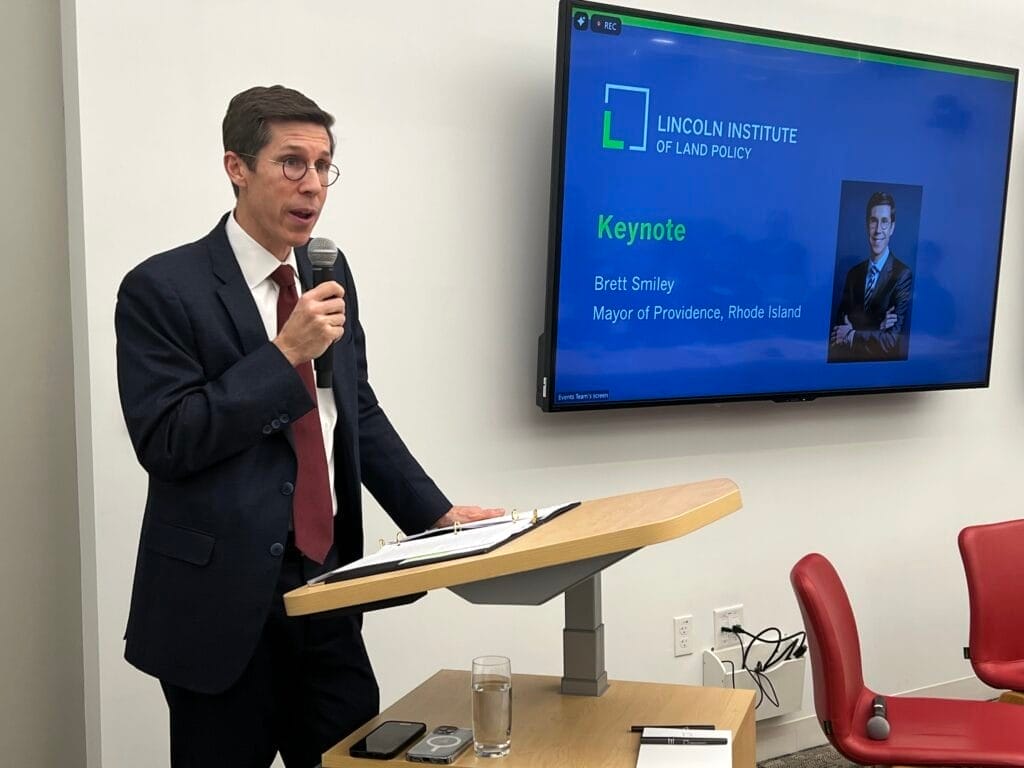
The journalists also heard from Brett Smiley, the mayor of Providence, Rhode Island, who referred to Sandel’s description of state and local governments as historically laboratories of democracy, but now seen more as “outposts or sanctuaries of democracy. I found that pretty meaningful and certainly motivating for the work that we’re doing in the environment that we’re in right now.” As a classic second city in the orbit of Boston, Providence is daylighting rivers, taking down freeways, and promoting arts and culture to attract those seeking an alternative to larger cities, Smiley said. More affordable housing is a key part of the city’s economic development strategy.

Brett Smiley, mayor of Providence, Rhode Island, describes the city’s efforts to address affordability and sustainability. Credit: Anthony Flint.

Finally, a panel of journalists and publishers in the closing “Practicing the Craft” roundtable addressed a troubling dilemma: that while the actions of state and local governments are more important than ever, many communities lack the capacity to cover those activities.

Over the last 20 years, about 3,500 newspapers have shut down, most of them weeklies that provided the kind of granular, hyper-local neighborhood coverage that community democracy depends on, said Dan Kennedy, a professor at Northeastern University. Some 50 million Americans are left with limited or no access to a reliable source of local news, according to the Local News Initiative at Northwestern University’s Medill School of Journalism.

Kennedy cited several successful examples of independent digital startups based on a nonprofit model, though he added “they tend to be located in affluent suburban communities, and urban communities of color and rural areas are struggling.” Success stories included Brookline.News,  which co-founder Ellen Clegg reported was gaining in circulation covering local stories in that Boston suburb of 65,000 people. Dale Anglin, representing Press Forward, a national local news network funded by the MacArthur Foundation, reported “strengthening information networks that keep communities engaged and informed” through chapters in 32 states, and suggested that not only formal news outlets but video influencers and others deserve support.

Local reporters and editors can do their jobs better if they have access to training for covering complicated issues like housing, said Jon Greenberg of the Poynter Institute. Charles Sennott, co-founder of Report for America and publisher of the Martha’s Vineyard Times, suggested that local outlets—just like cash-strapped local governments—need to work smarter and more efficiently, and could make judicious use of artificial intelligence.

Participants in the 2025 Lincoln Institute Journalists Forum connect during a break in the action. Panel members Tracy Loh of the Brookings Institution and Nestor Davidson of the Harvard Graduate School of Design stand at left (facing away from the camera). Credit: Anthony Flint.

Anthony Flint is a senior fellow at the Lincoln Institute of Land Policy, host of the Land Matters podcast, and a contributing editor of Land Lines. Jon Gorey is a staff writer at the Lincoln Institute of Land Policy. Catherine Benedict is the digital communications manager at the Lincoln Institute of Land Policy.

Lead image: 2025 Journalists Forum panelists shared their work with reporters from media outlets across the country. Credit: Catherine Benedict