Topic: Planejamento Urbano e Regional

A New Ground Lease on Life: In Virginia, County-Owned Land Becomes a Site for Student and Senior Housing

By Jon Gorey, Março 31, 2026

Musician Curtis Hunter approaches the world with a smile—even if the world doesn’t always return the gesture. But fate seemed to smile on Hunter last June, at least, when he moved into a new senior housing development built on county-owned land in Fairfax County, Virginia.

A few years before, at 58, Hunter had been assaulted near his old apartment building in Seven Corners, suffering a collapsed lung and broken bones. A difficult stretch followed, including a bout of homelessness and another violent attack. But last year, a Fairfax County caseworker suggested Hunter look into a new affordable housing development for seniors, called Belmont at One University. It’s one of several recent projects that have seen Fairfax County leverage the value of its publicly owned land to spur new affordable housing.

A former handyman and touring musician (he played guitar and harmonica in bands that opened for Los Lobos and Donovan, among other acts), Hunter now lives on disability income and says he’s grateful for his new home.

“I appreciate it so much, it’s a very wonderful thing. I really appreciate that they allow my pet,” he says. Unlike three of his former cats—who would accompany Hunter outside, perched on a carpeted platform he would attach to a backpack or bike rack—his latest cat, Sophie, is timid; adopted at nine and a half, she prefers lounging in the window, gazing at the nearby sports complex and neighbors walking along the bike path.

The field house across the street, where Hunter has taken in the occasional lacrosse or soccer game, is part of George Mason University, a public university with about 40,000 students.

One University is located next door to the college, on a 10.8-acre property owned by the Fairfax County Redevelopment and Housing Authority (FCRHA). The parcel previously held an FCRHA affordable housing complex of 46 townhomes, called Robinson Square. In 2021, those tenants were relocated to temporary housing until the new homes were ready—a step that was not without challenges or misgivings, but which allowed for a fivefold increase in the number of affordable housing units on site.

The property now comprises three new buildings: Robinson, named for the former townhome complex, which holds 120 affordable one- to four-bedroom units for all ages; Belmont, with 120 affordable one- and two-bedroom apartments reserved for seniors aged 62 and older; and Main on University, with over 300 market-rate student apartments.

The three buildings sit on county-owned land leased at a nominal rate for 99 years—the land added an estimated $12 million subsidy to help the projects get built. However, the buildings are privately owned and managed, and thus pay the county hundreds of thousands of dollars apiece in local property taxes.

This kind of arrangement—a ground lease that allows communities to hold onto their land while sharing in the revenue generated by development on that land—is one of several ways  communities are putting public land to use in order to expand affordable housing. And it’s providing new opportunities for tenants of all ages.

Curtis Hunter speaks to the camera. He has gray hair and is wearing a striped orange, blue, and white polo shirt.
Musician Curtis Hunter, who lives in an apartment complex built on county-owned land in Fairfax County, Virginia. Credit: Belmont at One University/Paradigm Property Management, LLC.

Hunter enjoys having college students next door and says some have helped organize social events for the senior residents, from game nights to group walks. “There’s one group, they come over, and they help with getting some of these things together—the art class and the open mic, and they have what’s called ‘Cups and Company,’ where they get people from the two buildings to come down and have tea and cookies together,” he explains. “I appreciate them being there, since I don’t have family and don’t get to see my nieces and nephews.”

This Land Is Your Land

In 2022, Fairfax County doubled its affordable housing target, committing to the addition of 10,000 new affordable units by 2034, with no net loss of existing affordable homes. The original goal of 5,000 affordable homes, set in 2019, was always intended to be “a floor, not a ceiling,” according to the advisory panel that issued the recommendation. While median household incomes are high in Fairfax, at more than $154,000 a year, median home values are more than double the national average, at $760,400, according to US Census data. The county has, in some cases, acquired new land in order to develop transit-oriented affordable housing. But lately, especially after the success of One University, the FCRHA is looking more closely at co-locating new affordable housing with existing public facilities on land it already owns or controls.

“We’re looking at a few public facilities, [including] two libraries,” says Anna Shapiro, deputy director for real estate development and finance at the FCRHA. The libraries’ large parking lots offer the potential to co-locate housing on county-owned sites that are “also really accessible in terms of transportation infrastructure and access to jobs and amenities,” she notes. “That piece is really important for us, because as we’re evaluating these properties, we want to make sure that we’re setting people up for success and not isolating people.”

Positioned on the edge of a college campus, One University is fairly walkable, about a mile from grocery stores and the city center. “I bought a little sit-down scooter that gets me up to the Giant and to the Safeway in Fairfax City,” Hunter says. A network of wide bike paths and sidewalks makes it easy to get around.

The county’s latest co-located affordable housing development, currently nearing completion, is also centrally located—on a pair of underutilized parking lots next to the county’s Government Center offices. Fairfax Crest, as it’s called, will hold 279 affordable units for renters earning 30 to 70 percent of the area median income (AMI). The project is actually a sequel of sorts: The nearby Residences at Government Center were completed almost a decade ago. However, Fairfax Crest includes more amenities, like a public plaza, 15,000 square feet of community space, and a childcare center.

An aerial rendering of Fairfax Crest shows two apartment buildings facing an interior courtyard with a playground.
An aerial rendering of Fairfax Crest, an affordable housing development underway on county-owned land in Fairfax County, Virginia. Credit: KTGY.

The average two-bedroom apartment in Fairfax rents for more than $2,400 a month, according to Zillow and RentCafe estimates, while income-restricted two-bedroom apartments at Robinson and Belmont currently rent for $1,653 to $2,022 per month. Rents at Fairfax Crest have yet to be announced, but between the income-restricted rents and energy-efficient appliances and construction (including rooftop solar panels) that reduce utility costs, most tenants should not have to spend more than 30 percent of their gross income on housing expenses—relieving them of the “cost-burdened” status nearly half of US renters experience.

Shapiro was able to tour one of the Fairfax Crest buildings as construction was wrapping up. “We got to go up to one of the units, and I have to say, the views from the top floors of what is an affordable housing development are gorgeous,” she says. “The county has been very clear that just because it’s affordable housing, it shouldn’t look different than our other housing—and we do have pretty high expectations for what people deliver in our county.”

Building Support for Building

While the federal government owns plenty of land, much of it—from military bases to national parks and wildlife refuges—is not particularly sensible for residential development. States and municipalities, however, control over 250,000 acres of buildable land in high-demand, urban areas, according to a 2024 analysis by the Lincoln Institute’s Center for Geospatial Solutions. This includes surface parking lots, vacant lots, and shuttered municipal buildings in prime locations near jobs and public transit.

Still, it takes initiative and money—and, often, some political courage and leadership—to convert municipally owned land to affordable housing or other publicly beneficial uses.

Shapiro thinks the success of One University and other recent projects helped build the necessary confidence and support among county officials to pursue the Fairfax Crest project. “Seeing all those results, I think they said, ‘Okay, let’s do this in our front yard. Let’s make this really visible, and show our commitment very clearly to affordable housing,’” Shapiro says.

An aerial photo of the One University area, with the site outlined in red.
A map of the One University site, a 10.8-acre property owned by Fairfax County that previously held 46 affordable townhomes and meeting space for the Fairfax County Redevelopment and Housing Authority. The site was redeveloped to hold 240 affordable units for seniors and families, as well as apartments for students attending nearby George Mason University. Credit: Fairfax County Department of Planning and Development.

The County Board of Supervisors has been “critical in actually making this happen,” she adds, championing the housing affordability issue politically. “Not only do we have this goal of 10,000 net new units in the county, we’re also going to put our money where our mouth is and put our land where our mouth is.”

Fairfax Crest consists of two main buildings, each with its own cocktail of financing and tax credits. As with One University, the buildings are owned and operated by private companies, on land leased from the county for a 99-year term. “We are very, very concerned about keeping long-term control of our county,” Shapiro says, especially right next to the government offices. “We understood that the value of the land would really help to subsidize the development of the property.”

Each building combined a 4 percent low-income housing tax credit from Virginia Housing with an additional 9 percent tax credit won through a competitive process, in what Shapiro calls a “twinning” strategy. The FCRHA also issued a pair of bonds to help finance the development, totaling $23.5 million, as well as $25 million in loans from its Blueprint fund. “There are other sources in the deal, too—some other state funding and a grant for the daycare buildout,” Shapiro says. “We try to set up our underwriting criteria to really ensure that developers are going out and getting outside capital as well.”

Fairfax County’s decision to retain ownership of its land through ground leases is preferable to what many municipalities end up doing to spur affordable housing development: selling the lot for a dollar, granting a 20-year tax abatement, and “losing all of the value of the asset forever just to achieve the outcome,” says Robert ‘R.J.’ McGrail, director of the Lincoln Institute’s Accelerating Community Investment program.

Every incentive matters, McGrail notes, and each one “can be the difference between shovels in the ground and cranes in the air or not.” But surrendering future tax revenue risks degrading the public services that the new residents, from across the income spectrum, will rely on. “Losing pieces of that to get a deal done is a choice, one that jurisdictions make every day,” he says. “For me, optimizing the disposition strategy in a way that is least extractive of downstream public revenue makes a land activation housing affordability strategy also a municipal fiscal health strategy.”

As of early February, Fairfax County has delivered 1,373 new affordable units toward its goal, with another 2,470 units in 11 projects either under construction or in the pipeline, including Fairfax Crest, according to FCHRA’s affordable housing dashboard. In addition to the libraries Shapiro mentioned, the FCHRA is evaluating other county-owned sites for affordable housing potential, including a park-and-ride lot and a community center. And as the Town of Franconia prepares to move its government offices to a new campus, the county planning commission in February approved a proposal to build 120 units of new affordable housing on the vacated site, along with a district police station, museum, and expanded public library.

‘It Makes Me Smile Again’

What none of those numbers quite captures is the impact a welcoming, safe, affordable place to live can have on individuals and families—the friendships made, the worries dispelled.

Cheerful and outgoing, Hunter is something of a Belmont ambassador, recruiting residents to the building’s social events and classes, and suggesting new ones. He’d like to see parties held for people’s birthdays, for example. “I have a funny feeling that people might appreciate that,” he says. “People who don’t have family, who don’t have company coming all the time, who don’t get out as often … it’s probably pretty special for them.”

In his first-floor apartment, his instruments at hand, Hunter now plucks out a short melody; his cat, Sophie, makes for a captive if indifferent audience. “She’s my comfort animal, after what I’ve been through, and having pets all my life,” he says. “It was pets and music, those were my calming things.”

As the chords ring out over the jingle of a tambourine, Sophie lazes in the window. “She’s up there at least 10 and a half hours a day, sitting there just staring out that window,” Hunter says. “Right outside my window is the bike trail. So that’s where all the dogs from the neighborhood get walked … Every once in a while, a dog notices her and comes up to see her, and the same with people,” he adds.

“I’m glad I have this window; it’s important for me, too,” Hunter reflects. “I’m an extrovert, and watching people walk by, it makes me smile again to look at people. There are a few people who’ll look in the window to see if Sophie’s there today—that helps my soul.”

A cat sits on a platform looking out a window at leafless trees and a red car.
Sophie keeps watch at One University. Credit: Curtis Hunter.

Jon Gorey is a staff writer at the Lincoln Institute of Land Policy.

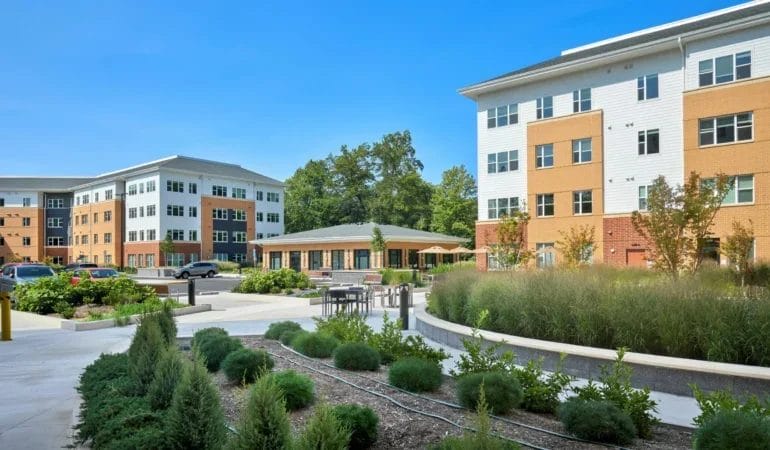
Lead image: Part of the One University redevelopment on County-owned land in Fairfax County, Virginia. Credit: Hartman Design Group.

Blog Post
Aerial view of downtown Detroit on a bright day, with a dense cluster of high-rise buildings along the Detroit River. Glass and stone skyscrapers rise above lower office buildings, while the river stretches behind the skyline and the far shoreline is visible in the distance under a blue, lightly clouded sky.

Lincoln Institute at the 2026 National Planning Conference

By Catherine Benedict, Março 17, 2026

Experts from the Lincoln Institute of Land Policy will lead and participate in discussions about planning for data centers, equitably addressing climate change, leveraging scenario planning, and more at the American Planning Association’s National Planning Conference from April 25 to April 28 in Detroit, Michigan.

We encourage conference attendees to stop by the Lincoln Institute’s booth (#100) in the exhibit hall to explore multimedia displays and our wide range of publications. Policy Focus Reports will be available free of charge, and conference attendees can purchase books at a discount, including City Tech: 20 Apps, Ideas, and Innovators Changing the Urban Landscape; Mayor’s Desk: 20 Conversations with Local Leaders Solving Global Problems; Scenario Planning for Cities and Regions; and Design with Nature Now. The discount will also be available for online orders.

In late May, Lincoln Institute researchers will present an additional set of online sessions in the virtual portion of the conference. 

Learn more about the in-person and online sessions featuring Lincoln Institute programs below. 

SATURDAY, APRIL 25

11:00 a.m.–12:00 p.m. ET  | The 2026 Trend Report: Emerging Trends and Signals (HPCC, Room 310AB)

We live in a world characterized by accelerating change and increased uncertainty. Planners are tasked with helping their communities navigate these changes and provide guidance on preparing for an uncertain future. However, conventional planning practices often fail to adequately consider the future, even while planning for it. Most plans reflect past data and current assumptions but do not account for trends emerging on the horizon. 

To create resilient and equitable plans for the future, planners need to incorporate foresight into their work. This presentation outlines emerging trends that will be vital for planners to consider and introduces strategies for making sense of the future while practicing foresight in community planning. By embracing foresight, planners can effectively guide change, foster more sustainable and equitable outcomes, and position themselves as critical contributors to thriving communities. The practice of foresight is imperative for equipping communities for what lies ahead. 

Moderator and Speaker: Ievgeniia Dulko, American Planning Association

Speakers:

  • Petra Hurtado, PhD, American Planning Association
  • Senna Catenacci, American Planning Association
  • Joseph DeAngelis, AICP, American Planning Association

SUNDAY, APRIL 26

10:30 a.m.–12:30 p.m. ET | Planning with Foresight (Room 250A-C)

Futures literacy is becoming increasingly important in planning. It is the skill that allows people to better understand the role the future plays in what they see and do. This involves imagining multiple plausible futures, incorporating future scenarios into our work, and planning with foresight.  

This interactive learning experience, presented in a learning lab format, focuses on applying strategic foresight in planning and serves as an essential learning lab for individuals dedicated to shaping a better future for their community.  

Moderator and Speaker: Ievgeniia Dulko, American Planning Association

Speakers:

  • Petra Hurtado, PhD, American Planning Association
  • Senna Catenacci, American Planning Association
  • Alykhan Mohamed, Lincoln Institute of Land Policy

1:00 p.m.–1:45 p.m. ET | Leading Cities Through Change—Mayors Panel (Room 420AB)

Local leaders will discuss innovations in planning, affordable housing, climate resilience, and public finance in the context of a rapidly changing political environment.  

Moderator and Speaker: Anthony Flint, Lincoln Institute of Land Policy

Speakers: 

  • Mayor Sheldon Neeley, City of Flint
  • Mayor Christopher Taylor, City of Ann Arbor
  • Mayor David LaGrand, City of Grand Rapids

1:00 p.m.–1:45 p.m. ET | When the Cloud Drops—Planning for Data Centers (Room 410AB)

As the demand for digital infrastructure and artificial intelligence accelerates, communities are increasingly approached by data center operators seeking suitable sites. While marketed as drivers of economic growth, these facilities often carry significant costs that are not fully transparent during the siting process. Data centers require immense physical resources—land for large footprints, vast amounts of water for cooling, and energy that strains local grids—raising questions about sustainability and long-term resilience. They also may introduce frontline communities to new sources of pollution, increased truck traffic, and environmental justice concerns, yet these voices are often marginalized in opaque political and regulatory processes. Promised economic benefits, such as job creation and tax revenue, are frequently overstated or unevenly distributed, leaving cities to shoulder environmental burdens with limited community gain.  

This presentation convenes a diverse panel to unpack complex planning challenges such as critically assessing data center proposals, advocating for accountability, and elevating community priorities. By examining the trade-offs of siting decisions through the lenses of resource management, equity, and governance, you will leave with practical strategies to question assumptions, navigate political opacity, and build stronger negotiating positions to ensure decisions genuinely serve the long-term interests of municipalities and their residents.  

Moderator and Speaker: Mary Ann Dickinson, Lincoln Institute of Land Policy

Speakers: 

  • Kyle Mucha 
  • Manny Patole
  • Brett Gracely  

2:00 p.m.–2:45 p.m. ET | Equitable Urban Planning for a Changing Climate (Room 410AB)

This presentation offers actionable strategies to help planners advance equitable policies that simultaneously address climate change, housing affordability, and economic inequality. A new Lincoln Institute Policy Focus Report, Planning in a Polycrisis, synthesizes responses from surveys of professional planners and policymakers working in cities across North America. It highlights emerging innovations and the trade-offs in effectively integrating these considerations into their work. Other constraints are caused by shifting political landscapes, limited funding, and deepening social vulnerabilities. However, these planners’ work also advances integrated, equity-driven urban climate planning, and their innovations form a framework for cities to move from ad hoc responses toward a long-term equitable climate urbanism.  

The report’s authors and practicing planners explore practical strategies to address the barriers and trade-offs cities face. The conversation sheds light on how climate and housing planning can co-adapt to counter rising socioeconomic vulnerability, with a focus on the most recent shifts in practice. Showcasing these examples aims to empower city leaders with specific recommendations and strategies for advancing a model of climate urbanism that responds to the demands of a polycrisis.  

Moderator and Speaker: Amy Cotter, Lincoln Institute of Land Policy

Speakers: 

  • Eleanor Sharpe 
  • Emilia Oscilowicz 
  • Adam Lyons  

5:00 p.m.–6:00 p.m. ET | APA Water and Planning Network Meeting (Marriott Renaissance Center Hotel, Joliet B Room)

This meeting is for those interested in the American Planning Association’s Water and Planning Network, a gathering of land use planners and water systems planners who work towards better integration of water and land use planning led by the Lincoln Institute’s Mary Ann Dickinson. The network’s activities include newsletters and webinars on relevant topics. The next 12 months of the Network’s activities will be discussed.

Moderator and Speaker: Mary Ann Dickinson, Lincoln Institute of Land Policy


THURSDAY, MAY 28 (VIRTUAL)

1:30 p.m. – 2:15 p.m. ET | Navigating Uncertainty—Using Strategic Foresight for Action-Oriented Planning (Channel 2)

Planners are fielding more “what-if” questions than ever as residents and local officials cope with increasing uncertainty and rapid change. Scenario planning is a systematic approach to answering these questions and kickstarting conversations with stakeholders about possible futures and their implications for today’s better decisions. These foresight tools can help planners create more flexible, resilient strategies to achieve local goals, come what may.  

 This presentation highlights how the Chicago Metropolitan Agency for Planning (CMAP) is using horizon scanning and exploratory scenario planning to define a long-term vision (the Century Plan) in a large, complex metropolitan region composed of seven counties, 284 municipalities, and 8.5 million residents. CMAP is considering drivers of change and an understanding of regional systems—including transportation, natural resources, and the economy—to explore the grand challenges and strategic responses that should define the region’s next era. Presenters explore how these tools are bringing foresight into planning and discussions for bold regional action. Learn how CMAP engaged with elected leaders and other planners, and how you can use resources from state and regional agencies to encourage local officials to shift to a horizon-based mindset.  

Moderator and Speaker: Heather Sauceda Hannon, AICP, Lincoln Institute of Land Policy

Speakers: 

  • Elizabeth Ginsberg 
  • Austen Edwards

2:30 p.m. – 3:15 p.m. ET | Exploratory Scenario Planning for Brazil’s Public Lands (Channel 1)

Brazil’s Secretariat for Federal Assets (SPU), an agency within the Ministry of Management and Innovation in Public Services (MIG), collaborated with the Lincoln Institute of Land Policy to apply exploratory scenario planning (XSP) to federal land policy. The work supports the Imóvel da Gente (Property of the People) program, which positions federal land as a strategic asset for socioenvironmental development.  

Attendees will learn how futures thinking can be integrated into national policy frameworks with practical methods for designing participatory scenario planning processes in complex governance settings. The session will present strategies for engaging multiple agencies, fostering collaboration among jurisdictions, and embedding equity goals into long-term planning.  

Through the case of Brazil’s first XSP initiative, participants will explore tools for identifying drivers of change, developing plausible future scenarios, and translating scenario outcomes into actionable strategies. These approaches can help planners address uncertainty, adapt to shifting conditions, and create policies that are resilient and inclusive.  

The session emphasizes how collaborative, futures-oriented methods can strengthen institutional capacity, broaden participation, and ensure that land use policies serve diverse community needs. Attendees will leave with transferable strategies to support equitable, future-ready planning in their contexts.  

Moderator and Speaker: Daniela Faria, Lincoln Institute of Land Policy

Speakers: 

3:30 p.m. – 4:30 p.m. ET | State Preemption for Housing—Benefit or Bane? (Channel 1)

Increasingly, states are taking legislative action to preempt planning and zoning decisions by local governments. Sometimes this can pave the way for important planning initiatives, but it can also prevent cities from achieving their goals. Hear a national land use law expert and planning directors from across the country discuss how state preemption is affecting local planning—for better and for worse.  

Moderator and Speaker: Heather Sauceda Hannon, AICP, Lincoln Institute of Land Policy

Speakers: 

  • Andreea D. Udrea 
  • Lucy Kempf 
  • Meagan McMahan

FRIDAY, MAY 29 (VIRTUAL) 

12:30 p.m.–1:15 p.m. ET | Integrated Resource Planning—Where Land Meets Water (Channel 1)

Pick up a range of perspectives and tools, including foundational context, local examples, and strategies using various planning frameworks, to advance the integration of land and water planning. Presenters bring a wealth of experience at multiple planning scales and contexts, both governmental and nongovernmental. 

Moderator and Speaker: William E. Cesanek, AICP, CDM Smith

Speakers:

  • Steve Epting
  • Rachael Belisle-Toler
  • Adam Schempp
  • Mary Ann Dickinson, Lincoln Institute of Land Policy

Catherine Benedict is the senior digital communications manager at the Lincoln Institute of Land Policy.

Lead Photo: The skyline of downtown Detroit, where the 2026 National Planning Conference will take place. Photo Credit: Vadym Terelyuk via iStock / Getty Images Plus.

Eventos

NPC 2026 Session: Integrated Resource Planning—Where Land Meets Water

Maio 29, 2026 | 12:30 p.m. - 1:15 p.m. (EDT, UTC-4)

Online, Channel 1

Offered in inglês

This session will be presented by the Lincoln Institute of Land Policy at the American Planning Association’s National Planning Conference.

Pick up a range of perspectives and tools, including foundational context, local examples, and strategies using various planning frameworks, to advance the integration of land and water planning. Presenters bring a wealth of experience at multiple planning scales and contexts, both governmental and nongovernmental.

Resources:


Detalhes

Data(s)
Maio 29, 2026
Horário
12:30 p.m. - 1:15 p.m. (EDT, UTC-4)
Local
Online, Channel 1
Idioma
inglês

Palavras-chave

Planejamento, Água, Planeamento hídrico

Eventos

NPC 2026 Session: State Preemption for Housing—Benefit or Bane?

Maio 28, 2026 | 3:30 p.m. - 4:30 p.m. (EDT, UTC-4)

Online, Channel 1

Offered in inglês

This session will be presented by the Lincoln Institute of Land Policy at the American Planning Association’s National Planning Conference.

Increasingly, states are taking legislative action to preempt planning and zoning decisions by local governments. Sometimes this can pave the way for important planning initiatives, but it can also prevent cities from achieving their goals. Hear from a national land use law expert and planning directors from across the country about how state preemption is affecting local planning—for better and for worse.


Detalhes

Data(s)
Maio 28, 2026
Horário
3:30 p.m. - 4:30 p.m. (EDT, UTC-4)
Local
Online, Channel 1
Idioma
inglês

Palavras-chave

Habitação, Planejamento

Eventos

NPC 2026 Session: Exploratory Scenario Planning for Brazil’s Public Lands

Maio 28, 2026 | 2:30 p.m. - 3:15 p.m. (EDT, UTC-4)

Online, Channel 1

Offered in inglês

This session will be presented by the Lincoln Institute of Land Policy at the American Planning Association’s National Planning Conference.

Brazil’s Secretariat for Federal Assets (SPU), an agency within the Ministry of Management and Innovation in Public Services (MIG), collaborated with the Lincoln Institute of Land Policy to apply exploratory scenario planning (XSP) to federal land policy. The work supports the Imóvel da Gente (Property of the People) program, which positions federal land as a strategic asset for socio-environmental development.

Attendees will learn how futures thinking can be integrated into national policy frameworks with practical methods for designing participatory scenario planning processes in complex governance settings. The session will present strategies for engaging multiple agencies, fostering collaboration among jurisdictions, and embedding equity goals into long-term planning.

Through the case of Brazil’s first XSP initiative, participants will explore tools for identifying drivers of change, developing plausible future scenarios, and translating scenario outcomes into actionable strategies. These approaches can help planners address uncertainty, adapt to shifting conditions, and create policies that are both resilient and inclusive.

The session emphasizes how collaborative, futures-oriented methods can strengthen institutional capacity, broaden participation, and ensure that land use policies serve diverse community needs. Attendees will leave with transferable strategies to support equitable, future-ready planning in their contexts.


Detalhes

Data(s)
Maio 28, 2026
Horário
2:30 p.m. - 3:15 p.m. (EDT, UTC-4)
Local
Online, Channel 1
Idioma
inglês

Palavras-chave

Planejamento, Planejamento de Cenários

Eventos

NPC 2026 Session: Navigating Uncertainty—Using Strategic Foresight for Action-Oriented Planning

Maio 28, 2026 | 1:30 p.m. - 2:15 p.m. (EDT, UTC-4)

Online, Channel 2

Offered in inglês

This session will be presented by the Lincoln Institute of Land Policy at the American Planning Association’s National Planning Conference.

Planners are fielding more “what-if” questions than ever as residents and local officials cope with increasing uncertainty and rapid change. Scenario planning is a systematic approach to answering these questions and kickstarting conversations with stakeholders about possible futures and their implications for today’s better decisions. These foresight tools can help planners create more flexible, resilient strategies to achieve local goals, come what may.

This presentation highlights how the Chicago Metropolitan Agency for Planning (CMAP) is using horizon scanning and exploratory scenario planning to define a long-term vision (the Century Plan) in a large, complex metropolitan region composed of seven counties, 284 municipalities, and 8.5 million residents. CMAP is considering drivers of change and an understanding of regional systems—including transportation, natural resources, and the economy—to explore the grand challenges and strategic responses that should define the region’s next era. Presenters explore how these tools are bringing foresight into planning and discussions for bold regional action. Learn how CMAP engaged with elected leaders and other planners, and how you can use resources from state and regional agencies to encourage local officials to shift to a horizon-based mindset.


Detalhes

Data(s)
Maio 28, 2026
Horário
1:30 p.m. - 2:15 p.m. (EDT, UTC-4)
Local
Online, Channel 2
Idioma
inglês

Palavras-chave

Planejamento, Planejamento de Cenários

Eventos

NPC 2026 Session: Equitable Urban Planning for a Changing Climate

Abril 26, 2026 | 2:00 p.m. - 2:45 p.m. (EDT, UTC-4)

Detroit, MI United States

Offered in inglês

This session will be presented by the Lincoln Institute of Land Policy at the American Planning Association’s National Planning Conference.

This presentation offers actionable strategies to help planners advance equitable policies that simultaneously address climate change, housing affordability, and economic inequality. A new Lincoln Institute Policy Focus Report, Planning in a Polycrisis, synthesizes responses from surveys of professional planners and policymakers working in cities across North America. It highlights emerging innovations and the trade-offs in effectively integrating these considerations into their work. Other constraints are due to shifting political landscapes, limited funding, and deepening social vulnerabilities. However, these planners’ work also advances integrated, equity-driven urban climate planning, and their innovations form a framework for cities to move from ad hoc responses toward a long-term equitable climate urbanism.

The report’s authors and practicing planners explore practical strategies to address the barriers and trade-offs cities face. The conversation sheds light on how climate and housing planning can co-adapt to counter rising socioeconomic vulnerability, with a focus on the most recent shifts in practice. Showcasing these examples aims to empower city leaders with specific recommendations and strategies for advancing a model of climate urbanism that responds to the demands of polycrisis.

Resources:


Detalhes

Data(s)
Abril 26, 2026
Horário
2:00 p.m. - 2:45 p.m. (EDT, UTC-4)
Local
HPCC
Room 410AB
Detroit, MI United States
Idioma
inglês

Palavras-chave

Mitigação Climática, Planejamento Ambiental

Eventos

NPC 2026 Session: When the Cloud Drops—Planning for Data Centers

Abril 26, 2026 | 1:00 p.m. - 1:45 p.m. (EDT, UTC-4)

Detroit, MI United States

Offered in inglês

This session will be presented by the Lincoln Institute of Land Policy at the American Planning Association’s National Planning Conference.

As the demand for digital infrastructure and artificial intelligence accelerates, communities are increasingly approached by data center operators seeking suitable sites. While marketed as drivers of economic growth, these facilities often carry significant costs that are not fully transparent during the siting process. Data centers require immense physical resources—land for large footprints, vast amounts of water for cooling, and energy that strains local grids—raising questions about sustainability and long-term resilience. They also may introduce frontline communities to new sources of pollution, increased truck traffic, and environmental justice concerns, yet these voices are often marginalized in opaque political and regulatory processes. Promised economic benefits, such as job creation and tax revenue, are frequently overstated or unevenly distributed, leaving cities to shoulder environmental burdens with limited community gain.

This presentation convenes a diverse panel to unpack complex planning challenges such as critically assessing data center proposals, advocating for accountability, and elevating community priorities. By examining the trade-offs of siting decisions through the lenses of resource management, equity, and governance, you will leave with practical strategies to question assumptions, navigate political opacity, and build stronger negotiating positions to ensure decisions genuinely serve the long-term interests of municipalities and their residents.

Resources:


Detalhes

Data(s)
Abril 26, 2026
Horário
1:00 p.m. - 1:45 p.m. (EDT, UTC-4)
Local
HPCC
Room 420AB
Detroit, MI United States
Idioma
inglês

Palavras-chave

Planejamento de Uso do Solo, Planeamento hídrico

Eventos

NPC 2026 Session: Planning with Foresight

Abril 26, 2026 | 10:30 a.m. - 12:30 p.m. (EDT, UTC-4)

Detroit, MI United States

Offered in inglês

This session will be presented by the Lincoln Institute of Land Policy at the American Planning Association’s National Planning Conference.

Futures literacy is becoming increasingly important in planning. It is the skill that allows people to better understand the role the future plays in what they see and do. This involves imagining multiple plausible futures, incorporating future scenarios into our work, and planning with foresight.

This interactive learning experience, presented in a learning lab format, focuses on applying strategic foresight in planning and serves as an essential learning lab for individuals dedicated to shaping a better future for their community.

Resources:


Detalhes

Data(s)
Abril 26, 2026
Horário
10:30 a.m. - 12:30 p.m. (EDT, UTC-4)
Local
HPCC
Room 250A-C
Detroit, MI United States
Idioma
inglês

Palavras-chave

Planejamento, Planejamento de Cenários