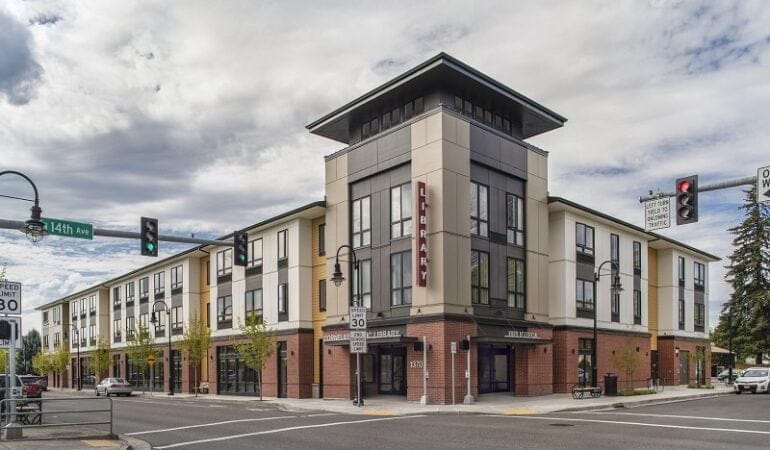
In early 2019, the town of Cornelius, Oregon, celebrated the opening of a new mixed-use development called Cornelius Place. Situated on the town’s main thoroughfare, the building features a 13,650-square-foot public library that replaces one at City Hall that was only one-quarter that size. It also includes a café, a courtyard that will host concerts and a farmers’ market, and a 2,900-square-foot YMCA recreation and fitness center. “Our town didn’t have a senior, youth, or community center, so our library is a lot more than a repository for books—it’s a multi-purpose community space as well,” says Library Director Karen Hill, who shepherded the project.
Cornelius Place offers something else for the community: above the library are 45 apartments intended to be affordable for seniors with household incomes of up to 60 percent of area median income (AMI). Eleven apartments are part of the Section 8 program, making them more deeply affordable by requiring households to pay no more than 30 percent of their income in rent.
Cornelius, a city of 12,400 in metro Portland, anticipates growing by more than one-third in the next five years. Cornelius Place is its first three-story building, first mixed-use building, and an anchor for a new walkable-downtown master plan, says Ryan Wells, community development director. Combining a new public library with affordable senior housing made both projects possible. “There is cost sharing to construction when you mix those uses,” says Wells. “We could not have built the library on its own.”
Despite predictions that they would die in the digital age, public libraries in many U.S. communities are in fact busier and more loved than ever. Increasingly viewed as community hubs, the nation’s 16,568 public libraries are places where visitors peruse the stacks, focus on laptops, upgrade job skills, study English, try out “maker” equipment, connect with social workers on staff, and more. But many libraries are struggling to meet this demand with facilities that are small, outdated, and in need of repair—or in need of major upgrades to offer the collaborative areas, flexible workspaces, and cutting-edge technology that patrons increasingly expect.
As public libraries look to rebuild, however, they often face financial challenges. Land values and construction costs in many cities are on the rise, making such projects increasingly costly and frequently requiring special tax levies or capital campaigns. Meanwhile, cities seeking new solutions to the affordable housing crisis are eyeing some desirable real estate: the air space above those typically low-lying public libraries. Joining forces makes it possible to invest public dollars in—and leverage additional funds for—projects that serve the community in multiple ways.
“The evolution of public libraries in U.S. cities generally has followed the evolution of community needs, and in a growing number of cities, that now means combining new libraries with affordable housing,” says Loida Garcia-Febo, a library consultant and 2018–2019 president of the American Library Association. “Most libraries see their value in how they integrate and respond to the community, and it’s clear that in tight real estate markets, libraries can leverage their physical assets to increase the value they provide to the community.”
Living at the Library
Combining libraries with apartments is “part of a trend away from single-use zoning and back to mixed uses,” says Robin Hacke, executive director of the Center for Community Investment at the Lincoln Institute, which helps disadvantaged communities harness investment to achieve their economic, social, and environmental priorities. Hacke added that the trend also reflects a recognition of the importance of libraries as “third places for civic engagement and social cohesion.”
One of the nation’s first examples of a library and affordable housing sharing space took shape in San Francisco in 2006. As part of the 50-acre Mission Bay redevelopment, the city partnered with Catellus Development Corporation and Mercy Housing, a nonprofit affordable housing developer, to add a 7,500-square-foot branch library as a civic anchor. The building that houses the library includes a community meeting hall, an adult day health center, a coffee shop, and Mission Creek Senior Housing, with 140 apartments for low-income seniors.
Though it has been successful, this project so far has been a one-off for the city. At least one public official has asked the city’s acting librarian to explore whether future library renovations might be combined with affordable housing. “We are in an affordability crisis and we need to maximize our existing public land for 100 percent affordable housing,” wrote Sandra Lee Fewer, a member of the city’s Board of Supervisors, in an email response to Next City (Brey 2018). “It would be a missed opportunity to not pursue adding affordable housing above newly renovated public resources like our libraries.”
Although San Francisco has been slow to replicate the Mission Bay model, other cities have taken up the idea, including Chicago. Under Mayor Rahm Emanuel’s leadership from 2011 to 2019, the city made more than $300 million in new investments to renovate or build 30 public libraries in the city’s network of 80 libraries, which serves 10 million visitors annually. The “Branching Out: Building Libraries, Building Communities” initiative has focused on investing in libraries as community anchors with high-quality civic architecture and programming.
Since 2011, six new libraries have been built, and 14 branches have seen significant updates. By the end of 2019, construction of five additional libraries will be finished, with four existing libraries renovated.
Three of the new libraries are co-located with housing in world-class examples of modern architecture. In 2016, the city announced a partnership between the Chicago Public Library (CPL) and Chicago Housing Authority (CHA) that would cut costs, increase library patrons, and invest in attractive, sustainable buildings that provide the kinds of services the city needs. A city-run competition attracted submissions from 32 architecture firms, and three award-winning, Chicago-based firms were selected to design the projects:
- The six-story, $33.4 million Independence Branch Library and Apartments in Irving Park on the Northwest Side, designed by John Ronan Architects and developed by Evergreen Real Estate Group, has a two-level library featuring a music studio and makers’ workshop, topped by 44 subsidized apartments for seniors.
- The $34 million Northtown Public Library and Affordable Apartments in West Ridge, a four-story, curvilinear structure designed by Perkins and Will, also was developed by Evergreen Real Estate Group. The bright, 16,000-square-foot library has a garden and a rooftop terrace shared with tenants. The upper floors include 44 apartments for seniors, with 30 CHA public housing and 14 affordable apartments.
- The seven-story, $41 million Little Italy Branch Library and Taylor Street Apartments on the Near West Side, designed by Skidmore, Owings & Merrill (SOM) and developed by Related Midwest, includes a single-level, open-floor-plan library and six floors with 73 apartments above, including 37 CHA public housing, 29 affordable, and seven market-rate apartments.
Besides traditional library programs, such as book clubs for seniors and intergenerational educational and cultural programming, each branch offers early-learning playspaces and facilities for teens to explore digital design, music, and recording technology with help from skilled mentors. They also provide high-tech programming such as 3D printing, virtual reality, and robotics, as well as dedicated workforce development support and technology tutors.
In West Ridge and Irving Park, “these projects enabled CHA to deliver new housing units and expand affordable housing opportunities in two communities where CHA had not previously had much of a presence,” says Molly Sullivan, CHA senior director of communications. “This helped meet a demand for affordable senior housing in those communities.” The library system also had been seeking ways to bring modern facilities and services to these communities, says Sullivan, so combining housing with libraries made sense.
“Co-locating libraries with affordable housing provides housing and learning centers where they are needed—and makes communities more resilient and sustainable,” says Sullivan. “We know that housing is vital to our neighborhoods, but strong, healthy communities also require anchors that provide resources for lifelong learning.”
Critiquing the three projects in The New York Times, architecture critic Michael Kimmelman characterized the libraries as “just plain good urban planning.” He praised Emanuel for promoting the idea that “distinguished civic buildings in underserved neighborhoods constituted their own brand of equity” (Kimmelman 2019).
In June, Smart Growth America named the Taylor Street library its Project of the Year. “We knew when we embarked on this unique project and partnership that we were building more than a new building,” said former Chicago Housing Authority CEO Eugene E. Jones, Jr., when the award was announced. “We were creating a community anchor and asset that will have a lasting impact on residents and this neighborhood” (CHA 2019).
A Branch Grows in Brooklyn
Brooklyn is also leveraging opportunities to improve library infrastructure with housing, using aging branches as sites for redevelopment projects that combine new libraries with affordable apartments, or, in one case, sleek new tower architecture with market-rate luxury condominiums.
The Brooklyn Public Library (BPL) is an independent library system that serves the 2.5 million residents of the borough. BPL is the fifth-largest library system in the U.S., with 59 neighborhood libraries and 7.9 million annual visits. That might sound like a lot of capacity, but many of the system’s buildings are crowded, worn, and inadequate for modern use. In total, New York City libraries have some $1.1 billion in unfunded capital needs, mostly repairs, with $271 million needed just in Brooklyn, according to a 2014 report by the Center for an Urban Future, an independent nonprofit research and policy organization (Giles 2014). The report recommends ways to bolster libraries as community centers, including incorporating affordable housing.
“We see libraries performing a much bigger role in New York,” says Eli Dvorkin, editorial and policy director for the Center. “We have never relied on libraries as we do today.” He says libraries “are the single resource of first resort for immigrants, teenagers, seniors. They are the 21st-century settlement house, building the social infrastructure of our cities, but we haven’t invested in their infrastructure.”
That is changing with projects like Brooklyn’s Sunset Park Public Library redevelopment. Built in the 1970s, the popular Sunset Park branch was too small to meet the needs of a community whose population increased 34 percent between 1990 and 2014, double the citywide growth rate. During the same period, housing became more expensive, with median rents increasing 63 percent, far outpacing Brooklyn’s median income growth of 25 percent. In 2017, the city issued a competitive RFP and selected the Fifth Avenue Committee (FAC), a Brooklyn-based nonprofit affordable housing developer and social justice organization, as a partner in revamping the library. FAC proposed a 21,000-square-foot library—double the original size—with 49 units of permanently affordable housing on top.
Located on the first two floors of the eight-story building, the library will be outfitted with collections, technology, and flexible space. Above that, the apartments are slated for low- and middle-income households ranging from formerly homeless residents with no income to those earning between 30 and 80 percent of AMI. Apartments in the building, which is expected to open in 2020, will rent for well below the current market rents in the neighborhood.
“The City of New York isn’t creating more land, but our population is growing, and resources are in demand for both libraries and affordable housing,” says Michelle de la Uz, executive director of FAC and a New York City planning commissioner. The city has a long history of combining civic uses with other development, she noted, but those projects haven’t included 100 percent affordable housing. “We wanted to create the model so it can be replicated and we can have more of these win-win-win situations for libraries, for people who need affordable housing, and for taxpayers” to achieve the greatest benefit possible from public land.
The Sunset Park branch is one of several library-housing hybrids in New York. The three-story, 26,000-square-foot Inwood Public Library in Upper Manhattan, now under construction, anchors a 14-story mixed-use building called the Eliza, which has 175 deeply affordable apartments, universal pre-K classrooms, a social services delivery center, and amenities including a children’s playroom, gym, and roof garden.
The Inwood site was rezoned to allow for a sizeable increase in height and density, notes de la Uz, while “at Sunset Park, we built as-of-right and didn’t have to rezone—the height was allowed.” She agrees with a recommendation from the Center for an Urban Future that rezoning, where appropriate, would make many more of these projects feasible (see sidebar). “We’ve done many projects in partnership with government, and giving land at a reduced rate is how you make affordable housing happen,” she says. “The project has to be a certain size” to support the cost of construction, she notes, and rezoning and revaluing the land on which libraries sit to allow for higher buildings and greater density “would allow for many more affordable units above libraries and greater public benefit to be realized.”
Not Always Affordable
Not all of the city’s library-housing projects offer affordable housing, and some have inspired controversy. The 28,000-square-foot 53rd Street Library across from the Museum of Modern Art in Midtown Manhattan, which opened in 2016, provides a three-story base for the 50-story luxury Bacarat hotel and apartment tower. And a rebuild of BPL’s Brooklyn Heights branch saw the original 1962 building demolished and the site reenvisioned as One Clinton, a mixed-used, 38-story condominium tower with a new library, STEM learning center, and retail space at its base. Due to be completed in 2020, the tower’s 133 market-rate condominiums are listed for between $1 million and $6.4 million.
The Brooklyn Heights branch would have required over $9 million for renovations and upgrades. Instead, Hudson Companies paid $52 million for the old branch library site. That money is providing funding for BPL’s capital needs, including $12 million to fit out the new One Clinton library—and $10 million for the Sunset Park branch.
Critics of One Clinton have been outspoken about the dangers of “privatizing” public land and property, the plan to scrap the old library rather than renovating it, and the new project’s lack of on-site affordable housing. As part of the deal, Hudson Companies is building 114 units of permanently affordable workforce apartments nearby, at no cost to the city. Off-site development of affordable housing within the same community district is allowed under the city’s mandatory inclusionary housing program. The apartments are intended for households earning from 60 to 125 percent of AMI, with half reserved for local residents.
Milwaukee is also combining a mix of market-rate and affordable housing with libraries. Milwaukee Public Library (MPL) has partnered with developers to build four new mixed-use branches that cost the library system a total of $18 million. They include the Mitchell Street Branch Library and Alexander Lofts, which opened in 2017 in the South Side historic commercial district. With 23,000 square feet on two floors that feature a large community room, recording studio, makerspace with kitchen, and a reading area with a fireplace, Mitchell Street is now the city’s largest branch library. The $21 million project—$6 million for the library and $15 million for market-rate housing—involved the restoration of a historic building that once housed a department store. The new development has 52 market-rate apartments and eight adjacent townhouses.
The housing for these four projects varies from affordable to market-rate, a decision left to the developer, says Sam McGovern-Rowen, MPL project manager. “The library board and the city have expressed a preference for mixed-use housing developments, but we do not dictate the affordability aspect,” he says. “The developers propose projects through our RFP process, and we have selected projects that cover the full spectrum of affordability.”
Co-locating libraries with at least some market-rate housing “means that the library can play a role in community economic development,” McGovern-Rowen points out. “We take formerly untaxed property and put it on the tax rolls, generating hundreds of thousands of dollars in tax base so far.” The libraries have also been “a shot in the arm to the neighborhoods and business districts where we build these projects,” he says, as thousands of library visitors and new residents patronize local businesses.
Unlocking the Value of Land
Co-locating libraries and affordable housing “seems to fit into a broader trend of unlocking the value of land,” says Rick Jacobus, principal of Street Level Advisors in Oakland, California, and author of a Lincoln Institute report, Inclusionary Housing: Creating and Maintaining Equitable Communities (Jacobus 2015). “Libraries also are an obvious and synergistic pairing with affordable housing, which needs a ground-floor activation that is not housing.”
“A common challenge in mixed-use buildings, especially with developers of affordable housing, is they run into difficulty locating the right institution or organization to partner with for ground-floor development, and banks then have trouble financing the projects,” confirmed Hacke of the Center for Community Investment. Incorporating a library, Hacke says, “can contribute to financial viability for a building, but also to the well-being of people who live in the building. When you can bake that into the design of the project, it serves the financials as well as the residents.”
Are co-located libraries and affordable housing any more difficult to finance than separate projects? Yes and no. Generally a city’s public library division pays for the library, and the housing developer, whether it’s the local housing authority, a nonprofit, or a private for-profit developer, works separately to secure financing. The affordable housing component, and often the library, typically have to seek multiple funding partners. But co-location can provide a core and shell for the library building, some shared space, and a catalyst for additional funding. “Mixed-use development and shared costs make the building of new libraries affordable,” says ALA’s Garcia-Febo.
The $20 million Cornelius Place project in Oregon, developed by the national nonprofit BRIDGE Housing with local service provider Bienestar, was 12 years in the planning and required more than a dozen financial partners. After a library levy failed to pass, the library conceived of introducing senior housing as a feasibility step. The library cobbled together its $5.8 million share of construction costs from sources such as local businesses, individuals, and county, state, and federal funds, including a $500,000 grant from the National Endowment for the Humanities. The city owns the land, and the building is owned by BRIDGE Housing, with the library paying a nominal leasing fee for its space.
Mixed-use projects, especially those with an affordable housing component, can also offset construction costs by taking advantage of low-income housing tax credits or state tax credits. In 2009, the Miami-Dade Public Library System joined forces with the county’s Homeless Trust and Carrfour Supportive Housing to build the Hispanic Branch Library and, above it, the Villa Aurora Apartments. The project included 76 units of permanently affordable housing: 39 for formerly homeless families and 37 for low-income families. The new 12,000-square-foot branch library quickly became a community destination. Carrfour, a nonprofit affordable housing provider, built the complex on the site of a former Salvation Army shelter and leases the first-floor space to the library system. Funding sources for the $29 million project included the Enterprise Social Investment Corporation’s tax credit equity, an incentive loan from the Florida Housing Finance Corporation, deferred developer fees, and city, county, and federal funds. The cost to the library system was $3 million.
The City of Chicago worked to persuade federal officials that public libraries could be co-located with public housing without putting federal housing subsidies at risk, noted Kimmelman in The New York Times. The three Chicago projects had different funding packages. Financing for the Little Italy branch, for example, included U.S. Department of Housing and Urban Development (HUD) funds, federal tax credits, revenue from two tax-increment financing districts, and another housing fund. By adding the housing component to the library, the project qualified for federal tax credits and government housing funds, including from HUD, that provided almost half the needed funds. Thus, the construction of the building was underwritten significantly by co-location.
In Brooklyn, FAC is leveraging eight sources to finance the $35.8 million Sunset Park library, which breaks down to $7.8 million for the “core and shell” of the library and $28 million for the residential portion. Funding sources include over $10 million in state and federal affordable housing tax credits and $8.75 million from the New York City Department of Housing Preservation and Development. The developer is constructing the building at no cost to BPL, which will fit out the new library for $10 million—half the cost of demolishing the library and building a new one—derived from the sale of air rights to the old Brooklyn Heights library site. The city turned the property over to FAC during development, but when construction is completed, the city will own the library in perpetuity, with both its portion and the housing units treated as condominiums. FAC will own and manage the apartments.
For the Common Good
Smart rezonings could allow dozens more libraries to be upgraded and more co-located library and affordable housing projects to be built. The Center for an Urban Future worked with the architecture firm Marble Fairbanks to identify at least 25 libraries in New York City with surplus development rights that they could leverage for affordable housing or other uses, depending on the community’s needs.
“Cities are trying to lean more heavily into the production of affordable housing, and what’s relevant here is the land,” says Jacobus. “If you have an asset like urban land, you might as well use it to its fullest potential. This could happen in many cities with one- or two-story libraries in places that could be denser. By building a building that is denser, they’re able to unlock the value of the land to subsidize affordable housing, and that extra value is a public asset.”
Even projects with market-rate rather than affordable housing can provide significant public value, says Jacobus. The One Clinton project in Brooklyn Heights, for example, provides the library, housing to ease a tight market, and a fair amount of capital to underwrite improvements to other new libraries, while the developer also provides affordable housing nearby. “They were able to use the value of an asset to leverage affordable housing,” Jacobus says. “It’s a smart move and there’s a trend there that seems promising.”
Pairing libraries and affordable housing helps cities meet other goals such as financial management and neighborhood development, he notes. “The bigger issue is that you get obvious public benefit out of the project, which helps with public acceptance of affordable housing,” often a target for community opposition. While Jacobus doesn’t see mixed-use housing and library projects as a widespread trend—in part because libraries still require additional public funding to build and operate—he does see cities becoming more entrepreneurial and using all the resources they can to create more affordable housing.
Garcia-Febo of the ALA is more optimistic. As a wise use of public land that provides value to the community, co-location of libraries with housing “is a great new opportunity to distribute services across neighborhoods, and I think we’ll see many more of them,” she said. “It’s difficult to equate the value of libraries with the land or air space they occupy, but for many library leaders, this is an opportunity to reinforce the value of libraries for access, education, lifelong learning, and the civic commons.”
Co-location Considerations
For a mixed-use library and housing project to succeed, planners must consider many factors, including the following:
Zoning. Zoning should allow for mixed uses combining residential with public institutions (and perhaps other uses), and for the height and density required to build a critical mass of housing over library space. A 2018 neighborhood rezoning decision by the New York City Council allowed for mixed uses and additional building height to achieve goals such as developing affordable apartments and encouraging economic development that benefits the local community. The decision paved the way for the 14-story Eliza building, which combines the new Inwood Library with 175 affordable apartments.
Air Rights. Development rights generally refer to the maximum amount of floor area permissible on a lot. When the actual built floor area is less than the maximum permitted floor area, the difference is referred to as “unused development rights,” or “air rights.” The value of air rights, which can be sold to adjacent property owners or others, can vary by location and can depend on factors such as zoning restrictions, the height and density of adjacent buildings, and proximity to public transit and services.
Financing. Libraries generally are funded by a city’s capital budget or by special tax levies. Market-rate housing generally is financed privately or through commercial banks. Private developers of affordable housing can take advantage of low-income housing tax credits. Municipal housing authorities can access funds from local, state, and federal sources to develop subsidized public housing for low-income households. Depending on the needs of the community and developers’ plans, co-location can include a mix of publicly subsidized, affordable, and market-rate housing; the latter can help underwrite development of the more affordable units.
Tax Implications. Market-rate housing that shares space with libraries is almost always taxable, so these projects can help expand a community’s tax base. In contrast, affordable housing is usually tax-exempt, at least when it is owned by a housing authority or land trust. The best housing option depends on a community’s needs—fiscally stressed cities may prioritize their tax base, while hot-market cities prioritize affordable housing. In general, reducing costs for the construction of libraries and public housing will benefit taxpayers.
Kathleen McCormick, principal of Fountainhead Communications in Boulder, Colorado, is a contributing editor for Land Lines. She writes frequently about sustainable, healthy, and resilient communities.
Photograph: Cornelius Place, a mixed-use development in Cornelius, Oregon, combines a ground-floor library with affordable senior housing that is walkable to the downtown area. Credit: Scott | Edwards Architecture, photo by Pete Eckert.
References
Brey, Jared. 2018. “How Library Systems Can Help Address Affordable Housing Crises.” Next City. June 18, 2018. https://nextcity.org/daily/entry/how-library-systems-can-help-address-affordable-housing-crises.
CHA (Chicago Housing Authority). 2019. “Taylor Street Apartments and Little Italy Branch Library Garner National Award.” Press release. June 24. https://www.thecha.org/news-media/news/taylor-street-apartments-and-little-italy-branch-library-garner-national-award.
Giles, David, Jeanette Estima, and Noelle Francois. 2014. Re-envisioning New York’s Branch Libraries. New York, NY: Center for an Urban Future. September. https://nycfuture.org/pdf/Re-Envisioning-New-Yorks-Branch-Libraries.pdf.
Jacobus, Rick. 2015. Inclusionary Housing: Creating and Maintaining Equitable Communities. Policy Focus Report. Cambridge, MA: Lincoln Institute of Land Policy. https://www.lincolninst.edu/publications/policy-focus-reports/inclusionary-housing.
Kimmelman, Michael. 2019. “Chicago Finds a Way to Improve Public Housing: Libraries.” The New York Times. May 15. https://www.nytimes.com/2019/05/15/arts/design/chicago-public-housing.html.


 SHARE
SHARE


 SPU’s water infrastructure work is one such effort — scheduled for construction from 2019 to 2024, the updates will confront sea level rise in Seattle’s only riverside neighborhood which