Topic: finanzas públicas

Eventos

2024 Urban Economics and Public Finance Conference

Abril 19, 2024 - Abril 20, 2024

Cambridge, MA United States

Offered in inglés

The economic growth and development of urban areas are closely linked to local fiscal conditions. This research seminar offers a forum for new academic work on the interaction of these two areas. It provides an opportunity for specialists in each area to become better acquainted with recent developments and to explore their potential implications for synergy.


Detalles

Fecha(s)
Abril 19, 2024 - Abril 20, 2024
Hora
8:30 a.m. - 12:15 p.m. (EDT, UTC-4)
Ubicación
Lincoln Institute of Land Policy
Cambridge, MA United States
Idioma
inglés

Palabras clave

desarrollo económico, economía, vivienda, inequidad, uso de suelo, planificación de uso de suelo, valor del suelo, tributación del valor del suelo, gobierno local, tributación inmobilaria, finanzas públicas, orden espacial, tributación, urbano, valuación, impuesto a base de valores

This video teaching case study tells the story of the Chicago Skyway Toll bridge and how the city of Chicago endured years of complications before it turned the liability into a valuable asset. The purpose of this case study is to explain the evolution of a city asset and examine one option for monetizing that asset. This will enable students to critically assess the decisions made by the city throughout the story.

Students should consider the following questions when watching this video:

  1. What other options were available to the city besides leasing the Skyway?
    Do you think using the lease model of a public private partnership was the best way to deal with the Skyway?
    Where do you think the money from the lease went (e.g. was it used to plug a budget deficit, or was it used to fund city projects)?

Credits:
Production Company: Skalawag Productions
Executive Producer: Mark Skala
Director/Producer: Monica Zinn
Producer: Kyle Goldhoff
Associate Producer: Bailey Synclaire
Director of Photography: Aaron Dolan
Editor: Aaron Dolan
Motion Graphics: Ryan Kelly
Archival Researcher: Juanita White
Drone Footage: Aaron Dolan
Project Supervisor: Dakin Henderson
Advisors: Ge Vue & Jenna DeAngelo Martin

Featuring:
Tom Morsch
Walter Knorr

Archival:
AP Images
Barry Brecheisen/WireImage via Getty Images
Chicago History Museum; STM-000304770; Rich Hein
Chuckman Chicago Nostalgia
Envato Elements
Getty Images
Library of Congress
Millennium Park Foundation
National Archives
Pond5
The Times of Northwest Indiana
Wikimedia

Introduction

This three-part video teaching case study examines how Chicago’s Millennium Park was financed and how it is currently funded so that it can remain a city asset for years to come. The purpose of this case study is to explain the different ways this megaproject was financed so that students can critically assess the decisions made by the city throughout the development process.

Topics

Public-private partnerships, debt financing, tax increment financing, urban redevelopment

Timeframe

1996 – 2006

Prerequisite Knowledge

None

Learning Objectives

  • Analyze the different policy and funding options available to urban decision-makers when planning and financing public infrastructure projects
  • Evaluate the benefits and risks of public-private partnerships in the financing of parks vs. other public infrastructure projects

Summary

This case traces the evolution of Millennium Park, from Mayor Richard M. Daley’s 1998 introduction of the planned makeover of an underused rail yard adjacent to Grant Park, through the new park’s opening in 2004, and its subsequent history. It weaves together video interviews and informational text to illustrate the funding mechanisms and strategies for public infrastructure projects, in particular those involving public-private partnerships. The project was also beset with cost overruns, delays, engineering challenges, and problems with management and oversight. The relatively pedestrian scheme unveiled in 1998, with an estimated cost of $150 million ($120 million public and $30 million private), grew in scope and ambition to an almost half-billion-dollar undertaking ($270 million public and $220 million private). While the end product has been widely hailed, its complex funding picture reflects the political and economic realities confronting its managers.

Financing Development

On March 30, 1998, nine years into his tenure as Mayor of Chicago, Richard M. Daley unveiled plans to convert an underused Illinois Central rail yard on the northwest corner of Grant Park into a new green space and performance venues in time for the turn of the millennium. The mayor and his supporters touted the proposed Lakefront Millennium Park as completing the shoreline scheme advanced by Daley’s hero Daniel Burnham in his 1909 Plan of Chicago. The new reclamation plan called for the creation of a transit hub topped by a massive green roof spanning the railroad tracks. This would take the form of a 16-acre Beaux Arts-inspired park, designed by architectural firm Skidmore, Owings & Merrill (SOM). As then-chief financial officer, Walter Knorr, recalls, the presentation was short on financial details (Knorr 2018). The mayor and his senior staff had been advised by SOM to avoid specifics on the topic of cost. In general terms, parking revenue could anchor the project’s financing. Daley also sought to tap private resources to construct the new park. Confronted at the press conference with the inevitable question of the project’s price tag, then-transportation commissioner, Tom Walker, cited the ballpark figure of $150 million that was hashed out during a city hall planning meeting days earlier and was based on SOM’s qualified cost estimates.

Knorr found the occasion somewhat awkward. Too many variables remained unclear for a solid estimate of the cost to build the park. From that point, the project’s fiscal planners had to play catch-up. Knorr and his staff and other city officials had to adapt to a constantly shifting set of requirements, planning the project and scoping out funding on the basis of scant and rapidly changing information. Typically, in such major infrastructure projects, planners had the benefit of feasibility studies and pro forma financial statements outlining various scenarios before committing to a strategy. Given the preliminary state of the park design and the relatively tight initial deadline of the new millennium, this wasn’t possible. One thing was clear from the start, though. The mayor pledged that taxpayers wouldn’t foot the bill for the public investment in the project.

From his first inauguration in April 1989, Mayor Daley was focused on developing Chicago’s downtown and especially its shoreline. Daley came into office with the backing of groups who shared his interest in remaking the lakefront and building an economic development strategy around tourism, finance, real estate, and global business. Projects like the renovation of Soldier Field and Navy Pier (and eventually the creation of Millennium Park) were catalysts for tourism and real estate development, raised property values, and helped attract businesses and professionals to the central city. Like the rerouting of Lake Shore Drive and the creation of a landscaped campus around the museums in Grant Park, they were large-scale public works and infrastructure projects that created jobs and provided contracts for local firms.

Chicago and surrounding Cook County in the mid-1990s had capped property taxes following a tax revolt in the adjacent, so-called ‘collar,’ counties (Fegelman and Becker 1995). Thus, Knorr sought to identify funding sources other than politically fraught property taxes. He proposed the selling of parking revenue bonds. The appeal of the parking scheme was that the city’s funding could come through the sale of tax-exempt bonds supported by revenue and parking taxes from city-owned parking garages rather than general obligation bonds, which would be supported by the city’s full faith and credit and are payable from a dedicated property tax levy.

The City, with the approval of the city council, sold $150 million in parking revenue bonds, a figure based on an estimate of the number of parking spaces and anticipated parking rates, factoring in operating expenses and debt service, according to Knorr. Because he wasn’t able to secure firm estimates of the planned garage’s construction costs or anticipated revenues, Knorr had to include in the bond offering a “limited general obligation” backup pledged to other city revenue streams. These could include, various taxes and fees, though not additional property taxes, explained David Narefsky, a partner at the Chicago-based law firm of Mayer Brown, which represented the city and other parties in financing and managing aspects of the Millennium Park project. “The City was taking the risk that parking revenues would be sufficient,” he said (Narefsky 2018).

The bond terms were somewhere between a “moral obligation” pledge to pay any shortfall in parking revenue from general revenues or other property tax and the strict “full faith and credit” requirements of general obligation municipal bonds. “I think that’s stronger than a moral obligation, which often we see as I have a limited stream of revenue that’s pledged to pay off some debt, and if that’s insufficient […] as an executive branch issuer, I promise I will put an appropriation for the deficiency into the next budget. I can’t make the legislature approve [it, but] hopefully they will do the right thing,” Narefsky said.

The city in 1999 would issue a further $40 million in parking revenue bonds under the same terms, again with city council approval. Mayor Daley enjoyed the support of the legislative body representing Chicago’s fifty wards, largely by respecting their traditional autonomy in matters of local services and their veto power over zoning board decisions (Spirou and Judd 2016). Not long after the $190 million bond issue, it became clear that in the face of the park’s expanding footprint and more ambitious program, additional public money was needed (Washburn 2000).

Finding New Revenue

Edward Uhlir, an architect and head of research and planning for the Chicago Park District, was credited with the original notion of creating a new park as a massive green roof over below ground parking. Mayor Daley chose Uhlir to direct the Millennium Park project. In organizing his bid to remake the Illinois Central rail yard, Daley appointed John Bryan, president and CEO of Illinois-based consumer products giant Sara Lee Corp., who was a well-known Chicago arts patron and fundraiser, to head the private fundraising effort. Initially, this meant a capital campaign for the Millennium Park project to raise $30 million of the original $150 million total estimated costs. However, Bryan had a more ambitious vision for Millennium Park that featured enhancements underwritten by private donors and raised over $200 million in private funds to construct marquee features like the Frank Gehry-designed Pritzker Pavilion and Anish Kapoor’s iconic Cloud Gate sculpture. To support the new features above ground, the City fortified the underground parking garage, which drove up construction costs and reduced parking spaces and parking revenue. The cost of the Millennium Park project ballooned from an initial estimate of $150 million to $490 million. The City and Chicago Park District officials scrambled to come up with the funds to pay for construction costs and sizeable debt payments to see the project through to completion.

Knorr found a solution in tax increment financing (TIF). Illinois adopted TIF legislation in the late 1970s, and by the late 1990s Chicago had dozens of TIF districts. Because Millennium Park was just outside the Central Loop TIF district, across Michigan Avenue, it didn’t qualify for TIF funds. On the suggestion of William Luking, a consultant to the Mayor’s Office of Governmental Affairs, the Daley administration in late 1999 successfully lobbied the state legislature in Springfield to amend the TIF law to permit the use of TIF funds in a public works project separated from a TIF district by a public right of way. This narrowly tailored legislative change allowed the city to redirect almost $100 million to Millennium Park (Uhlir 2005). Controversially, the city used TIF funds to supplement parking garage revenue in order to make debt payments (Martin and Cohen 2002).

The city’s creativity in making up shortfalls in parking revenue extended to the use of interest rate swaps, in a short-lived deal with Bear Stearns, to make its quarterly bond payments. The investment bank paid a termination fee in excess of $12 million to the city to cut its losses on the deal (Washburn 2003).

Sustaining Operations Through Partnerships

Revenue from the parking garage continued to fall short of debt payments. To meet the rising debt service costs, the city might have to consider raising property taxes or tapping into other revenue streams, like sales taxes, license fees, and franchise fees, Narefsky noted. “Then you might create a budget shortfall, so you’d have to figure out how to solve that problem,” he said. Another option was restructuring the debt, deferring debt service until revenue projections improved. The city could also consider a Public-Private Partnership (PPP) and lease the park district-owned garages to a private operator and use the proceeds to repay the underground garage revenue bonds, for parks capital improvements, offset loss of parking revenues, and cover transaction costs for the lease deal. ‘Public-private partnership’ describes a wide range of relationships. It typically refers to a long-term agreement between a government entity and the private sector to share the risks and rewards of delivering an essential public service. Government can be a meaningful player in many deals, such as contracting for engineering, construction, or other services qualifies, but it does not automatically make for a PPP.  The term has come to be applied to projects with a significant reliance on private-sector finance, risk sharing, and often design, management, and operations.

In 2006, the City entered into a Public Private Partnership (PPP) and negotiated a $563 million deal to lease four city and park district-owned garages in and around Grant Park to Morgan Stanley for 99 years (Dardick 2014). As part of that deal, which saw parking rates rise, the city agreed not to build or approve competing parking in the area. The city ran afoul of this provision, to the tune of an almost $60 million penalty.

Results

Despite these and other complications, Chicago’s internationally recognized Millennium Park, with its iconic Frank Gehry music pavilion, the glass towers and video screens of Jaume Plensa’s fountain, and Anish Kapoor’s mesmerizing stainless steel sculpture Cloud Gate, ranks among the top tourist draws in the U.S.

Beyond tourism, the 24.5-acre park is credited with spinning off significant economic activity, including spurring over a billion dollars in residential development (Kamin 2014). From the park’s opening in 2004, the reviews have been positive, validating the massive commitment of public and private resources that went into converting a disused rail yard, parking lot, and neglected green space into a civic gem.

Analysis and Evaluation

Millennium Park’s success came at a high price—nearly half a billion dollars—and it was a magnet for a host of big-city complications. Like most major urban infrastructure projects, the park was the product of power politics, in this case benefitting from the backing of a powerful mayor, Richard M. Daley, who counted both the city’s business community and many of its traditional political constituencies as allies. This alignment of key interests gave the park project the support to evolve into an aesthetically and functionally successful undertaking, but it also opened the way to what some observers have described as extravagant costs and instances of outright corruption (Dardick 2014).

Though ultimately successful, Millennium Park was the product of a broad-brush concept and ad-hoc planning. The amount and sources of public money, which came to include funds generated through tax increment financing (TIF), and the influence of private parties in the creation and running of public amenities, generated controversy on top of practical, fiscal challenges.

Lessons Learned

During Walter Knorr’s 13 years as Chicago comptroller and chief financial officer, many significant projects had what he terms a “short fuse” between concept and announcement, affording little opportunity for detailed financial prep work. Lakefront mega-projects like the development of Millennium Park and the renovation and financing of Soldier Field, and associated infrastructure capital programs, fit this pattern. “That was the environment of day – announcing public works projects even if all the details, including financing plans, were still in flux,” he said.

City officials and their advisors set out to meet Millennium Park’s provisional price tag of $150 million with a combination of revenue bonds and private donations. The undertaking would have benefitted from a schedule that allowed for time to fully scope the project, including detailed engineering cost projections and contingencies, and a formal, independent feasibility study of the prospective parking garage revenues, according to Knorr. And, given the scale and complexity of the infrastructure involved, the project called for an internal engineering project manager. “So much was not contemplated from the beginning – the doubling of the size of the park, the loss of 20 percent of the parking spaces when the Harris Theatre was added, and the infrastructure needs to accommodate the generous private funded projects,” Knorr said. “As a result, the project ‘budget’ escalated quickly, forcing the city to resort to the TIF assistance.”

While Millennium Park harnessed the resources of public and private sectors, it wasn’t until after the park was open that the city entered into what would be widely recognized as a formal public-private partnership – the lease of the Millennium Park garage and the other Grant Park garages to a private entity. Knorr counts this as a successful PPP. “It resulted in the city defeasing (paying off) the Millennium Park revenue debt,” he noted. “The transaction was done on the heels of the very successful Chicago Skyway lease hoping for a similar payoff – proceeds in excess of debt defeased. However, the penalty paid by the city because of the disconnect between the lease covenants and the later public parking conflict issue certainly dampened the transaction’s success.” Chicago has a mixed record with PPPs, including an unsuccessful effort to lease Midway airport and an unpopular 2008 deal to lease the city’s parking meters to an investment consortium led by Morgan Stanley. The latter arrangement helped the city eliminate some budget shortfalls, but also saw parking rates and customer complaints soar (Spirou and Judd 2016).

Timeline

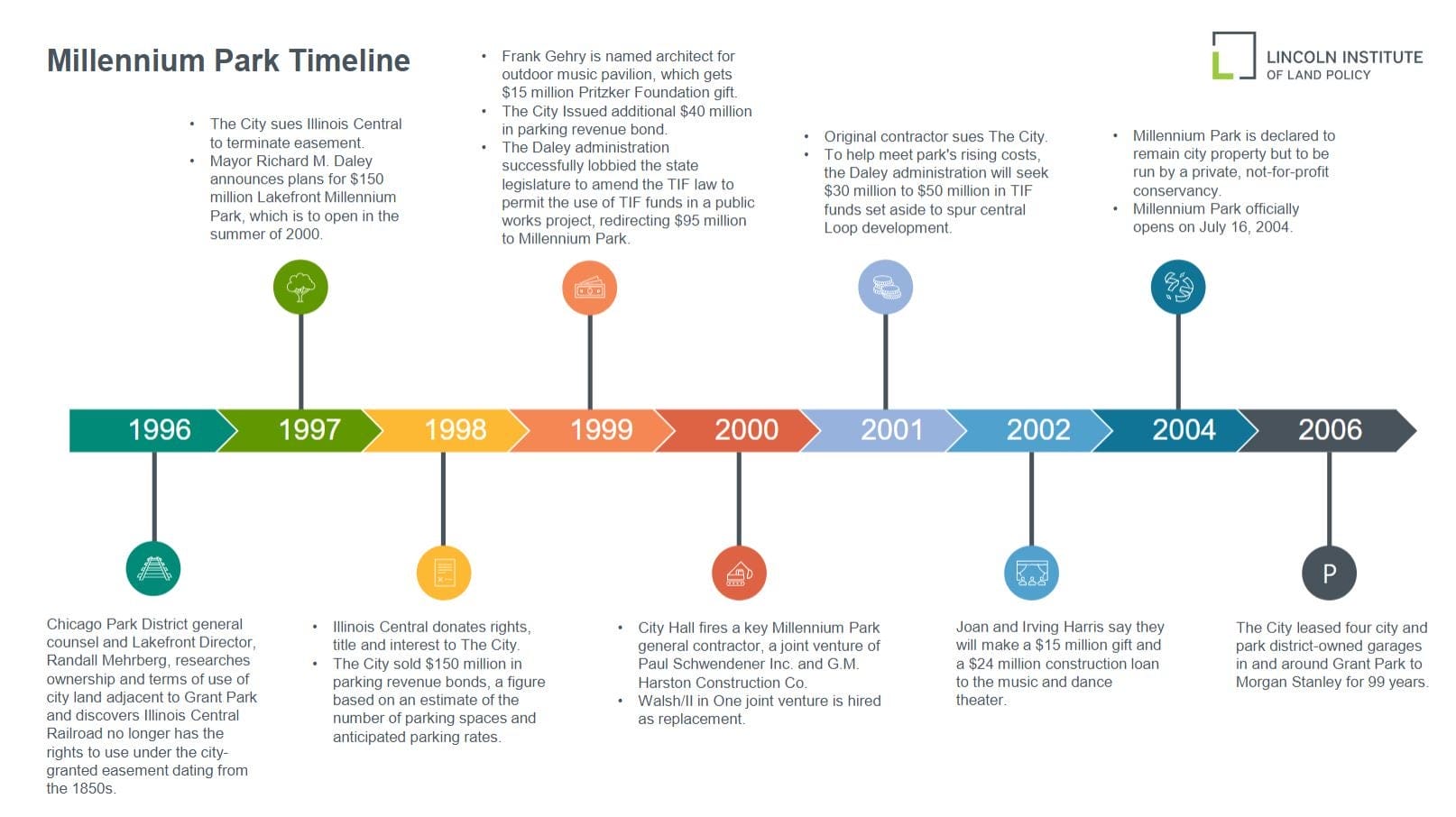
MP Timeline

Discussion Questions

  1. Imagine that you are a Chicago city council member representing the interest of your community, what are your questions and concerns when the plan to build Millennium Park and the strategy to fund it was proposed?
  2. What are some of the pros and cons of using revenue bonds in general?
  3. What are some of the pros and cons of using TIF?
  4. What are some of the pros and cons of using a P3 model?
  5. What other financing or funding options could the city have used to pay for the park?
  6. What are the pros and cons of Rachel Weber’s suggestion towards the end of the series – implementing a special assessment to pay for the park?
  7. Municipal finance is more than just numbers, it is also about how and why cities spend the revenue they collect from taxes and fees. Looking at a map of where Millennium Park is located (see here), do you think the city of Chicago made the right choice in building the park where they did? Compare the year 2000 demographics and existing parks in the Central Loop district (demographic data) to that of a place like Brighton Park (demographic data) or Calumet Heights (demographic data). What about the decision to build a park in the first place – could the city have made a different kind of investment in that area or another area of the city?
  8. What are your takeaways from this case and how might it be applied to similar projects in the future?

References

Dardick, Hal. 2014. “Millennium Park built ‘the Chicago Way’,” Chicago Tribune, July 13.

Fegelman, Andrew and Robert Becker. 1995.“Cook County Now Knows Rewards, Pain of Tax Caps,” Chicago Tribune, September 30.

Kamin, Blair. 2014. “Millennium Park: 10 years old and a boon for art, commerce and the cityscape,” Chicago Tribune, July 12.

Knorr, Walter. 2018. Interviewed by phone, October 29 and November 13.

Martin, Andrew and Laurie Cohen. 2002. “Millennium Park Fund Plan Fails,” Chicago Tribune, January 13.

Merriman, David. 2018. Improving Tax Increment Financing (TIF) for Economic Development. Cambridge, MA: Lincoln Institute of Land Policy.

Narefsky, David. 2018. Interviewed by phone, October 29 and December 10.

Spirou, Costas and Dennis R. Judd. 2016. Building the City of Spectacle: Mayor Richard M. Daley and the Remaking of Chicago. Ithaca and London: Cornell University Press. Kindle Edition.

Uhlir, Edward K. 2005. “The Millennium Park Effect,” Economic Development Journal 4, no. 2, (Spring).

Washburn, Gary and Andrew Martin. 1997. “Daley Springs to Defense of City’s TIFs,” Chicago Tribune, November 5.

Washburn, Gary. 2000. “City Fires Millennium Park General Contractor,” Chicago Tribune,  June 6. 

Washburn, Gary. 2003. “Millennium Park deal terminated,” Chicago Tribune, August 27.

Video Production Credits

Production Company: Skalawag Productions
Executive Producer: Mark Skala
Director/Producer: Monica Zinn Producer: Kyle Goldhoff
Associate Producer: Bailey Synclaire
Director of Photography: Aaron Dolan
Editor: Khalil Williams
Motion Graphics: Ryan Kelly
Archival Researcher: Juanita White
Drone Footage: Aaron Dolan
Project Supervisor: Dakin Henderson
Advisors: Ge Vue & Jenna DeAngelo Martin

Featuring:
David Merriman
Rachel Weber
Scott Stewart
Timothy Gilfoyle
Tom Morsch
Walter Knorr

Archival:
AP Images
Barry Brecheisen/WireImage via Getty Images
Chicago Tribune. All right reserved. Distributed by Tribune Content Agency, LLC
Getty Images
Library of Congress
Millennium Park Foundation
National Archives
Pond5
Ralf-Finn Hestoft/Corbis Historical via Getty Images
The Times of Northwest India

This multimedia case examines the impact of Burlington, VT’s affordable housing strategies on the Old North End (“the ONE”)—a historically low-income neighborhood which boasts a robust stock of affordable housing while facing rising costs of living and demand for housing. It traces the history of Burlington’s efforts back to the 1980s, when the city government under then-mayor Bernie Sanders established programs and policies to produce affordable housing and combat gentrification and displacement.

This case study video was named Gold Telly Winner in the 45th Annual Telly Awards in two categories: Documentary: Short Form and Education & Training.

The Case Study

The Backstory

Still the ONE: Lessons from a Small City’s Big Commitment to Affordability, by Julie Campoli appears in the October 2023 issue of Land Lines, the quarterly magazine of the Lincoln Institute of Land Policy.

Exhibits

Map: The Champlain Housing Trust’s 2,569 Rentals and 675 Shared-Equity Homes in Northwestern Vermont


Map: All Permanently Affordable Units in the Old North End 

Timeline

Burlington Case Study TImeline

References

Aurand, Andrew, et al. 2021. 2021 Picture of Preservation. National Low Income Housing Coalition and Public and Affordable Housing Research Corporation. https://preservationdatabase.org/wp-content/uploads/2021/10/NHPD_2021Report.pdf.
Aurand, Andrew, et al. 2022. “Out of Reach: The High Cost of Housing.” National Low Income Housing Coalition. https://nlihc.org/oor.

Cohen, Helen, and Lipman, Mark. 2016. Arc of Justice: The Rise, Fall and Rebirth of a Beloved Community (documentary film). https://www.arcofjusticefilm.com/.

Davis, John Emmeus. Ed. 2020. The Community Land Trust Reader. Lincoln Institute of Land Policy. https://www.lincolninst.edu/publications/books/community-land-trust-reader.

Davis, John Emmeus. 1990. Building the Progressive City: Third Sector Housing in Burlington. Philadelphia: Temple University Press. https://ecommons.cornell.edu/handle/1813/40513.

Ellen, Ingrid, et al. 2021. Through the Roof: What Communities Can Do About the High Cost of Rental Housing in America. Policy Focus Report. Cambridge, MA: Lincoln Institute of Land Policy. https://www.lincolninst.edu/publications/policy-focus-reports/through-roof-what-communities-can-do-high-cost-rental-housing.

Freddie Mac. 2018. Spotlight on Underserved Markets: Affordable Housing in High Opportunity Areas. Policy Brief, Washington, DC: Federal Home Loan Mortgage Corporation. https://mf.freddiemac.com/docs/Affordable_Housing_in_High_Opportunity_Areas.pdf.

Jickling, Katie. 2018. “Ready or Not: Is Gentrification Inevitable in Burlington’s Old North End?” Seven Days. January 17. https://www.sevendaysvt.com/vermont/ready-or-not-is-gentrification-inevitable-in-burlingtons-old-north-end.

Libby, James M. Jr. 2006. “The Policy Basis Behind Permanently Affordable Housing: A Cornerstone of Vermont’s Housing Policy Since 1987.” Montpelier, VT: Vermont Housing and Conservation Board. https://vhcb.org/sites/default/files/pdfs/articles/permanentaffordability06.pdf.

Opportunity Insights. “Neighborhoods Matter: Children’s Lives Are Shaped by the Neighborhoods They Grow Up In.” Online Research Collection. Cambridge, Massachusetts: Harvard University. https://opportunityinsights.org/neighborhoods.

Quigley, Aidan. 2019. “Who Owns Burlington? The Largest Holdings Are in the Hands of a Few.” VTDigger. November 3. https://vtdigger.org/2019/11/03/who-owns-burlington-the-largest-holdings-are-in-the-hands-of-a-few.

Torpy, Brenda. 2015. “Champlain Housing Trust.” Case Study. Center for Community Land Trust Innovation. https://cltweb.org/case-studies/champlain-housing-trust.

For Teachers

Topics

Affordable housing, community land trusts, gentrification and displacement

Timeframe

1980 – 2023

Prerequisite Knowledge

None

Learning Objectives

  • Evaluate the impact of permanently affordable housing in high-opportunity areas
  • Identify the policy approaches that helped Burlington develop and preserve affordable housing opportunities in gentrifying neighborhoods
  • Articulate how a community land trust works and why this model is effective in Burlington

Accelerating Community Investment

Accelerating Community Investment (ACI)

Contact

ACI Team
aci@lincolninst.edu

Accelerating Community Investment (ACI) improves public finance by creating opportunities for public development, housing, and infrastructure finance agencies to engage with philanthropies, mission-aligned investors, and the broader capital markets. These partnerships help create new, community-led investments in places that have experienced disinvestment or exclusion from mainstream capital systems.

ACI seeks to increase the availability of capital in the right places, at the right times, and for the right purposes. The initiative comprises field research, a national community of practice, and technical assistance and support for participants to develop and deploy impactful mission-aligned investment opportunities. These opportunities create a more fertile environment for investment in community and economic development, housing, and more, benefiting residents and communities. ACI also works with public finance agencies, community capital conduits, and impact-aligned investors to further develop the community investment ecosystem.

About ACI

Through research and a community of practice, ACI explores the intersection of public finance, capital providers, impact investors, and community—enabling those actors to more deeply  influence the profound multilevel systems change needed to achieve greater opportunity for people in place by:

  • Strengthening the connection of impact investors to public economic development, housing finance, and/or community development finance
  • Optimizing impact investing portfolios for various asset holder types
  • Boosting positive impact of capital on people in place across the national community investment ecosystem
Inviting Investors to Put Their Money Where Their Mission Is

An event that felt like an altruistic episode of Shark Tank played out in Boston at the Accelerating Community Investment initiative’s latest investor challenge. ACI now includes more than 100 member organizations in 18 states, as well as a network of more than 50 investors.

Read the article
Logo of Metro Blueprint pordcast, Brookings.
How local leaders and communities are leading the transition to clean energy

In this episode of Metro Blueprint, a podcast by the Brookings Institution, Robert “R.J.” McGrail, director of ACI, joins Xavier de Souza Briggs, senior fellow at Brookings Metro, and Melanie Allen, founding co-director of the Hive Fund, to discuss how federal policy affects our energy future and what it will take to bring affordable and resilient energy to everyone.

Listen to the podcast
An aerial view of a row of building roof tops with solar panels installed on them.

Policy Downloads

Building an American Energy Future for All 

Learn how community-scale clean energy projects can drive economic growth, create jobs, cut carbon emissions, and provide energy savings while empowering communities to build a cleaner, more reliable energy future.

View Publication

Watch this panel discussion on the origins and goals of ACI featuring Lincoln Institute CEO and President George W. “Mac” McCarthy, Lincoln Institute Senior Fellow and ACI Director Robert J. “R.J.” McGrail, and former FB Heron Foundation President Dana Bezerra.

Our Work

National Community of Practice

We connect participants in local community investment ecosystems to each other and to their peers elsewhere through a community of practice that includes 100 agencies and institutions from 18 states. The group meets both virtually and in person to build partnerships, identify new investment opportunities, and share experiences and advice. Learn about the latest convening.

Training, Coaching, and Technical Assistance

ACI has provided significant virtual and in-person coaching, education, and learning beyond the community of practice, exposing participants to new knowledge and tools that increase their effectiveness and impact.

Local Investor Challenges

ACI hosts local investor challenges to spotlight community investment opportunities and enable participants to develop and share new, community-driven opportunities to impact investors and catalytic capital holders. Four initial sessions—held in Atlanta, Cincinnati, New Orleans, and Austin—have allowed participants to pitch investment-ready projects to local investors and receive direct feedback from potential investors.

Community of Practice

At the heart of this is a national community of practice of community and institutional leaders, who will build partnerships, receive training and technical assistance, and identify new investment opportunities. Current participants are listed below.

A map of the US that depicts the states where the ACI Community of Practice is active. Specific states are shaded in shades of green, yellow, and orange to show which community of practice is active there. States with no activity are shaded in gray.


Introduction

Topics

Land value capture, social housing, infrastructure

Timeframe

1970–2018

Learning Goals

  • Identify the economic and social forces that led to the establishment of the Água Espraiada Urban Operation in São Paulo.
  • Examine the national and local policy reforms that created the framework for the design and implementation of solutions.
  • Explore the tensions resulting from conflicting interests and motivations of residents, real estate developers, and city officials involved in redeveloping informal settlements.
  • Compare and contrast the benefits and limitations of traditional strategies (i.e., local taxes and fees) versus land value capture strategies (i.e., sale of development rights) for raising revenue to fund large-scale infrastructure projects.
  • Evaluate the outcomes of the Água Espraiada Urban Operation and identify ways the program realized or did not realize its original vision.

Primary Audience

  • Municipal officials and administrators from cities confronting challenges and opportunities for large-scale infrastructure projects involving real estate development pressure and informal settlements.
  • Staff of NGOs and community organizations involved in providing social housing and upgrading informal settlements.
  • Policy makers and advocates interested in using land value capture to help finance public infrastructure and social housing.

Prerequisite Knowledge

None.

Summary

Financing A City’s Vision: The Social Mobilization of Land Values in São Paulo is a four-part documentary series created by the Lincoln Institute of Land Policy that explores a large-scale infrastructure project called the Água Espraiada Urban Operation in São Paulo, Brazil. Urban operations allow Brazilian cities to recapture the land value generated by land use changes and public investment. São Paulo employed a unique financing tool, certificates of additional construction potential (CePACs), which are tradable development rights sold at public auctions. Featuring the voices of favela residents, city officials, real estate professionals, and a range of academics, the series examines the Água Espraiada Urban Operation from multiple perspectives.

These videos contain dialogue in both English and Portuguese. Subtitles are available in English, Portuguese, and Spanish. Click the “CC” button in the video player to enable subtitles.

Chapter 1: Development and Displacement

The first chapter of this four-part series covers the decades leading up to the creation of the Água Espraiada Urban Operation—a large-scale infrastructure and densification project in São Paulo, Brazil. The video highlights three forces shaping the city during the 1970s, 1980s, and 1990s: the growth of informal “favela” communities, traffic congestion, and growing interest in the area’s real estate. When Mayor Paulo Maluf initiated a project to build a road along the Água Espraiada stream in 1991, a decade before the urban operation was established, thousands of favela residents were evicted and the city was plunged into debt. From this context, the idea for the Água Espraiada Urban Operation emerged. How might a city accomplish large-scale urban interventions without displacing residents or taking on debt?

Chapter 2: An Innovative Solution

The second chapter of the series explains what an “urban operation” is, how CePACs work, and the inspiration behind these unique tools for major urban development projects. Community activism and a receptive administration in City Hall allowed a provision for social housing and services to be included in the list of interventions. A legal tool called special zones of social interest, or ZEIS, gave favela residents the right to housing on specific pieces of land.

Chapter 3: The Fight to Stay

In the third chapter of this four-part series, residents of the Jardim Edite favela community fight for their right to stay as powerful economic forces threaten to displace them. The first auctions of CePACs are held, raising money for the famous cable-stayed Estaiada Bridge, but it’s unclear whether money will be spent on the community’s promised social housing units.

Chapter 4: Reflection and Renewal

The final chapter of the series brings us to the present. The video reflects on the dramatic transformation that has taken place since the urban operation was established in 2001, much of it funded through CePACs. The urban operation still has much to do to achieve its ambitious goals: the road needs to be extended and social housing for thousands of families needs to be built. As the city contemplates holding more CePAC auctions, social housing advocates work to ensure that funding is available.

Exhibits

References

Barbosa, Eliana Rosa De Queiroz, et al. 2019. “Expectant Territories and Urban Instruments: The Case of Urban Operation Água Branca.” Rev. Bras. Estud. Urbanos Reg. 21(2) (Maio-Ago): 451–71. https://www.scielo.br/j/rbeur/a/ffchSrgY6CPMTdnjfQhXw4c/?lang=en

Biderman, Ciro, et al. 2006. “Large-Scale Urban Interventions: The Case of Faria Lima in São Paulo.” Land Lines (April), Lincoln Institute of Land Policy: 8–13. https://www.lincolninst.edu/publications/articles/large-scale-urban-inte…

Caldeira, Teresa, and James Holston. 2005. “State and Urban Space in Brazil: From Modernist Planning to Democratic Interventions.” Global Anthropology: Technology, Governmentality, Ethics. London: Blackwell: 393–416.

Fernandes, Edésio. 2011. Regularization of Informal Settlements in Latin America. Policy Focus Report. Cambridge, MA: Lincoln Institute of Land Policy. https://www.lincolninst.edu/publications/policy-focus-reports/regulariza…

Kim, Julie. “CePACs and Their Value Capture Viability in the U.S. for Infrastructure Funding.” 2018. Working Paper No. WP18JK1. Cambridge, MA: Lincoln Institute of Land Policy., https://www.lincolninst.edu/publications/working-papers/cepacs-their-val…

Mahendra, Anjali, et al. 2020. “Urban Land Value Capture in São Paulo, Addis Ababa, and Hyderabad: Differing Interpretations, Equity Impacts, and Enabling Conditions.” Working Paper No. WP20MA1. Cambridge, MA: Lincoln Institute of Land Policy (January) https://www.lincolninst.edu/publications/working-papers/urban-land-value…

Marcio, Fortes, and Billy Cobbett. 2010. The City Statute of Brazil: A Commentary. Cities Alliance and Ministry of Cities. Brazil., https://www.citiesalliance.org/sites/default/files/CA_Images/CityStatute…

Ribeiro, Silvio Cesar Lima, et al. 2016. “ZEIS Maps: Comparing Areas to Be Earmarked Exclusively for Social Housing in São Paulo City.” Land Use Policy 58(44667): 445–55. Amsterdam, Netherlands: Elsevier. (December 15) doi:10.1016/j.landusepol.2016.08.010

Sandroni, Paulo. 2011. “Urban Value Capture in São Paulo Using a Two-Part Approach.” Working Paper No. WP11PS1. Cambridge, MA: Lincoln Institute of Land Policy., https://www.lincolninst.edu/publications/working-papers/urban-value-capt…

Sandroni, Paulo Henrique. 2011. “Recent Experience with Land Value Capture in São Paulo, Brazil.” Land Lines (July): 14–19., https://www.lincolninst.edu/publications/articles/recent-experience-land…

Siqueira, Marina Toneli. 2019. “New Urban Policies, New Forms of Social Participation? The Challenges of the Água Espraiada Urban Consortium Operation in São Paulo, Brazil.” Cadernos Metrópole 21(45) (May/August): 417–38.

Smolka, Martim O. 2013. Implementing Value Capture in Latin America: Policies and Tools for Urban Development. Policy Focus Report. Cambridge, MA: Lincoln Institute of Land Policyhttps://www.lincolninst.edu/publications/policy-focus-reports/implementi…

Somekh, Nadia, and Cintia Marino. 2012.“São Paulo Planning History: From Sanitarism to Strategic Project.” Paper presented at the 15th International Planning History Society Conference, São Paulo, Brazil. http://www.usp.br/fau/iphs/abstractsAndPapersFiles/Sessions/31/SOMEKH_MA…

SP Urbanismo and Cidade de São Paulo. 2020. Operação Urbana Consorciada Água Espraiada Sumário. https://gestaourbana.prefeitura.sp.gov.br/wp-content/uploads/cadernos_ou…

Yu-Hung, Hong, and Gregory K. Ingram. Municipal Revenues and Land Policies (proceedings of the 2009 Land Policy Conference). Cambridge, MA: Lincoln Institute of Land Policy. https://www.lincolninst.edu/publications/books/municipal-revenues-land-p…

Curso

Financiación Urbana y Políticas de Suelo

Abril 10, 2024 - Abril 13, 2024

Ofrecido en español


El curso de Financiación Urbana y Políticas de Suelo examina las alternativas que ofrecen la gestión del suelo y la movilización de plusvalías para atender algunos de los principales desafíos que enfrentan los gobiernos subnacionales, como son la financiación de infraestructuras de movilidad y la provisión de vivienda asequible. Se centra en la experiencia colombiana analizada en el contexto de América Latina, y combina la discusión de aspectos conceptuales interdisciplinarios con la revisión de experiencias y casos de estudio.

El curso, además, promueve espacios de debate, análisis comparativos, aproximaciones al enfoque de desarrollo urbano orientado al transporte sostenible (DOT), y ejercicios de medición de las plusvalías y sus posibilidades de movilización, al tiempo que analiza los principales instrumentos de planificación y gestión en el marco de la financiación basada en el valor del suelo que han sido aplicados en Colombia. En el último día del curso se realizará una visita técnica para observar proyectos de movilidad, gestión del suelo, y vivienda de interés social en la ciudad de Bogotá.

Relevancia 

Las ciudades de América Latina y el Caribe enfrentan grandes desafíos para orientar y financiar sus procesos de desarrollo urbano, ante los cuales la planeación territorial y el fortalecimiento de fuentes de financiación basada en el valor del suelo ameritan especial atención y consideración.

Colombia es uno de los países en la región que cuenta con marcos legales que proporcionan una base para la implementación de instrumentos de gestión y financiación base suelo. La experiencia colombiana permite identificar y evaluar avances, aprendizajes y alternativas para aportar a la discusión sobre el uso de estos instrumentos en América Latina. El curso aborda el potencial de los instrumentos en relación con dos aspectos específicos: la movilidad y el acceso a vivienda asequible, en el marco de la planeación territorial en Colombia.

Detalles de la convocatoria


Detalles

Fecha(s)
Abril 10, 2024 - Abril 13, 2024
Período de postulación
Enero 9, 2024 - Febrero 11, 2024
Fecha de notificación de seleccionados
Febrero 21, 2024 at 11:59 PM
Idioma
español
Tipo de certificado o crédito
Lincoln Institute certificate

Palabras clave

mitigación climática, medio ambiente, vivienda, regulación del mercado de suelo, uso de suelo, planificación de uso de suelo, valor del suelo, tributación del valor del suelo, temas legales, gobierno local, salud fiscal municipal, planificación, finanzas públicas, políticas públicas, desarrollo orientado a transporte, transporte, urbano, desarrollo urbano

Oportunidades de becas

2024 Lincoln Institute Scholars Program

Fecha límite para la inscripción: March 8, 2024 at 11:59 PM

This program provides an opportunity for recent PhDs (one to two years post-graduate) specializing in public finance or urban economics to work with senior academics.

Lincoln Institute Scholars will be invited to the institute for a program on April 18–20, 2024, that will include:

• presentations by a panel of journal editors on the academic publication process;

• a workshop in which senior scholars comment on draft papers written by the Lincoln Institute Scholars;

• an opportunity for the Lincoln Institute Scholars to present their research; and

• a seminar in which leading scholars in public finance and urban economics present their latest research.

For information on previous Lincoln Scholars, please visit Lincoln Scholars Program Alumni.


Detalles

Fecha límite para la inscripción
March 8, 2024 at 11:59 PM

Descargas


Palabras clave

economía, tributación inmobilaria, finanzas públicas

Anuncio

Accelerating Community Investment Launches Second Community of Practice

By Kristina McGeehan, Noviembre 28, 2023


The Lincoln Institute of Land Policy launched the second round of the Accelerating Community Investment initiative’s Community of Practice (ACI CoP) in November, kicking off with a convening in Sante Fe, New Mexico. ACI improves the practice of public finance by creating opportunities for public development, housing, and infrastructure finance agencies to engage in skill building and peer learning with philanthropies, mission-aligned investors, and the broader capital markets, with the goal of increasing investment and its impact on communities across the nation. 

Through this initiative, the Lincoln Institute connects participants in local community investment ecosystems to each other and their peers elsewhere—helping to form partnerships that create new, community-led investments in underserved places and people. The ACI CoP, first launched in 2021 with approximately 40 agencies and institutions from 14 states, has expanded to 100 participants now representing 18 states across the country. 

“My team’s participation in the Lincoln Institute’s ACI CoP over the past three years has been transformational,” said Laura N. Brunner, president and CEO of the Port of Greater Cincinnati Development Authority. “It is difficult to say whether the education or the relationship building has been more impactful, because both far exceeded our expectations. The technical content contributes to our ability to move from ‘good to great,’ and the friendships and perspectives of fellow members allow us to benchmark ourselves against others and enjoy the comfort of safe spaces to learn.” 

ACI seeks to increase the availability of capital in the right places, at the right times, and for the right purposes. The initiative includes field research, a national CoP focused on peer learning and skill development, and technical assistance and support for participants to develop and deploy impactful mission-aligned investment opportunities. These opportunities create a more fertile environment for investment in community and economic development, housing, and more, for the benefit of residents and communities.  

“Our work in ACI, focusing on deepening the skills of public finance practitioners and creating connections with values-aligned impact capital holders, is helping to drive new investments that improve the quality of life in underserved communities across the country,” said Robert J. “R.J.” McGrail, senior fellow at the Lincoln Institute and initiative director for ACI. “These public finance leaders not only have the capacity to tap large pools of capital and leverage public funding, but they can also help impact-minded and values-aligned investors channel new capital to communities where it will create deeper impact.” 

“Over the last few years in the Accelerating Community Investment initiative, we’ve seen the benefits of bringing together new civic coalitions to tackle local problems,” said George W. McCarthy, president and CEO of the Lincoln Institute. “Whether we’re trying to meet the challenge of supplying adequate affordable shelter to residents, preparing to support a low- or no-carbon fleet, or adapting our cities to endure the climate crisis, we need unprecedented multisectoral cooperation to deploy unprecedented volumes of financial and human resources. When the public, private, and civic sectors bring their respective knowledge, discipline, and creativity together, the results can be magical.”   

More information about ACI and a complete list of CoP participants can be found on the Lincoln Institute’s website. 


Kristina McGeehan is director of communications at the Lincoln Institute of Land Policy.